Win League Slots at Permit Based Scheduling Parks (U.S. Playbook)
Win League Slots at Permit Based Scheduling Parks (U.S. Playbook)

You can run a paid pickleball league at most permit-based scheduling parks, but you need an organized-use permit rather than a simple court reservation, and you must meet the municipal timeline, insurance, and documentation requirements before scheduling any matches. Start today by checking your city’s organized-use permit page, confirming the season submittal window, and gathering your Certificate of Insurance (COI) and Additional Insured Endorsement (AIE). Cities such as Seattle, Portland, and Norwalk all run some version of this process, and software like Flex League Plus can help you produce the paperwork fast.
TL;DR:
- Organizers must submit permit applications at least three months in advance and ensure all insurance and documentation are complete to avoid rejection or late fees.
- Schools and city programs have priority over adult or commercial leagues, and repeating your schedule annually can improve your chances of retaining permits.
- A complete permit packet typically includes a roster, schedule, insurance, and proof of nonprofit status, with the Additional Insured Endorsement being critical for approval.
- Using league management software can streamline permit preparation by exporting rosters, schedules, and payment proofs in formats accepted by parks departments.
- Failure to follow administrative rules, such as timely renewals and proper notification of non-use, is the main reason leagues lose permits, not the league concept itself.
Table of Contents
- What counts as an organized-use permit versus a simple reservation
- How lead times, priority groups, and allocation windows work
- Checklist of paperwork cities require: rosters, insurance, and tax status
- How to apply for a permit, pay fees, and avoid rejection
- Running your season without losing your permit
- How league software can produce your permit packet
- What most permit advice gets backward
- Run your permit-compliant league without the spreadsheet chaos
- FAQ
- Sources
What counts as an organized-use permit versus a simple reservation
A simple reservation covers short, drop-in blocks of time, the kind of booking you’d make for a casual match with friends. An organized-use permit is a different category entirely: it applies when you’re running a season, a tournament, or any activity with registered participants paying to play. Portland Parks & Recreation draws this line explicitly, defining “Simple Permits” for short, limited-duration bookings and separating them from league and tournament applications that require processing fees and supporting documentation.
Cities require this distinction for practical reasons. A paid league creates recurring conflicts with other user groups, generates wear on courts and turf that affects maintenance schedules, and raises liability questions that a casual drop-in game never does. Once money changes hands and a roster exists, the park department needs a paper trail.
You’ll typically encounter three permit types:
- Single-use permits for one-time events like a charity tournament or exhibition match.
- Multiple-use or seasonal permits for leagues that run weekly across a defined season.
- Special event or tournament permits for larger gatherings with vendors, spectators, or multi-day formats.
Knowing which category your league falls into determines which application you file and how far ahead you need to submit it.
How lead times, priority groups, and allocation windows work
Timing is where most new league organizers lose their preferred slot before they even know it’s gone. Norwalk Parks & Recreation requires new organizations to submit requests roughly three months ahead of the use date, and seasonal windows often open on fixed calendar dates, such as January 1 for spring requests, April 1 for summer, and June 1 for fall. Applications filed within 14 days of the intended use date risk rejection or late fees.
Municipal departments also rank requests by priority classification. A typical order looks like this:
- City-run recreation programs get first access to courts and fields.
- School district activities often rank next.
- Historical users, meaning groups that held the same slot in prior seasons, usually retain strong priority.
- Youth programs frequently outrank adult leagues.
- Commercial or for-profit leagues often sit at the bottom of the priority list and may pay higher rates.
Where demand exceeds supply, cities use lotteries for new applicants and first-come, first-served rules for leftover capacity. Permits can also carry revocation clauses, so a confirmed slot is not a guaranteed one if you violate the terms.
Pro Tip: File for the same day and time every season. Building a history as a “historical user” is one of the simplest ways to improve your allocation odds year over year.
Checklist of paperwork cities require: rosters, insurance, and tax status
Municipal permit packets follow a fairly consistent pattern across jurisdictions, and Santa Clarita’s reservation procedures lay out a packet that mirrors what Portland asks for as well. Expect to assemble:
- A completed and signed application form.
- A full player roster with names and addresses.
- Your complete season schedule, including match days, times, and courts.
- A Certificate of Insurance (COI) naming the city as an interested party.
- An Additional Insured Endorsement (AIE), commonly requested as an ISO form such as CG 20 12 or CG 20 26, per Snohomish County’s sample insurance guidance.
- Proof of nonprofit status, such as 501©(3) or 501©(7) documentation, if you want to avoid commercial surcharges.
A COI alone often isn’t enough. Many departments specifically require the AIE language because it extends coverage to the municipality itself, and Snohomish County’s sample documentation notes minimum liability limits of $1 million per occurrence and $2 million aggregate as a common benchmark. Missing the endorsement is one of the most frequent reasons packets bounce back for revision. Keep the physical permit onsite during every session: departments retain the right to request it on demand.
How to apply for a permit, pay fees, and avoid rejection
Submission methods vary by city but generally fall into three channels: online application portals, email submission to the parks department, and in-person filing at a recreation office. Seattle Parks & Recreation’s scheduling brochure requires a signed application and notes that your organization’s account needs to be in good standing before any new permit gets processed.
Fee structures follow a predictable rhythm:
- An application processing fee is due at submission, separate from the usage fee.
- Deposits are common, often around 10% of the total fee due within 10 days of approval, with the balance due roughly 30 days before the season starts.
- Commercial and non-resident organizers frequently pay premium rates compared to resident nonprofits.
- Late applications, meaning those filed within 30 or 14 days of the first use date, often trigger higher per-field fees and stricter review.
For tournaments specifically, expect additional steps. James City County’s tournament application allows requests up to 12 months in advance and typically requires a planning meeting or site walk-through, plus deposits tied to vendor and logistics coordination. Bring site maps and an emergency plan to that meeting, and plan to schedule it roughly 30 days ahead of your event.
Running your season without losing your permit
Securing the permit is only half the job. Keeping it valid through an entire season means following the operational rules your city attaches to the paperwork.
- Keep a physical or digital copy of the permit onsite at every scheduled session.
- Designate two authorized representatives who can speak for your league during inspections or scheduling questions.
- Enforce your roster exactly as filed. Subleasing time to another group or swapping in unregistered players violates most permit terms.
- Notify the parks department promptly if you won’t use a scheduled slot. Santa Clarita’s procedures state that repeated non-use without notice can lead to forfeiture or revocation of your allocation.
- Plan logistics ahead of game day: portable restrooms for larger events, staffing for check-in, parking guidance for players and spectators, and a contingency plan for weather cancellations or venue changes.
Waitlist and late-registration handling also matter here, since a roster that doesn’t match your filed schedule can create compliance headaches mid-season. A 12 to 24-hour offer window for waitlisted players keeps your roster current without leaving spots empty, and clear cutoffs for late registration help you avoid submitting roster updates the city never approved.
Pro Tip: Build calendar reminders for your permit’s submittal window, deposit deadline, and balance due date. Missing any one of these can bump you out of a season entirely.
How league software can produce your permit packet
Automated scheduling tools can cut the time it takes to assemble a permit packet, since most of what a city asks for, roster, schedule, and payment history, already lives inside a league management platform once registration opens. League management software automates registration, generates schedules, exports rosters, and tracks payment receipts, and some offer DUPR integration to support the kind of verified competitive structure that commercial permit reviewers often want to see documented.
Whatever platform you use, validate it against these requirements before permit season:
- Roster export that includes player names and addresses, not just usernames.
- Printable, dated schedules formatted for direct submission to a parks department.
- Payment receipts grouped by event or season, useful for proving fee collection matches your roster.
- Report generation that can be handed to permit reviewers without manual reformatting.
A tool that handles these four items removes most of the manual assembly work from your application, as outlined in the Youth & Local Sports Playbook for local sports organizers.
What most permit advice gets backward
Most guidance on this topic treats the permit application as the hard part. It isn’t. The application itself is a form. The part that actually determines whether you get a usable slot is the unglamorous administrative discipline that happens months before you file: tracking submittal windows, keeping insurance documentation current, and protecting your historical-user status season after season.

Organizers who lose slots rarely lose them because a city rejected their league concept. They lose them because they filed 10 days late, let their COI lapse, or failed to notify the department about a bye week and got flagged for non-use. The conventional advice to “apply early” is true but incomplete. Applying early only helps if your documentation packet is already complete, because an incomplete submission often gets treated the same as a late one.
If you organize paid leagues at permit-based parks, prioritize building a repeatable documentation workflow over chasing the perfect pitch for a new permit. The slot follows the paperwork.
— Robert
Run your permit-compliant league without the spreadsheet chaos
Assembling rosters, schedules, and payment records by hand is where most organizers lose hours they don’t have during permit season. We built our pickleball league software to generate exactly the materials parks departments ask for: exportable rosters with player details, printable schedules, and Stripe payment receipts grouped by season.
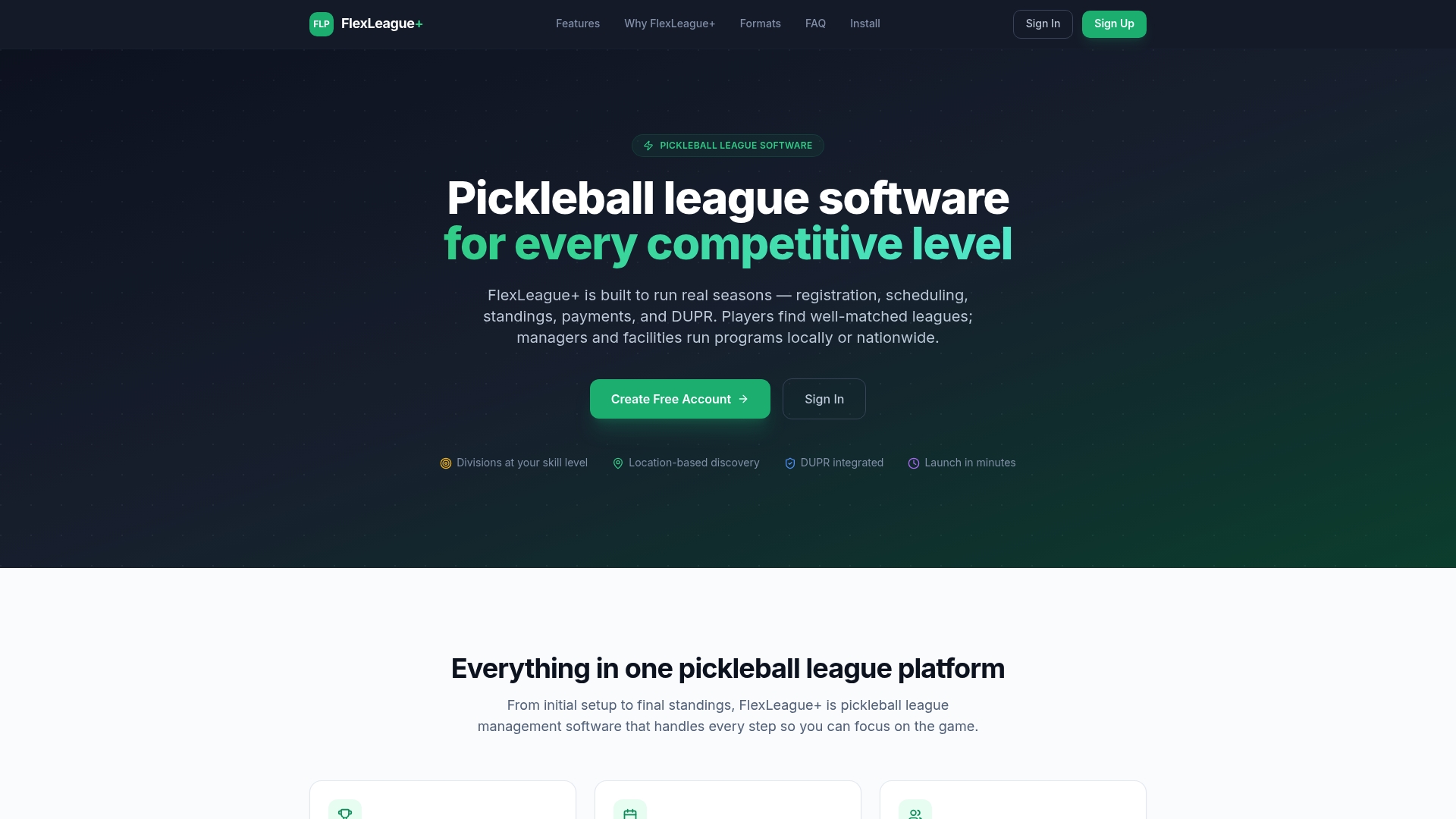
When you look at a demo of any league platform, including ours, check for three things: whether rosters export with full player information, whether schedules print in a format a permit reviewer can read, and whether it supports the documentation your city’s insurance process requires. Integration with DUPR also helps when a park department wants proof of verified competitive play rather than casual open sessions.
Our League platform fee is a flat $25 one-off charge per division, with no monthly subscription. See our full feature set and start building your next season’s permit packet today.
FAQ
How far in advance do I need to apply for a league permit?
Lead times vary by city, but Norwalk requires roughly three months’ notice for new leagues, while tournament permits in places like James City County can be filed up to 12 months ahead. Applications submitted within 14 days of your use date risk rejection or late fees in many jurisdictions.
What insurance documents do parks departments actually require?
Most departments ask for a Certificate of Insurance along with an Additional Insured Endorsement, often using ISO forms like CG 20 12 or CG 20 26, as outlined in Snohomish County’s sample documentation. A COI alone frequently isn’t sufficient because it doesn’t extend coverage to the municipality the way the endorsement does.
Do nonprofit leagues pay lower permit fees?
Many cities charge lower rates to groups that can show 501©(3) or 501©(7) documentation before the payment window closes, based on requirements described in Santa Clarita’s reservation procedures. If that paperwork isn’t ready in time, the municipality typically applies standard commercial fees instead.
What happens if I don’t use my scheduled permit time?
Departments generally expect you to notify them if you won’t use an allocated slot, and Santa Clarita’s policy warns that repeated non-use without notice can lead to forfeiture of your permit. Keeping the department informed protects your standing for future seasons.
What does Flex League Plus cost for running a permitted league?
Our League platform fee is a flat $25 one-off charge per division, with no recurring subscription required. Players pay their registration fees directly through Stripe when they sign up for your league.
Sources
- Norwalk Parks & Recreation — Athletic Fields
- Portland Parks & Recreation — Athletic field rental
- Santa Clarita Field and Court Reservation Procedures (2026)
- Seattle Parks & Recreation — Athletic scheduling brochure & application (2026)