Automated League Scheduling in Minutes for Pickleball Organizers
Automated League Scheduling in Minutes for Pickleball Organizers

Automated league scheduling uses software algorithms to build round-robin, divisional, or playoff calendars in minutes instead of the hours or days manual spreadsheets take, while automatically checking for conflicts like venue overlaps and unavailable teams. The main payoff for organizers is a balanced calendar that respects every constraint you feed it, produced in a fraction of the time. Your first move: collect team availability, venue hours, and blackout dates, then choose a scheduler built to handle the constraints your league actually has.
TL;DR:
- Most scheduling tools handle core constraints like venue conflicts and blackout dates, but they vary in depth and flexibility.
- Combining constraint programming with metaheuristics like simulated annealing often yields the most reliable results for complex league rules.
- Accurate, consistent input data and locking non-negotiable dates before running the algorithm significantly reduce manual rework.
- Automated schedules improve fairness by applying uniform rules across all teams, but weighting soft constraints requires careful review to prevent bias.
- Integration with communication, standings, and registration systems streamlines league management and reduces errors caused by manual data handling.
Table of Contents
- How Automated Schedulers Handle League Constraints
- What Algorithms Actually Power a League Scheduling Algorithm?
- What Inputs Does a Scheduler Need From You?
- Which League Formats Create the Toughest Scheduling Problems?
- Best Practices for Running Automated Scheduling Without the Rework
- What to Look For When Choosing Scheduling Software
- Does Automation Make Leagues More Fair?
- Connecting Scheduling to Your Broader League Tech Stack
- Where Automated Scheduling Still Falls Short
- How Do Organizers Handle Playoffs and Mid-Season Curveballs?
- How FlexLeague+ Applies These Principles in Real Leagues
- Get Your League Running on FlexLeague+
- Sources
How Automated Schedulers Handle League Constraints
A scheduler is only as good as the constraints it can enforce. Every credible tool on the market handles a similar core feature set, though depth varies widely between free spreadsheet macros and purpose-built platforms.
- Round-robin generators that assign every team a matchup against every other team, once or twice per season
- Blackout date handling so games never land on facility closures, holidays, or team-requested off weeks
- Venue and time-slot assignment across multiple courts or fields running in parallel
- Min/max games per day or week caps, so no team plays three matches in 48 hours while another sits idle
The distinction that trips up most first-time users is hard versus soft constraints. A hard constraint can’t be broken. Two teams can’t play in the same slot on the same court. A soft constraint is a preference the algorithm tries to satisfy but can override if satisfying it makes the whole schedule infeasible, like a team’s request to avoid Monday nights. Good tools let you weight soft constraints so the solver knows which preferences matter most when trade-offs are unavoidable.
Output typically comes as a full team calendar, a location-by-location view for facility managers, a list of any unresolved or unplaced games, and a CSV or Excel export you can hand to referees or post publicly.
What Algorithms Actually Power a League Scheduling Algorithm?
Vendors throw around terms like constraint programming and genetic algorithms, but what they mean for your league boils down to speed versus guarantees.
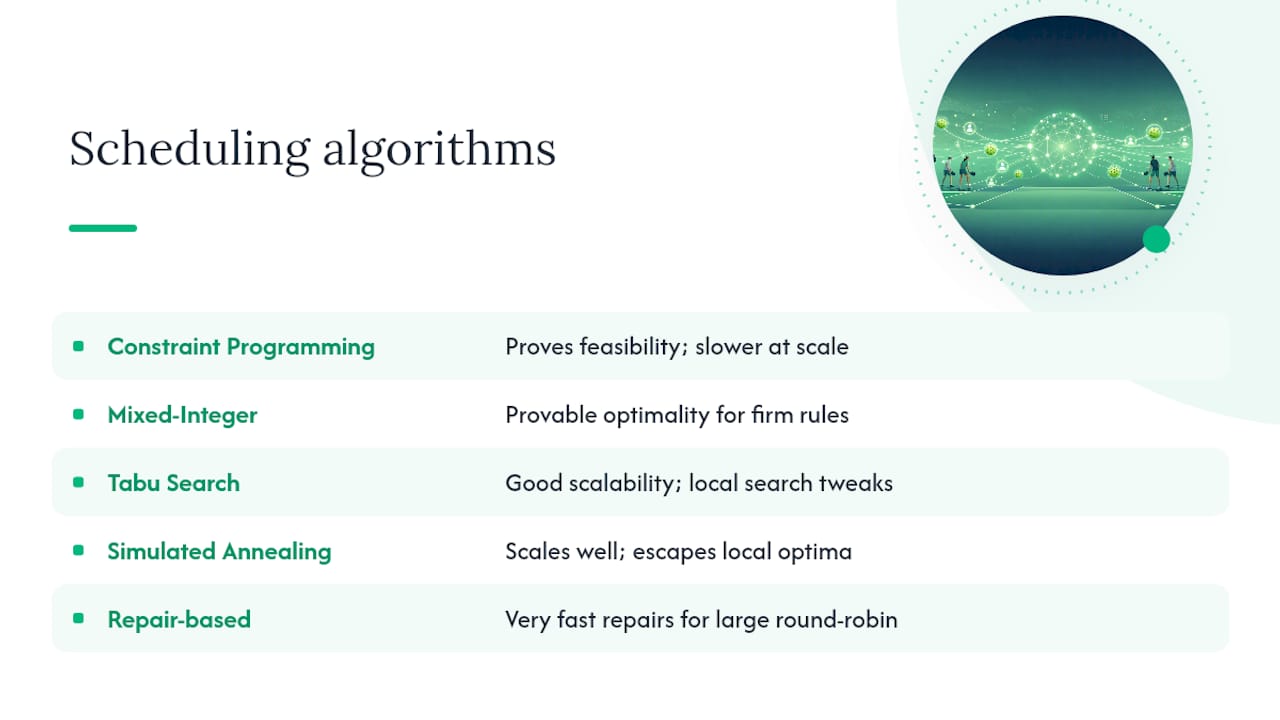
Constraint programming (CP) models your league as a set of rules, no team plays twice in one day, home and away games must alternate, and searches for any arrangement that satisfies every rule. CP is strong at proving a feasible schedule exists, but it can slow down as constraints multiply.
Mixed-integer programming (MIP/IP), the approach behind IBM’s DOcplex sports scheduling tutorial, turns your rules into a mathematical model and hands it to a solver like CPLEX. This shines when you have firm business rules, television windows, rivalry games, division travel limits, and need a provably optimal answer rather than just a workable one.
Tabu search and simulated annealing are metaheuristics. Instead of proving optimality, they start with a decent schedule and keep tweaking it, accepting occasional worse moves to escape dead ends, until quality plateaus. They scale better than pure CP on large, messy instances.
Repair-based linear-time algorithms (sometimes called L3S/E3S) fix a near-complete schedule fast, and they’re relevant mainly for very large round-robin leagues with specific team-count conditions, covered below.
In practice, hybrid pipelines that pair CP for feasibility with simulated annealing for refinement tend to produce the most reliable results for real-world leagues with mixed hard and soft rules.
What Inputs Does a Scheduler Need From You?
Garbage in, garbage out applies harder to scheduling than almost any other software category. Missing or inconsistent data is the single biggest cause of a schedule that needs manual rework.
- Team roster with unique IDs so the system never confuses two teams with similar names
- Home venues for each team, including which courts or fields they’re tied to
- Available time slots for every venue across the season, not just opening day
- Reserved or blackout dates where a venue is closed, a holiday falls or a tournament preempts league play
- Team-specific unavailabilities, since players often can’t make certain weeks even when the venue is open
- Season length and games-per-team target, which determines whether you’re running a single or double round-robin
Beyond the essentials, feeding the system preferred time windows, travel or rest buffers between matches, referee availability, and any required pairing rules (rivalry matchups, skill-tier separation) produces a noticeably cleaner first draft.
Formatting matters more than people expect. Use a consistent Excel or CSV template with uniform date and time formats and unique IDs for every team and venue. The leaguescheduler input template is a useful reference for how reserved-date columns should be structured before you run anything through a solver.
Which League Formats Create the Toughest Scheduling Problems?
Format choice drives complexity more than most organizers realize before they hit a wall.
A standard round-robin format pits every team against every other team once. A double round-robin (2RR) doubles that, with each pair meeting twice, once at each team’s home venue. The tricky part isn’t the matchup list, it’s the home-away pattern: balancing which teams get consecutive home games versus consecutive road games, sometimes called separating the timetable from the home-away assignment.
Divisional and pool play add another layer. Teams in different divisions often play unequal numbers of cross-division games, and travel minimization becomes a real constraint once venues span multiple towns or facilities.
There’s also a mathematical quirk worth knowing: certain team counts create harder-to-solve instances for the fast repair-based algorithms, specifically when (T minus 1) mod 3 equals zero. If your league hits one of those team counts, expect either a slightly longer solve time or a need to fall back on constraint programming instead of a linear-time shortcut.
Best Practices for Running Automated Scheduling Without the Rework
The organizers who get clean results on the first pass follow a consistent workflow rather than hoping the algorithm reads their mind.
Lock your non-negotiable dates first, opening night, championship weekend, any holiday blackout, before you run the generator. Locking these anchors first means the solver builds around them instead of you manually shuffling games later to make room.

Once you have a draft, run a validation pass looking specifically at unresolved conflicts and how evenly rest days are distributed across teams. If one team keeps drawing brutal back-to-back stretches, that’s usually a soft-constraint weighting issue, not a bug.
Use manual overrides sparingly. Every manual edit you make outside the solver is a change the algorithm doesn’t know about, which can quietly break a constraint elsewhere in the schedule. Document every override and keep a reproducible input file so you (or next season’s organizer) can regenerate the same baseline and adjust from there instead of starting over.
Pro Tip: Lock your essential fixtures, openers, finals, and any facility-mandated holidays, before you hit generate. Letting the algorithm fill everything else around those fixed points consistently produces schedules that need far fewer manual fixes afterward.
What to Look For When Choosing Scheduling Software
Skip the feature-list beauty contest and evaluate against your actual operational needs.
- Constraint expressiveness: can it encode your specific home/away balance rules and minimum rest days, or only generic round-robin patterns?
- Rescheduling and rainout handling: how easily can you shift one game without manually re-checking every other matchup for new conflicts?
- Bulk editing and audit reporting: can you move a block of games at once and see a log of what changed and why?
- Integrations that matter: registration, payment processing (Stripe is the standard most platforms build around), automated notifications, live standings, and clean CSV or calendar exports
- Usability and support: does it come with templates, onboarding help, and a pricing model that fits how your league actually operates, per-season, per-team, or platform-wide?
A tool that nails constraint handling but has no rescheduling workflow will frustrate you the first time a facility cancels on short notice, which happens more often than any organizer would like.
Does Automation Make Leagues More Fair?
Automated scheduling tends to improve competitive balance simply by removing human bias from the equation, intentional or not. A person building a schedule by hand, even with the best intentions, tends to unconsciously favor teams they know better, avoid awkward conversations about bad time slots, or default to whatever pattern is easiest to type into a spreadsheet.
An algorithm doesn’t care whose team gets the Friday night slot. It applies the same rest-day minimums, the same home-away balance targets, and the same venue rotation logic to every team in the league, every time. That consistency is where fairness actually comes from, not from any special “fairness algorithm” but from uniform rule enforcement across the board.
Where automation can accidentally hurt fairness is in how soft constraints get weighted. If you weight “avoid back-to-back road games” too loosely because you’re chasing a faster solve time, the algorithm might quietly sacrifice that rule for one unlucky team to satisfy everyone else’s preferences. This is why reviewing the rest-day distribution report after generation matters as much as running the generator itself.
Divisional balance is the other place fairness gets tested. Teams in smaller divisions sometimes end up with a different strength-of-schedule than teams in larger ones purely due to game-count math, not algorithm error. Reviewing final standings alongside strength-of-schedule, not just win totals, gives a truer picture of whether your season was actually competitive.
Connecting Scheduling to Your Broader League Tech Stack
Scheduling doesn’t operate in isolation, and treating it as a standalone task is where a lot of organizers create extra work for themselves. The moment a schedule generates, three other systems need to know about it: your communication channel, your standings tracker, and your registration system.

Communications is the most immediate need. Players expect to know their match times without you manually emailing 40 people every time a game shifts. Platforms that connect scheduling output directly to ready-to-send email templates cut that step from an afternoon task to an automatic notification.
Statistics tracking is the second connection point. If your scheduler and your standings system are separate tools, someone has to manually re-enter every score, and that’s exactly where transcription errors creep into a season’s final rankings. An integrated system updates standings the moment a score gets reported, no re-entry required.
Registration and payment sit on the front end of this same chain. The season length and games-per-team target you set during scheduling should match what players actually paid for when they registered, so a platform that ties registration, Stripe-based payment collection, and schedule generation together avoids the awkward scenario where a league accidentally promises 12 games and delivers 9. A partner platform like Athlo takes a similar integrated approach for broader club and league operations, worth a look if your organization runs multiple sports beyond a single league.
Where Automated Scheduling Still Falls Short
No scheduler is magic, and knowing where automation struggles saves you from blaming a tool for a problem it was never built to solve.
The biggest limitation is data quality dependency. An algorithm can’t guess that a venue closes early on the third Thursday of every month if nobody entered that as a blackout date. Most “the schedule is wrong” complaints trace back to an input gap, not a solver bug.
Complex soft-constraint stacking is the second common friction point. When you ask a tool to simultaneously minimize travel, balance home-away patterns, respect referee availability, and honor ten different team preference requests, something usually has to give. The algorithm will satisfy as many as it can, but organizers sometimes expect every soft preference to be honored perfectly, which isn’t how constraint solving works. Reviewing and re-weighting priorities after seeing a draft is normal, not a sign of failure.
Mid-season disruption is where even good schedulers need human judgment. A facility closure, a forfeit, or a sudden team withdrawal mid-season requires re-running the optimizer against already-played games, and a partial re-solve can occasionally produce awkward gaps or doubleheaders near the disruption point. Mitigate this by keeping your reproducible input file current throughout the season, not just at the start, so a re-run reflects reality instead of your original assumptions.
Finally, very large leagues can hit real computational limits with certain algorithm types, which is why understanding the team-count conditions that affect linear-time solvability matters before committing to a specific solver approach for a big multi-division league.
How Do Organizers Handle Playoffs and Mid-Season Curveballs?
Regular-season scheduling and exceptional-case handling are different problems, and treating them the same way is a common mistake.
Tie-breaker matches need to be modeled as conditional games from the start, not bolted on afterward. If your league might need a play-in game to settle a standings tie, reserve a date and venue for that possibility during initial scheduling rather than scrambling to find court time in the season’s final week.
Playoff scheduling typically shifts from a round-robin generator to a bracket-based structure once seeding is set, and that seeding depends entirely on regular-season data being accurate and current. Any lag in score reporting during the regular season creates seeding disputes right when stakes are highest, which is one more reason real-time standings integration matters more in the last few weeks than the first few.
Mid-season changes, a team dropping out, a venue losing its permit, a weather cancellation, call for targeted re-optimization rather than a full schedule rebuild. Locking every game that’s already been played as a hard constraint and letting the solver only touch future dates keeps disruption contained to the games actually affected. Organizers who rebuild the whole schedule from scratch after a single mid-season change usually create more conflicts than they solve, since a full re-run can shuffle games that were already working fine.
How FlexLeague+ Applies These Principles in Real Leagues
Robert has spent years watching pickleball organizers wrestle with spreadsheets built for baseball, not doubles rotations, court counts that change weekly, and rest-day rules nobody wrote down until a player complained. That gap between generic scheduling theory and pickleball’s specific format needs (singles, doubles, mixed, team formats like MLP-style play) is where practical tooling earns its keep.
FlexLeague+ pairs scheduling with DUPR-approved rating integration, Stripe payment collection, and built-in email templates, so a schedule change doesn’t mean a separate scramble to notify players and reconcile registrations. The workflow that works best: lock your opening week and finals date, then let the generator fill everything between, checking the conflict report before you publish.
— Robert
Get Your League Running on FlexLeague+
FlexLeague+ replaces the spreadsheet-plus-email-chain approach most pickleball organizers start with, handling scheduling, registration, payment collection, and score reporting in one connected workflow instead of four disconnected tools you have to keep in sync yourself.
For singles, men’s doubles, women’s doubles, mixed doubles, or FLP team leagues, the platform generates a balanced calendar around the dates you lock, then keeps standings current automatically as scores get reported, no manual re-entry, no separate spreadsheet to reconcile against your registration list. Because it’s DUPR approved and built on Stripe for payment processing, organizers get league fees collected and rating data connected without stitching together separate services. If you’re still building schedules by hand or patching together three different apps to run one season, check FlexLeague+ pricing and see which plan fits how your league actually operates.
Sources
- Hybrid Approaches to Sports League Scheduling using Constraint Programming and Simulated Annealing (2023)
- leaguescheduler v0.2.0 (PyPI)
- A linear-time algorithm to solve the Sports League Scheduling Problem (prob026 of CSPLib)
- Use decision optimization to help a sports league schedule its games (IBM DOcplex tutorial)