15–20 Minute Caps Fix Women's Doubles Format Workflow for Organizers
15–20 Minute Caps Fix Women’s Doubles Format Workflow for Organizers
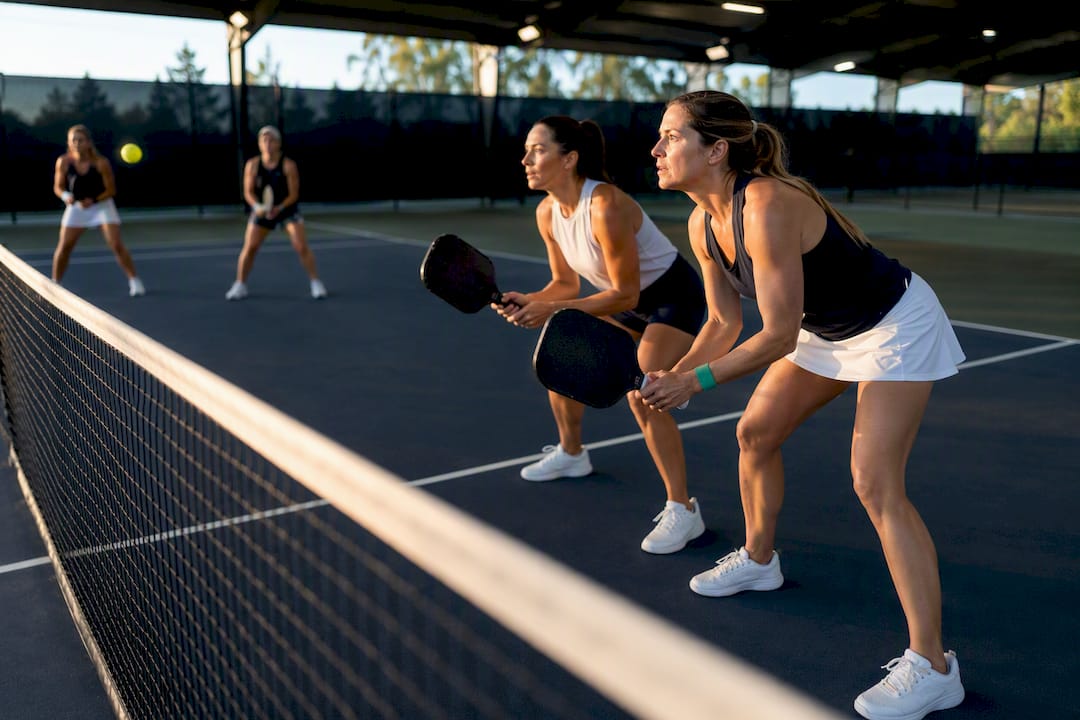
The standard for competitive women’s doubles is best 2-of-3 games to 11, win by 2. Single games to 11, 15, or 21 work fine for social play, and rally scoring is an approved alternative when you need faster matches. For league nights with limited court time, run a single game to 11 or set a 15-minute time cap per match rather than forcing best-of-3 into a crowded schedule.
TL;DR:
- The standard competitive women’s doubles match is best two of three games to 11 points, with a two-point lead required to win, aligning with official rules.
- Using a single game to 11 or time caps of 15-20 minutes is recommended for social leagues or busy schedules to maximize court turnover and reduce delays.
- Clear rules for serving order, score-calling, and the two-bounce rule prevent disputes, especially at the start of the game or during communication exchanges.
- Pre-publishing court assignments, warm-up procedures, and strict scheduling policies help avoid late starts and ensure smooth match flow within limited court time.
- Automated league management tools can streamline score reporting, standings updates, and registration, reducing manual errors and administrative effort.
Table of Contents
- Quick Format Checklist: Choosing the Right Women’s Doubles Match Format
- What Rules Should You Publish for Women’s Doubles Play?
- How Do You Schedule Women’s Doubles Matches Without Delays?
- Standings and Tiebreakers That Won’t Cause Arguments
- Which League Formats Work Best for Women’s Doubles?
- Organizer Checklist and Score-Reporting Workflow
- What Equipment Do Women’s Doubles Matches Require?
- What Fouls Come Up Most Often in Women’s Doubles?
- How Should Women’s Doubles Teams Position and Strategize?
- Who’s Eligible to Play Women’s Doubles in a League?
- What Warm-Up Routine Actually Helps Before a Match?
- Author Perspective: Three Organizer Lessons
- Run Your Women’s Doubles League Without the Spreadsheet Chaos
- Sources
- FAQ
Quick Format Checklist: Choosing the Right Women’s Doubles Match Format
Match your scoring format to what the session actually needs, not what feels “official.” Competitive divisions want depth; social nights want throughput.
- Best 2-of-3 to 11 (win by 2): the default for competitive play, playoffs, and tournament brackets where a single bad game shouldn’t decide a result. This is what the USA Pickleball Official Rulebook lists as standard, alongside single-game options to 15 or 21 for tournament flexibility.
- Single game to 11, 15, or 21: better for round-robins and social nights, since one game per match lets more pairs rotate through in the same court window.
- Rally scoring vs. side-out scoring: rally scoring awards a point on every rally regardless of who served, which shortens matches and changes how serve rotates. It’s a provisional option in the rulebook, and worth understanding fully before you adopt it, since it also changes how scores get called out loud during play.
- Time caps: a 15 to 20 minute window per match keeps a full slate of women’s doubles matches moving without anyone waiting an hour for a court. Organizer guides consistently recommend that same 15 to 20 minute range as the sweet spot for keeping courts turning over.
When a time cap expires mid-game, decide in advance whether the current leader wins outright or whether you finish the game to its natural end. Publish that rule before the season starts, not after the first dispute.
What Rules Should You Publish for Women’s Doubles Play?
Doubles has more moving parts than singles, and most disputes trace back to serving order and score-calling, not the score itself.
Serving order works like this: each team gets to serve until it loses a rally (side-out scoring), and within a team, the “first server” and “second server” both get a turn before the serve passes to the opposing team. There’s one wrinkle at the very start of the game: the serving team only gets one server turn, not two, before the first side-out. That single exception trips up more new players than any other rule in the book.
The two-bounce rule requires the ball to bounce once on each side after the serve before anyone can volley it. Combined with the non-volley zone (the “kitchen,” that 7-foot strip on each side of the net), it’s the rule that shapes almost every strategic decision in doubles, including how women’s doubles teams position at the net.
Score-calling in side-out scoring uses three numbers: your team’s score, the opposing team’s score, and which server (1 or 2) is serving. Something like “4, 6, 2” tells everyone exactly where the game stands. Getting your team comfortable with this call before the season starts saves a surprising amount of mid-match confusion. Rally scoring drops the server number entirely, since serve rotates every rally regardless of outcome.
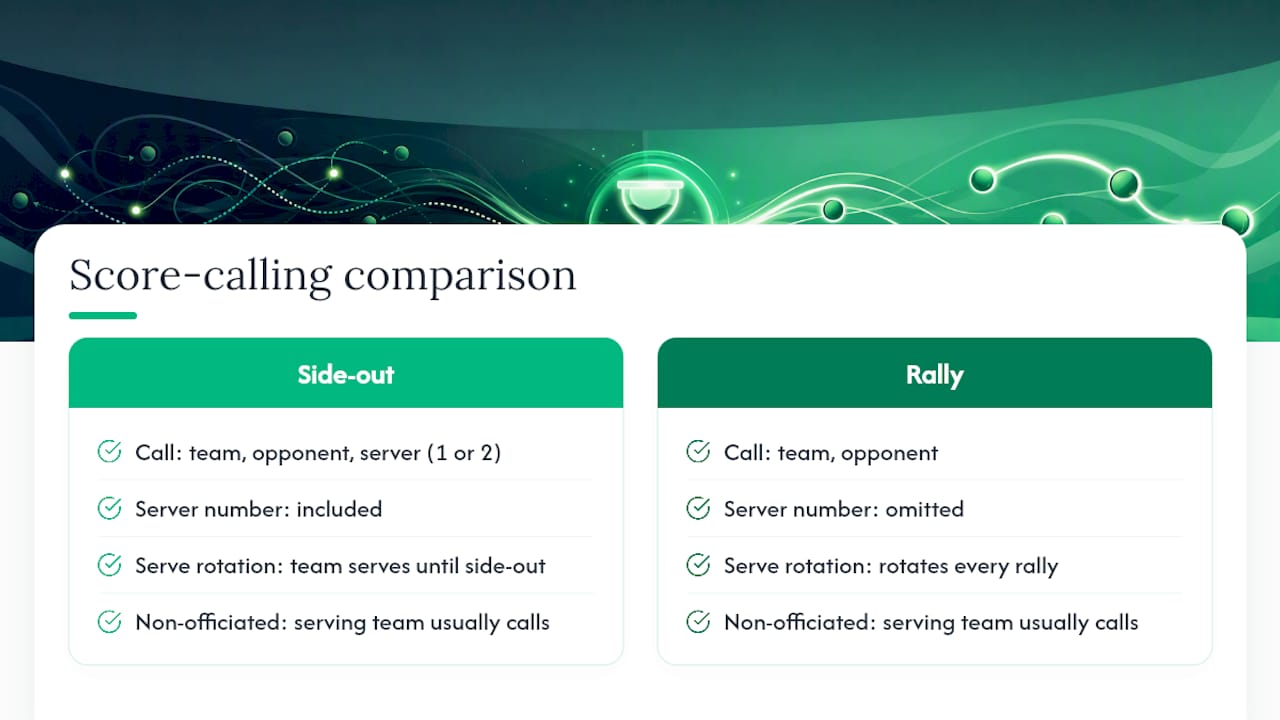
For non-officiated play, the serving team usually calls the score, and either side can call a fault. Give players a 10-second rule between the score call and the serve, and if a score gets called wrong, stop and correct it before the next rally rather than playing it out and arguing later. Recreational leagues that skip formal referees generally do fine with this kind of simple, self-officiated structure.
How Do You Schedule Women’s Doubles Matches Without Delays?
Court time is the real constraint in most leagues, not player interest. The format you choose determines how many matches fit into a two-hour window.
Best-of-3 to 11 makes sense when you have four courts and eight teams for the whole evening. It falls apart fast when you have twelve teams and two courts. In that case, single-game formats or time caps are what keep the night from running two hours past closing.
- Decide match length first: best-of-3 for divisions with 6 or fewer teams per court block, single-game or time-capped for anything larger.
- Set your time cap (15 to 20 minutes is the range most organizer guides recommend) and decide whether time-outs pause the clock.
- Assign courts in advance and post them, so teams know exactly where to go and warm-ups start on time instead of five minutes late.
- Build a substitution and no-show policy: a grace period of 5 to 10 minutes, then a forfeit, protects the schedule for everyone else waiting on that court.
Pro Tip: Post court assignments and warm-up start times the same way you post the schedule itself. Half of all late starts in rec leagues come from players not knowing which court is theirs, not from actual match delays.
Standings and Tiebreakers That Won’t Cause Arguments
Two approaches dominate: match-wins-first standings (simple, works for most recreational divisions) and game-wins-first standings (rewards teams that win more individual games even across fewer overall match wins, common in competitive brackets).
Whichever you choose, set your tiebreaker sequence before the season starts. The order most team-league guides recommend, and the one that’s easiest to explain to players, is head-to-head result first, then total games won, then point differential.
For forfeits, decide upfront whether a no-show counts as a loss by default score (11 to 0 is common) and whether you’ll guarantee players a minimum number of matches per session regardless of bracket outcome. Clear team-league structures with pre-set tiebreaker sequences head off most end-of-season complaints before they start.
Which League Formats Work Best for Women’s Doubles?
The match format and the season format are two different decisions. Here’s how the common season structures play out for women’s doubles specifically:
- Fixed lineup: a team captain sets the doubles pairing for the season, and that pairing plays together match after match. Works well for competitive divisions where chemistry between partners matters.
- Round-robin: every team plays every other team over the course of a session or season, maximizing total matches played per player. Best for larger, mixed-skill recreational pools.
- Dual match / team play: women’s doubles is one line among several (often alongside men’s doubles and mixed doubles) that combine to decide a single team result, similar in structure to formats like MLP-style team play.
Recreational divisions generally do better with round-robin for its throughput and flexibility. Competitive divisions lean toward fixed lineups or dual match play, where consistency and strategy across a season actually matter.
Organizer Checklist and Score-Reporting Workflow
A clean match sheet prevents most reporting errors. At minimum, include: team names, court number, match format (best-of-3 or single game), final score by game, winning team, and a signature or initials line from both sides.
Before each session starts, confirm four things:
- Courts, nets, and balls are set up and match the format’s ball type
- Score-reporting method is confirmed (paper sheet, app, or both)
- Court assignments and warm-up times are posted
- Backup courts identified in case of weather or equipment issues
The full workflow, from schedule to standings, runs: publish the schedule, collect signups, assign courts and pairings, players report scores after each match, standings update automatically. That last step is where most manual leagues lose time. FlexLeague+ is built specifically around that gap, automating scheduling, DUPR-approved registration, in-app score entry, and live standings so nobody’s manually retyping a match sheet into a spreadsheet on a Sunday night.
What Equipment Do Women’s Doubles Matches Require?
There’s no separate paddle or ball specification for women’s doubles. The equipment rules are the same across every doubles format, singles included, and they’re set entirely by USA Pickleball’s approved equipment list.
Paddles must meet the size and surface specifications on the official equipment standards published by USA Pickleball, which also lists every approved paddle model by brand. Balls fall into two categories: indoor and outdoor. Outdoor balls have more, smaller holes and are harder, built to resist wind; indoor balls have fewer, larger holes and a slightly softer feel suited to gym floors. A league playing on outdoor courts should specify outdoor balls in its published rules, since mixing ball types mid-season changes bounce height and play speed enough that players notice immediately.
The one place equipment choice does matter tactically in women’s doubles is paddle weight and grip size, which affects net reactions more than baseline power. Faster hands at the kitchen line often favor a lighter paddle, while players who rely on drives from the baseline sometimes prefer a bit more weight for pop. That’s a personal preference, though, not a rule. If your league has a policy on approved paddles (some do, to keep costs predictable for new players), publish it alongside your scoring rules so nobody shows up with gear that gets challenged mid-match.
What Fouls Come Up Most Often in Women’s Doubles?
Doubles generates more foul disputes than singles simply because there are four players and a partner to coordinate with instead of one.
The most common one is a kitchen violation: a player volleys the ball while their momentum carries them into the non-volley zone, even if the volley itself happened outside it. This happens constantly at the net in doubles, where both partners are often crowding the kitchen line to cut off angles. The second most common is a two-bounce violation, usually the receiving team volleying the serve before it bounces, which happens more in doubles because partners sometimes assume the other player will let it bounce.
Foot faults on serve show up too, particularly a server stepping on or over the baseline before contact. In doubles, this gets missed more often because both players on a team are focused on positioning rather than watching the server’s feet.
The infraction that’s genuinely more common in women’s doubles than in other formats is a communication fault: both partners going for the same ball, or neither taking it, which isn’t a rule violation but causes enough on-court confusion that it often triggers disputed line calls right after. Establishing a simple call system with your partner (whoever’s forehand it is takes the middle ball, for instance) solves this before it becomes a scoring argument.
Let calls and disputed out calls near the baseline round out the list, and in non-officiated leagues, the standard practice is that the receiving team’s call stands unless the serving team clearly saw otherwise.
How Should Women’s Doubles Teams Position and Strategize?
Positioning in women’s doubles comes down to one core principle: get to the kitchen line together, and stay there together.
The biggest strategic difference between doubles and singles is that both players advance to the non-volley zone line as a unit after the serve exchange, rather than one player camping the baseline. Teams that get both players to the kitchen line first typically control the point, because volleys hit from up there are harder to counter than groundstrokes from the baseline.
Communication between partners matters more in women’s doubles matches than the scoreline usually reflects. Calling “mine” or “yours” on balls down the middle, and deciding in advance who takes lobs over the backhand side, cuts down on the collisions and missed balls that cost points. Many pairs also develop a rough division of court coverage: one partner covering more of the middle, the other protecting the line, based on which player has the stronger backhand.
The third-shot drop, a soft shot hit from the baseline after the return of serve that lands in the opponent’s kitchen, is the shot that lets the serving team advance to the net safely instead of getting stuck on the baseline while the other team already controls the kitchen line. Teams that master it consistently transition to net position faster, and net position wins more points than power does in doubles. It’s a slower, more patient way to play than singles rewards, and it’s exactly why doubles strategy rewards accuracy and teamwork over pure pace.
Who’s Eligible to Play Women’s Doubles in a League?
Most leagues set eligibility around two things: skill level (usually a rating band like 3.0 to 3.5, or a DUPR range) and gender category for the division itself.
Team composition for women’s doubles is straightforward: both players on a team must meet the division’s eligibility criteria, whatever a specific league sets that to be. Some leagues allow a rating gap between partners (say, up to a 0.5 DUPR difference) to make pairing easier for players without a regular partner; others require both players to fall within the same band. Publish whichever rule you’re using clearly, since rating disputes are one of the more common friction points at signup.
Substitute policies matter more in women’s doubles than people expect, especially in fixed-lineup formats where a missing partner can knock out an entire pairing for the night. Decide in advance whether a substitute needs to meet the same rating band as the player they’re replacing, or whether a league allows a one-tier flex for substitutes to keep matches running. Using DUPR ratings for fair placement at signup, rather than self-reported skill level, cuts down on the mismatched pairings that frustrate both new and experienced players.
What Warm-Up Routine Actually Helps Before a Match?
A rushed warm-up is where a lot of early-match errors and minor injuries come from, and doubles has a specific rhythm worth building into your routine.
Start with 5 minutes of light movement, side shuffles, and dynamic stretches for the hips, shoulders, and wrists, since pickleball’s quick direction changes put real stress on those joints. Follow that with dinking practice at the kitchen line with your partner for another 5 minutes, since dinking mimics the soft-game exchanges that decide most doubles points and gets both players’ touch calibrated before real points start.
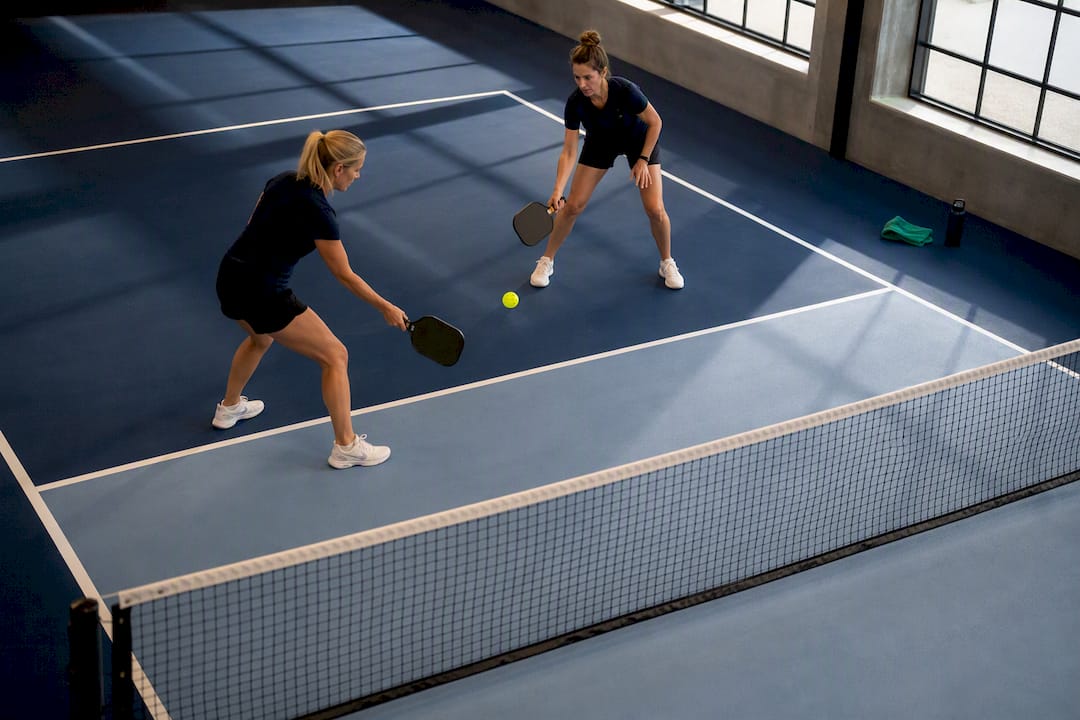
Spend the last few minutes on serve and return reps, alternating server and receiver roles with your partner so both players feel comfortable before the game clock starts. Skip straight to hard groundstrokes only after the soft game feels sharp, not before, since most doubles rallies are won or lost in that kitchen exchange, not on power shots from the baseline.
After the match, a short cool-down of static stretching, focused on shoulders, forearms, and calves, takes maybe five minutes and meaningfully cuts down on the next-day stiffness that keeps players from showing up the following week. For a league running multiple matches back-to-back in one night, that five minutes between matches matters more than it sounds like it should.
Author Perspective: Three Organizer Lessons
Every dispute I’ve seen trace back to one thing: rules nobody read because nobody published them clearly. Get your scoring format and time caps in writing before signups open. Automate score collection wherever you can, since manual entry is where errors and arguments both start. And set your tiebreaker order early. Enforcing minimum-match guarantees, even loosely, keeps players coming back next season.
— Robert
Run Your Women’s Doubles League Without the Spreadsheet Chaos
Manually tracking scores, standings, and payments across a season is where most organizers burn their Sunday nights. FlexLeague+ handles the parts that eat the most time: automated scheduling, live standings that update as scores get submitted, registration for fair skill matching, and payment collection so you’re not chasing registration fees by text message.

For a women’s doubles division specifically, that means players sign up, get matched by rating, submit their own scores after each match, and standings update automatically without you touching a spreadsheet. If you’re setting up a new season, take a look at the pickleball league software feature page and see whether it fits how your league actually runs.
Sources
Check the USA Pickleball Official Rulebook and official rules and equipment materials for exact rule language.
- USA Pickleball Official Rulebook
- USA Pickleball rules and official materials
- How to Start a Pickleball League: Complete Guide (2026) | LeagueArc
FAQ
What Is the Standard Women’s Doubles Match Format?
Best 2-of-3 games to 11 points, win by 2, is the standard competitive format, though single games to 11, 15, or 21 and time-capped matches are common in recreational leagues.
Is Rally Scoring Allowed in Women’s Doubles?
Yes, rally scoring is a provisional option in the USA Pickleball rulebook, and it’s a common league choice since it shortens match length and simplifies score-calling.
How Does Serving Order Work in Women’s Doubles?
Each team’s first and second server both get a turn before a side-out, except at the very start of the game, when the starting team gets only one server before the first side-out.
What’s a Fair Tiebreaker System for Standings?
Head-to-head result first, then total games won, then point differential, is the sequence most organizer guides recommend for its simplicity and fairness.
Does FlexLeague+ Support Women’s Doubles Leagues?
Yes, some pickleball league software supports women’s doubles alongside other formats, with features like registration and automated score reporting.