Volunteer Run Leagues: How to Join or Support One
Volunteer Run Leagues: How to Join or Support One

A volunteer-run league is a community sports program organized and staffed largely by unpaid parents, players, and neighbors instead of professional staff. If you want in, do three things today: message the league’s volunteer coordinator, sign up for a single one-hour shift on the schedule—you’ll usually find concessions and field setup shifts open—and ask whether a background check is required. Most leagues post a coordinator’s contact and a background-check policy right on their homepage. That’s the whole first step.
- Contact the volunteer coordinator or check the league’s sign-up page
- Grab one low-commitment shift to start (concessions, setup, or scorekeeping)
- Ask about background checks before your first youth-facing shift
Key Takeaways
Volunteer-run leagues stay affordable and community-controlled because parents and neighbors fill coaching, scorekeeping, field, and board roles that would otherwise require paid staff.
| Point | Details |
|---|---|
| Start with one shift | Concessions or scorekeeping require minimal training and let you learn the league before committing further. |
| Expect a background check | Any youth-facing role typically requires screening and often Safe Sport style training before you begin. |
| Know the fee tradeoff | Many leagues let families pay a modest non-volunteer fee instead of meeting hour requirements. |
| Recognition drives retention | Leagues that track hours and host thank-you events keep volunteers coming back season after season. |
| Organizers can cut admin work | Tools like FlexLeague+ automate registration, scheduling, and payment collection for pickleball leagues specifically. |
Table of Contents
- How Volunteer Run Leagues Actually Get Organized
- Common Volunteer Roles and How Much Time They Take
- Signing Up: Background Checks and Safety Requirements
- What Volunteering Does to Your Registration Fees
- Why Leagues Lean So Heavily on Volunteers
- What Actually Gets Volunteers to Stick Around
- Seven Things You Can Do Today
- What Organizers Wish New Volunteers Knew
- If You Run the League: Cutting the Coordination Headache
- Sources
How Volunteer Run Leagues Actually Get Organized
A small board runs most volunteer-run leagues: a president, treasurer, registrar, and a handful of committee heads, all unpaid, all doing this alongside full-time jobs. Underneath that board sits a rotating layer of parents and community members who show up for specific tasks. It’s a nonprofit or grassroots structure by default. There’s no corporate office, just a group of people who agreed to keep the season running.
The day-to-day work breaks down into recurring jobs someone has to own:
- Building the game schedule and posting it
- Handling registration and collecting fees
- Prepping and lining fields before games
- Umpiring or officiating
- Running concessions
- Organizing fundraisers and sponsor outreach
The better-run leagues write down who does what. A one-page role description with a time estimate attached does more to prevent burnout than any pep talk, according to volunteer-management toolkits used by youth sports groups.
Common Volunteer Roles and How Much Time They Take
Not every role demands a weekly commitment. Some are a single afternoon.
- Head coach: 3 to 5 hours a week during the season, plus a pregame planning call
- Assistant coach: 2 to 3 hours a week, mostly practice and game-day support
- Team parent: A few hours a month coordinating snacks, communication, and team logistics
- Scorekeeper: One shift per game, roughly 1 to 2 hours
- Umpire: Per-game commitment, often 1 to 2 hours with some upfront training
- Field coordinator: Early arrival before games for setup and lining, usually under an hour
- Concessions: One-hour shift slots, frequently split among multiple parents
- Board member: Monthly meetings plus off-season planning, a heavier year-round commitment
Fairfax Little League’s own volunteer roster reflects this same mix, from team managers and field coordinators down to concessions workers, which tells you this pattern isn’t unique to one town. If you’re new, start small. Concessions and scorekeeping need almost no ramp-up time and let you learn how the league operates before you commit to something bigger like coaching.
Pro Tip: If a league only advertises “volunteers needed” with no specifics, ask directly for a written role list with time estimates. Leagues that have one tend to be far better organized behind the scenes.

Signing Up: Background Checks and Safety Requirements
Getting started follows a predictable path:
- Find your local league through its website or your city parks and recreation page
- Contact the volunteer coordinator directly, by phone or the site’s sign-up form
- Complete any required registration paperwork
- Schedule background screening and training before your first shift
Any role that puts you near kids, coaching, team parent duty, even some concessions shifts, typically requires a background check. Many programs also run Safe Sport or equivalent abuse-prevention training before a volunteer can work directly with youth. Little League itself runs coaching clinics and off-season training meetings to prep new volunteers before opening day, so don’t expect to show up and coach cold.
Pro Tip: When you first reach out, ask three things upfront: the realistic time commitment, whether there’s a non-volunteer fee option, and when training or background-check windows open. That one message saves you three follow-up emails.
What Volunteering Does to Your Registration Fees
Registration costs in these leagues usually break into a few categories: a base player or team registration fee, sometimes a separate official’s fee, and occasionally added team fees for uniforms or equipment. City-run adult programs, like Las Vegas Parks and Recreation’s adult basketball league, show the pattern clearly: a team fee, a per-game official’s fee, and a set season length such as seven weeks plus playoffs.
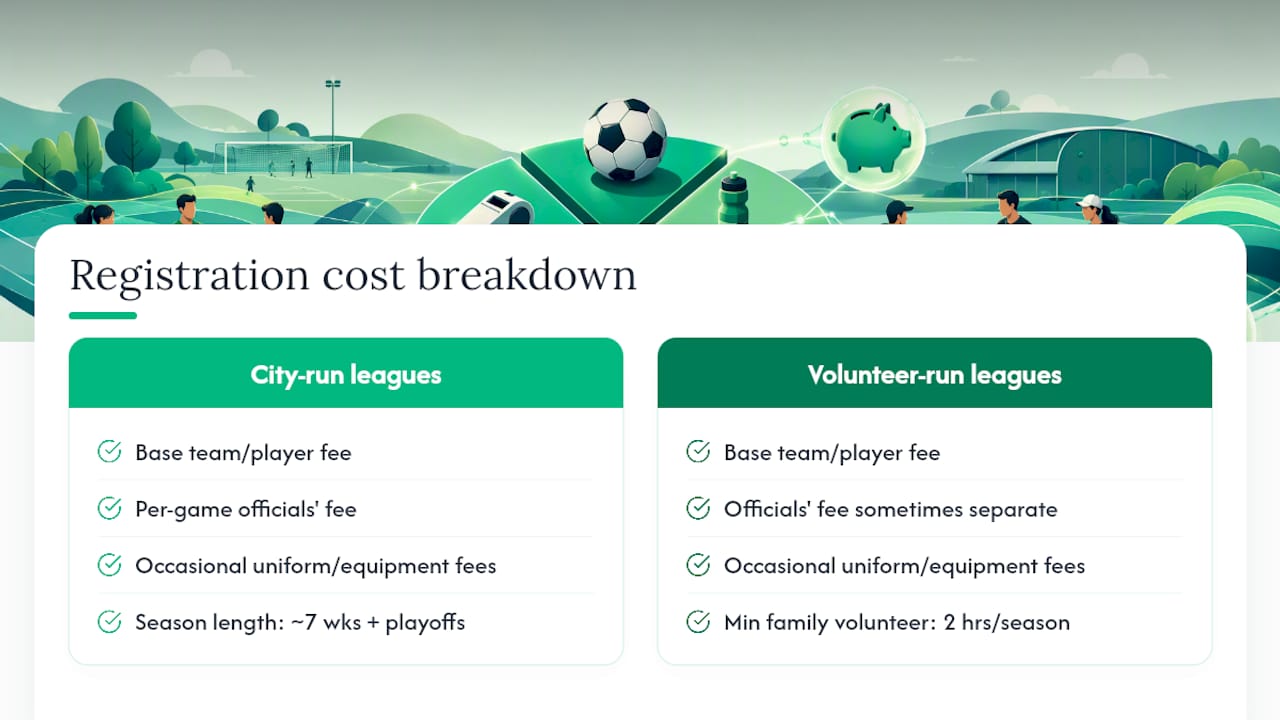
Volunteer-run youth leagues add another wrinkle. Many require a minimum family volunteer commitment, sometimes as little as two hours per season, and let families who can’t make that time work pay a non-volunteer fee instead.
That fee tends to be modest. University East Little League lists a modest non-volunteer fee as its buyout option, a figure that shows up across several other leagues too. If you can’t give the hours, giving that fee, plus a sponsorship or a fundraiser donation, keeps the league solvent without adding to a coordinator’s staffing headache.
Why Leagues Lean So Heavily on Volunteers
Volunteer labor is what keeps registration affordable and keeps the league answering to the community instead of a corporate parent org. Cut the paid-staff overhead and fees stay low enough that most families can afford to play.
- Lower registration costs across the board
- Decisions stay local, made by people who actually show up to games
- Access stays open to families who couldn’t afford a private club program
Volunteers get something back too: new friendships in the stands, a resume line if you’re coordinating a whole program, sometimes discounted registration for your own kid, and the kind of thank-you recognition that, according to volunteer coordinator guidance, keeps people coming back season after season.
What Actually Gets Volunteers to Stick Around
Recruiting is the easy part. Retention is where most leagues fall apart, usually because nobody defined the job clearly enough for a first-timer to say yes without anxiety.
- Write one-page role descriptions with time estimates attached
- Break big jobs into one-hour, bite-sized shifts
- Track volunteer hours somewhere visible
- Host at least one recognition event or send a real thank-you, not a form email
- Name one person as volunteer coordinator instead of leaving it to “whoever’s around”
Pro Tip: Frame every open slot as “one hour, this Saturday” instead of “help needed all season.” Vague, open-ended asks scare off exactly the busy parents you’re trying to recruit.
Leagues that make roles bite-sized see measurably better recruitment among parents juggling work and family, according to Fairfax Little League’s volunteer guidance. And recognition isn’t a nice extra. Volunteer coordinator toolkits built for youth sports point to tracking hours and hosting appreciation events as one of the most reliable ways to keep people from quietly disappearing after one season.
Seven Things You Can Do Today
- Look up your local league’s website or its city parks and recreation page
- Message the volunteer coordinator directly, don’t wait for a form to appear
- Ask about background check and training requirements before committing
- Pick one low-commitment shift to start (concessions, setup, scorekeeping)
- Ask if there’s a minimum family volunteer requirement or a non-volunteer fee option
- If you can’t give time, ask about donating supplies or sponsoring a team
- Put the shift on your calendar now, not “sometime this month”
What Organizers Wish New Volunteers Knew
Most first-time volunteers show up worried they’ll get stuck with more than they signed up for. The fix is simple: hand them a written description with a time estimate before they say yes, and actually say thank you when the season ends. New volunteers are almost always more capable than they think. Give them a clearly bounded one-hour job first, not a season-long commitment, and they’ll come back for a bigger role next year.

If You Run the League: Cutting the Coordination Headache
Running sign-ups through spreadsheets and group texts works fine until your league hits 60 players and three divisions, then it becomes someone’s second job. FlexLeague+ is built for pickleball league organizers who want registration, scheduling, and payment collection handled automatically instead of chased down manually.

The platform runs singles, doubles, mixed, and team-format leagues, handles Stripe payment processing for registration fees, and connects to DUPR for rating verification, three trust signals that matter when you’re asking players to hand over money and personal info to a volunteer-run program. Digital sign-up tools like this cut down on no-shows and make shift or match swapping simple, which takes real weight off a volunteer coordinator’s plate. If you’d rather not add a paid tool, your city or county parks department can often help coordinate scheduling at no cost. But if you’re managing a growing pickleball league and tired of chasing payments by hand, start a league on FlexLeague+ and see what a season looks like without the spreadsheet.
Sources
- Volunteer Opportunities - Fairfax Little League
- Volunteer coordinator toolkit - CAPTA
- Northside volunteer policy - Play Northside
- Volunteer coordinator job profile - Prospects