Best Tournify Alternatives for U.S. Pickleball Leagues
Best Tournify Alternatives for U.S. Pickleball Leagues

For U.S. pickleball league managers running paid leagues, Flexleagueplus is the recommended alternative to Tournify — it’s DUPR-approved, connects directly to Stripe for registration fee collection, and handles automated scheduling across singles, doubles, mixed doubles, and FLP team formats without requiring a subscription.

TL;DR: If you’re collecting player fees, syncing scores to DUPR, and managing multi-division leagues, Flexleagueplus covers all three in one place. The other platforms on this shortlist (Competize, LeagueRepublic, SportNinja, TeamSideline, and Tourny) each have a place, but most serve general sports or tournament-presentation needs rather than the paid-league workflow U.S. pickleball managers actually run.
Quick reasons to keep reading:
- Registration and payments: Flexleagueplus uses Stripe, which means secure, familiar checkout for players and direct deposit for organizers.
- Scheduling and brackets: Automated scheduling with division management, live standings, and playoff brackets built for league formats.
- Player experience: Players sign up, organize matches, and report scores through the app.
- Onboarding: No subscription required; managers can set up a league and start collecting fees quickly.
One honest note: if your primary need is a polished public tournament website with referee management and multi-language support, a presentation-heavy platform may suit that edge case better.
Table of Contents
- Which Tournify alternatives actually work for paid pickleball leagues?
- How do you choose the right platform for your league?
- Presentation-heavy vs. operational-heavy: which type fits your league?
- How this shortlist was built
- Key Takeaways
- Why Flexleagueplus is the right call for most U.S. league managers
- Flexleagueplus is built for exactly this
- Useful sources and next steps
Which Tournify alternatives actually work for paid pickleball leagues?
Aggregators list dozens of Tournify competitors, but most are built for general sports tournaments, not the recurring paid-league model pickleball managers run. The table below maps the platforms this shortlist covers against the dimensions that matter most.
| Platform | Best for | Core features | Scheduling & brackets | DUPR integration | Payment processing | Player experience | Pricing model | Support & onboarding |
|---|---|---|---|---|---|---|---|---|
| Flexleagueplus | Paid U.S. pickleball leagues | Registration, divisions, playoffs, score reporting, live standings | Automated scheduling, multi-division, playoff brackets | ✅ DUPR-approved | Stripe (built-in) | Mobile app, public pages, score reporting | Transaction-based, no subscription | Dedicated onboarding; direct support |
| Competize | Multi-sport league management | League scheduling, standings, registration | Moderate flexibility | Not confirmed | Varies by plan | Web-based player pages | Subscription-based | Standard docs and support |
| LeagueRepublic | Club and league administration | Registration, scheduling, results | Moderate | Not confirmed | Third-party integrations | Web portal | Subscription | Email/chat support |
| SportNinja | Recreational leagues and tournaments | Scheduling, standings, score entry | Good for rec leagues | Not confirmed | In-app payments | Mobile-first app | Freemium + paid tiers | Community + email |
| TeamSideline | Parks and rec departments | Registration, scheduling, facility booking | Standard league formats | Not confirmed | Integrated payments | Web and mobile | Per-season or subscription | Phone and email |
| Tourny | Tournament-focused events | Bracket management, round robin, power pools, tie-break logic | Advanced scheduling flexibility, drag-and-drop | Not confirmed | Event-based ($30 USD/event) | Public tournament site | Pay-per-event | Self-serve; docs-based |
Flexleagueplus
The only platform on this list built specifically for pickleball leagues, with DUPR approval and Stripe payments confirmed on its product pages.
- Supports singles, men’s doubles, women’s doubles, mixed doubles, and FLP team formats
- Automated scheduling, division management, live standings, and playoff brackets
- Players register, organize matches, and report scores through the app
- No subscription required; revenue model is transaction-based through Stripe
- Designed for U.S. league managers and facility operators collecting registration fees
Pros: Pickleball-specific, DUPR-native, Stripe-native, no subscription overhead. Cons: Narrower scope than general-sports platforms; not built for multi-sport facilities running non-pickleball leagues.
Tourny
Strong scheduling flexibility with power-pool workflows, double elimination, and configurable tie-break logic. Priced at $30 USD per tournament with no subscription.
- Built for tournament organizers who need game-day editability
- Drag-and-drop schedule editing and next-available-space scheduling
- No DUPR integration confirmed; no recurring league model
- Best for weekend tournaments, not ongoing paid leagues
Pros: Transparent per-event pricing, advanced bracket logic. Cons: No confirmed DUPR sync, no recurring league structure, no Stripe-native payments.
Competize, LeagueRepublic, SportNinja, TeamSideline
These platforms handle general sports leagues and work for facilities running multiple sports. None confirm DUPR integration, and payment processing varies. They’re reasonable fallbacks for multi-sport parks-and-rec departments, but they weren’t designed around pickleball’s specific scoring and ranking needs.
Pros: Broader sport coverage, established user bases. Cons: No DUPR support confirmed, generic scheduling logic, not pickleball-specific.
Cancellation and refund policies vary significantly across all platforms. Before signing any agreement, ask each vendor for their written refund policy for player registrations and their data-export terms. Some platforms lock player roster data behind proprietary formats.
Pro Tip: Ask every vendor during the demo: “Can I export my full player roster and match history as a CSV?” If they hesitate, that’s a workflow risk for mid-season platform switches.
How do you choose the right platform for your league?
Run this checklist before committing to any platform.
- Define your formats. List every league type you run: singles, doubles, mixed, team. Confirm the platform supports all of them natively.
- Test the scheduling engine. Input your actual court count, player count, and session length. See if the output matches what you’d build manually.
- Confirm DUPR sync. Ask for a live demo of a score submission flowing to DUPR. If they can’t show it, assume it doesn’t work.
- Run a payment flow test. Register as a test player, pay a $1 fee, and confirm the money lands in your account. Check what processing fees apply.
- Try the player-facing pages. Open the public league page on your phone. If it’s confusing, your players will email you constantly.
- Simulate a mid-season schedule change. Cancel a match, reschedule it, and see how long it takes. Game-day flexibility matters more than most managers expect until they need it.
Vendor questions to ask during demos:
- What are the total payment processing fees, including Stripe or equivalent?
- What is your written refund policy for player registrations?
- How are tie-breakers configured for round-robin divisions?
- Can I edit the schedule live on game day without contacting support?
- How does DUPR data sync — automatic after score entry, or manual batch?
- What does data export look like, and what formats are available?
Red flags to watch for:
- Registration flow that can’t be customized to your existing signup process
- Pricing that isn’t publicly listed or changes significantly after the demo
- No ability to edit the schedule live during an event
- Payment processing through an unknown third party with no Stripe option
- DUPR integration described as “coming soon” or “in development”
Migration timing matters. Moving platforms mid-season creates player confusion and data gaps. Off-season migration with a 4–8 week runway (covering data export, player communications, and a pilot division) is realistic for a medium-sized facility. Mid-season switches are possible but require a clean data export from your current platform before you start.
Presentation-heavy vs. operational-heavy: which type fits your league?
The market splits cleanly into two categories, and knowing which one you need saves weeks of demo time.
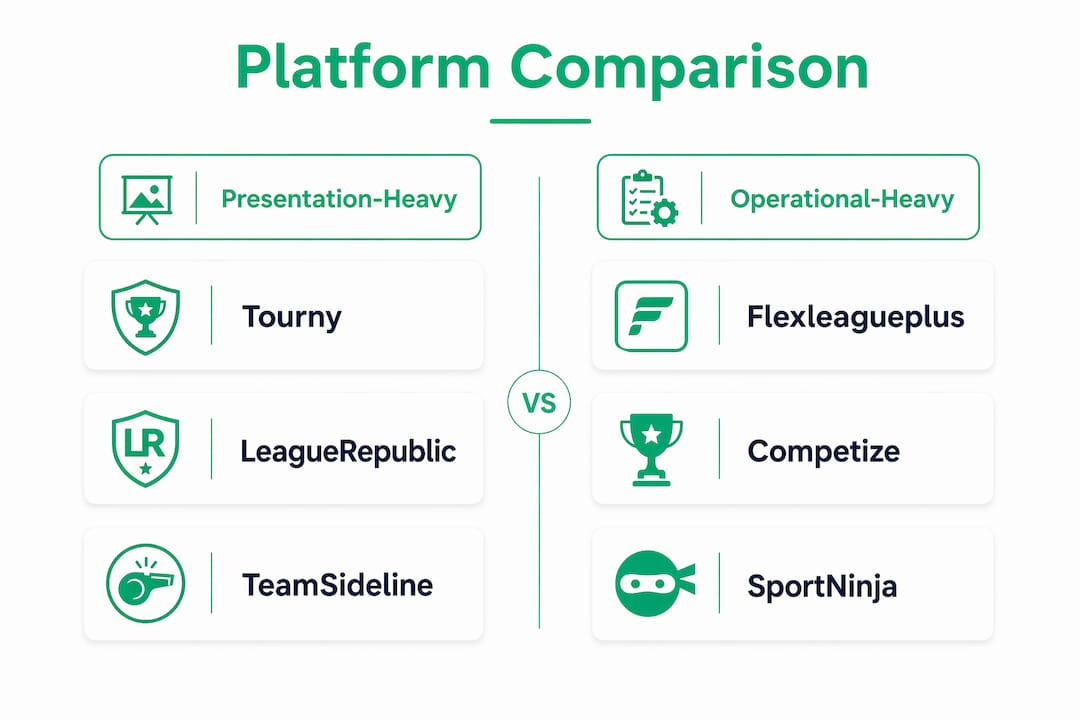
Presentation-heavy platforms prioritize polished public pages, mobile apps, and participant-facing features: schedules, brackets, and results displayed beautifully. They’re built for the spectator and participant experience.
Operational-heavy platforms prioritize scheduling logic, tie-break configuration, multi-stage advancement, and game-day editability. They’re built for the organizer running the event.
| Feature | Presentation-heavy | Operational-heavy |
|---|---|---|
| Polished public tournament site | ✅ Strong | ✅ Adequate |
| Mobile app for participants | ✅ Strong | Varies |
| Automated scheduling engine | Basic | ✅ Strong |
| Advanced tie-break logic | Limited | ✅ Strong |
| Power-pool / multi-stage advancement | Limited | ✅ Strong |
| Drag-and-drop game-day edits | Sometimes | ✅ Strong |
| DUPR integration | Rare | Flexleagueplus: ✅ |
| Stripe-native payments | Varies | Flexleagueplus: ✅ |
Use-case mapping:
- Small weekly 8-team rec league: Either type works, but operational-heavy saves time on scheduling each week.
- Seasonal 60-player divisions with playoffs: Operational-heavy wins here. Tie-break logic and multi-stage advancement become critical once you have more than two divisions.
- Weekend tournament with variable match lengths: Tourny’s next-available-space scheduling and drag-and-drop editing handle this well. Flexleagueplus is built for recurring leagues, not one-off tournaments.
Flexleagueplus sits firmly in the operational-heavy category, with the added layer of being pickleball-specific. The DUPR sync and Stripe integration aren’t bolt-ons; they’re core to how the platform works.
Pro Tip: If you run both recurring leagues and occasional tournaments, consider using Flexleagueplus for leagues and a per-event tournament tool for standalone events. You don’t need one platform to do everything.
How this shortlist was built
The evaluation used six axes: scheduling flexibility, registration and payments, DUPR integration, player-facing experience, pricing transparency, and support and onboarding quality.
- Scheduling flexibility: Can the platform handle your actual formats without workarounds?
- Registration and payments: Is Stripe (or an equivalent secure processor) built in, and are fees transparent?
- DUPR integration: Is it confirmed and live, not promised?
- Player-facing experience: Does the mobile experience reduce organizer support requests?
- Pricing transparency: Is pricing publicly listed, or does it require a sales call?
- Support and onboarding: Is there a real human available during setup?
Sources used include vendor product pages, platform aggregator listings, market intelligence profiles, and Flexleagueplus’s published feature set. Limitations: enterprise pricing tiers are often negotiated privately, and some vendor review pages are partially vendor-owned. Third-party verification for DUPR integration claims was limited to platforms that publicly document it.
Key Takeaways
Flexleagueplus is the strongest Tournify alternative for U.S. paid pickleball leagues because it combines DUPR approval, Stripe-native payments, and automated scheduling in a single pickleball-specific platform.
| Point | Details |
|---|---|
| DUPR integration is the filter | Only Flexleagueplus confirms DUPR approval; treat unconfirmed claims as a red flag during demos. |
| Test payments before committing | Run a live Stripe payment test during every demo; processing fees and refund policies vary widely. |
| Operational-heavy beats presentation-heavy | For recurring paid leagues with divisions and playoffs, scheduling logic matters more than polished public pages. |
| Migration needs a runway | Plan 4–8 weeks for off-season migration; mid-season switches risk data gaps and player confusion. |
| Flexleagueplus is the recommended pick | Built for pickleball leagues, transaction-based pricing, no subscription required for managers or players. |
Why Flexleagueplus is the right call for most U.S. league managers
Most platform comparisons treat DUPR integration as a nice-to-have. For U.S. pickleball leagues, it’s the opposite. Players expect their match results to flow into DUPR automatically. When they don’t, you field the complaints. That single operational reality narrows the field considerably.
What I find underappreciated in most software comparisons is how much the payment model shapes the manager experience. Platforms that charge per-player transaction fees through Stripe give organizers a clean, auditable revenue trail. Platforms that route payments through proprietary processors often obscure fees or complicate refunds. For a facility running three or four concurrent leagues, that difference compounds fast.
Tourny deserves credit for its scheduling flexibility and transparent per-event pricing. For a standalone weekend tournament, it’s a legitimate option. But it’s not built for the recurring paid-league model, and that’s the job most pickleball managers are actually hiring software to do.
The cases where a presentation-heavy platform makes sense are narrower than vendors suggest: primarily large showcase events where the spectator experience is the product. For the weekly or seasonal paid league, operational depth wins every time.
Flexleagueplus is built for exactly this
Running a paid pickleball league means juggling registration, scheduling, DUPR reporting, and player payments simultaneously. Flexleagueplus handles all of it in one place, with no subscription required and Stripe powering every registration fee.
Start your first league in minutes, or go deeper on the pickleball-specific features including DUPR sync, division management, and playoff brackets. When you’re ready to demo, test these four things live: DUPR score sync after a match entry, a Stripe payment from a test player account, a mid-season schedule edit, and a full roster data export. Those four checks will tell you everything you need to know. Support is available during onboarding, and setup doesn’t require a long-term contract.
Useful sources and next steps
Use these to verify claims and go deeper before committing to any platform.
- Flexleagueplus pickleball league software page — confirms DUPR approval, Stripe integration, and supported league formats
- Techjockey Tournify alternatives list — broad market overview of scheduling and registration priorities
- Nerdisa Tournify profile and alternatives — useful for auditing the full field of options quickly
- Tracxn Tournify company profile — market context and competitor density
- Tourny vs. Tournify comparison — detailed breakdown of scheduling flexibility differences
Suggested next steps:
- Schedule two 30–45 minute demos: one with Flexleagueplus, one with any operational-heavy platform you’re considering.
- Run a 7–10 day pilot with a single division before migrating your full league roster.
- Collect brief feedback from 5–10 players on the registration and score-reporting experience.
- Before signing anything, request written documentation of the refund/cancellation policy and confirm data export capability in CSV or equivalent format.