5 Questions for League Organizers: Pick Team or Individual Registration
5 Questions for League Organizers: Pick Team or Individual Registration

Use team registration when players already have a roster and just need a way to check in together. Use individual registration when you need to build balanced teams from a pool of unattached players, like in draft leagues or open ladders. Most well-run pickleball leagues actually run both at once, and the split usually comes down to whether you’re protecting social cohesion or roster balance. The mechanics for pulling that off are below.
TL;DR:
- Running a hybrid registration system with staggered deadlines and clear policies helps organizations manage both team and individual sign-ups efficiently.
- Supporting features like roster codes, invite links, and integrated payment processing reduce administrative workload and prevent common support issues.
- Clear communication about placement timelines, refunds, and play-with policies preserves participant trust and encourages repeat sign-ups.
- FlexLeague+ offers a unified platform that streamlines both registration types, handles payments via Stripe, and automates messaging to boost operational simplicity.
- Inclusive registration practices require offering options for newcomers and carefully framing skill and gender fields to avoid unintentional exclusion.
Table of Contents
- Team vs Individual Registration: What Each Flow Actually Collects
- What Individual Registration Collects and Why It Matters
- Running Both: Hybrid Registration, Pricing, and the “Stay Together” Problem
- How to Choose: Organizer Decision Checklist
- Common Problems and Operational Fixes
- Registration Software Feature Checklist
- Accessibility and Inclusivity in Both Registration Types
- Timeline and Communication Expectations for Individual Registrants
- Impact on Event Logistics and Resource Planning
- Payment and Refund Policies: Team vs Individual Registrations
- Pragmatic Rules of Thumb for Organizers
- Set Up Team and Individual Flows With FlexLeague+
- Sources
Team vs Individual Registration: What Each Flow Actually Collects
The two flows exist because they solve different problems. Team registration is built for groups that show up intact. A captain fills out one form, and the organizer collects captain contact details, team name, team color, estimated roster size, and division. Once approved, that entry becomes a team shell, and the captain adds actual players afterward, usually through a roster code or invite link rather than re-entering everyone’s information by hand.
This flow fits three common situations: social teams that have played together for seasons and just want a smooth check-in, tournament brackets where the team identity matters more than any single player, and corporate or charity events where a company or sponsor is footing the bill for a group.
On the operational side, organizers using team registration generally choose between two payment models; see how to manage karate tournament registrations efficiently for practical insights into bulk registration workflows. One event registration guide lays out both clearly:
- Individual sign-up via team link: each player registers themselves and pays their own fee, but their entry attaches to the team’s roster automatically.
- Bulk payment by captain or admin: one person pays for the whole roster in a single transaction, often using a pre-built team form to gather names and waivers beforehand.
Either approach still needs a waiver step. Skip it at your own risk, since a missing signature is the most common reason a “registered” player turns out not to be covered when something goes wrong on the court.
What Individual Registration Collects and Why It Matters
Individual registration exists to answer a different question: not “who’s on this team” but “how do we build a fair team from scratch.” That means the form has to capture more about the player, not just the player’s group.
Typical fields include personal contact information, self-reported skill rankings, preferred positions, gender for coed balance, and any play-with requests. That last field matters more than it looks. It’s where a player flags “I’d like to play with my neighbor” without formally registering as a team, and it’s the detail organizers most often overlook until draft night gets awkward.
This flow is the right call for:
- Draft leagues, where organizers or team captains pick players round by round using the skill data collected at sign-up.
- Free-agent pools, where singles or pairs need placement into an existing team with an open slot.
- Meet-and-play or mixer events, where the whole point is meeting new partners rather than arriving with one.
Organizers use the skill rankings and position data to run the draft itself, then use gender and play-with fields as constraints so the algorithm, spreadsheet, or committee doesn’t accidentally stack one team with five hitters and no one to cover the back court.
Running Both: Hybrid Registration, Pricing, and the “Stay Together” Problem
Most leagues that last more than a season or two end up running a hybrid model, not a pure one. Intact teams register as teams. Everyone else registers individually and gets placed. Pricing usually differs slightly between the two paths, since team fees often get quoted as a flat roster price while individual fees get quoted per player, sometimes with a small premium to cover the extra draft and placement work on the organizer’s end.
A few things make hybrid registration run smoothly instead of turning into a headache:
- Decide your play-with policy before you open registration, not after the complaints start. Organizers need to state upfront whether they’ll honor requests from individuals who want to be placed together, or whether every individual gets treated as an independent free agent.
- Watch for teams disguising themselves as individuals. Four friends who all check the same “play with” box are effectively a team trying to skip the team fee or the roster minimum. Decide in advance how you’ll handle it.
- Standardize the admin mechanics. Roster codes for teams, invite links for members joining after the fact, one bulk payment window for captains, and a single waiver flow that works whether the player came in through a team or alone.
How to Choose: Organizer Decision Checklist
Five questions cut through most of the confusion. Answer them honestly and the right model usually becomes obvious.
- What’s the event’s actual goal? Social continuity points toward team registration. Competitive balance points toward individual registration and a draft.
- How do participants typically show up? If your community already plays in fixed groups, fighting that with individual-only sign-up creates friction nobody asked for.
- How stable are your rosters season to season? High turnover leagues lean individual, since intact teams don’t survive long enough to justify the simpler flow.
- What’s your administrative capacity? Drafting and placing free agents takes real time. Team registration is close to hands-off once the roster code goes out.
- Are you optimizing for revenue per player or total signups? Individual registration tends to pull in more total participants because the barrier to entry (finding three friends first) disappears.
Pro Tip: Score each question 1 to 3 based on how strongly it points toward team versus individual. A total that leans heavily one direction means don’t overthink it, just run that model. A near-even split is your signal to run the hybrid.
Three quick profiles to sanity-check against:
- A Tuesday night social league with the same eight teams for three years straight: pure team registration.
- A new open ladder with no existing player base: individual registration with a structured draft.
- A city parks and rec program relaunching after a break, with some returning teams and a wave of new solo sign-ups: hybrid, with clear rules for both paths.
Common Problems and Operational Fixes
Most registration complaints trace back to a handful of repeat offenders, and all of them have known fixes.
- Teams posing as individuals. Covered above, but worth repeating as a policy line: state clearly whether play-with requests get honored or not.
Registration Software Feature Checklist
Once you know which model (or which hybrid) fits your league, the software you pick needs to actually support the workflow, not just the paperwork. A handful of features separate a smooth season from a support-ticket avalanche:
- Captain accounts with transferable ownership, so a dropped captain doesn’t sink the team’s registration.
- Roster codes or invite links, so players can join an approved team without the captain re-entering their data.
- Individual skill and position fields, built for draft mechanics rather than bolted on as an afterthought.
- Mixed pricing logic, supporting a flat team rate and a per-player individual rate in the same league.
- Integrated payment processing, so fees land in the organizer’s account without manual reconciliation.
- Automated messaging, covering placement updates and waitlist status without someone manually emailing every free agent.
FlexLeague+ is built around these exact requirements, supporting both team and individual flows with Stripe-based payment collection so organizers aren’t stitching together a spreadsheet and a separate payment link. Missing any one of these features tends to reappear later as a support headache, usually right when registration numbers spike.
Accessibility and Inclusivity in Both Registration Types
Team registration and individual registration create different accessibility challenges, and organizers who only think about one type usually get blind sided by the other.
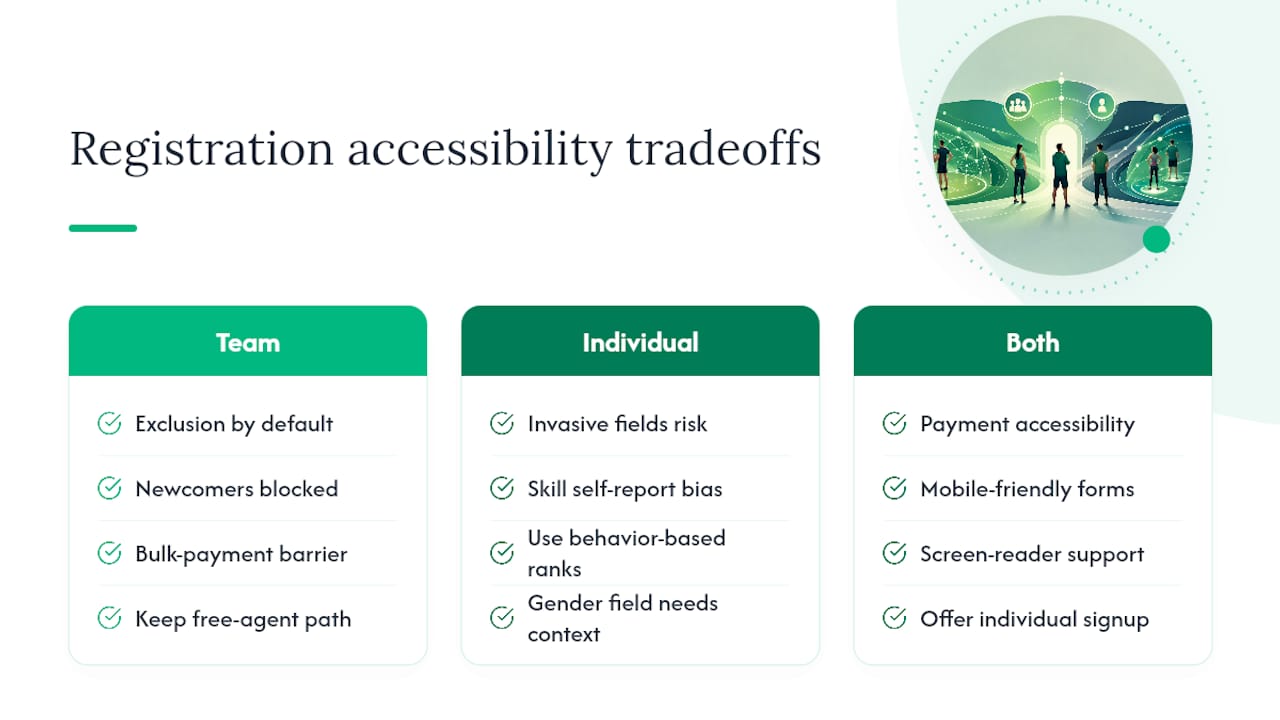
Team registration’s biggest inclusivity risk is exclusion by default. If joining requires already knowing three other players well enough to form a team, newcomers, people who recently moved to the area, or players without an existing social circle simply can’t get in the door. The fix isn’t complicated: always keep an individual or free-agent pathway open alongside team sign-up, even in a league that’s mostly intact teams.
Individual registration’s risk runs the other way. Skill self-reporting, gender fields, and preferred-position questions can feel invasive or exclusionary if they’re not framed carefully. Make skill ranking descriptions concrete and behavior-based (“plays mostly at the baseline,” “comfortable at the net”) rather than vague self-assessments that skew by confidence rather than ability. Gender fields for coed balance should include a way to note a preference or provide context, not just a binary checkbox, since coed leagues serve players with a range of comfort levels and needs.
Payment accessibility matters in both flows. A single bulk payment might work fine for a well-funded corporate team but create a real barrier for four friends splitting a fee unevenly. Individual, per-player payment links solve that for teams too, giving each member the option to pay their own share instead of routing everything through one card. Registration forms should also support screen readers and mobile completion, since a form that only works cleanly on desktop quietly filters out the players who most need a fast, simple sign-up.
Timeline and Communication Expectations for Individual Registrants
Individual registrants operate on a different clock than team members, and treating them the same way creates most of the drop-off organizers see. A team knows its own status the moment the captain hits submit. An individual registrant, by contrast, is waiting to find out whether they even have a spot.
That waiting period needs a published window, not an open-ended “we’ll be in touch.” A two to three week placement timeline gives organizers enough time to run a draft or fill rosters manually, while still giving players a concrete date to plan around instead of checking their inbox anxiously for a month.
Inside that window, silence is the enemy. A weekly update, even a short one confirming “still finalizing rosters, you’re in the pool,” keeps free agents from assuming they’ve been forgotten and quietly signing up for a competing league instead. Once placement happens, the confirmation message should include the team name, captain contact, and first match date immediately, not as a follow-up a few days later.
If a player genuinely can’t be placed, that message needs to go out as soon as you know, not after the season already started. A prompt “no spot available, here’s a refund or waitlist option” preserves goodwill far better than letting someone find out by noticing matches have already begun without them. Organizers who build this communication rhythm into their process consistently see individual registrants come back season after season, since the experience feels organized rather than left to chance.
Impact on Event Logistics and Resource Planning
The registration model you choose ripples straight into court scheduling, staffing, and equipment planning, often in ways organizers don’t anticipate until the season is already underway.
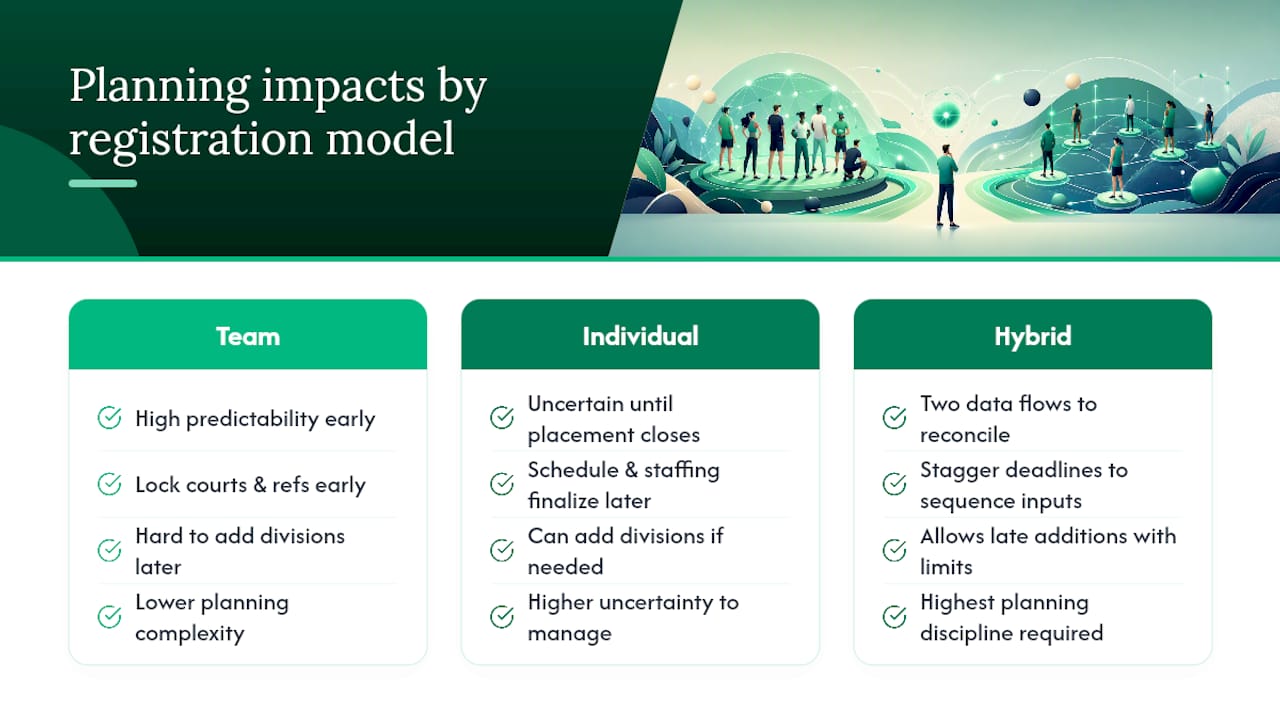
Team registration gives you predictable numbers early. Once a team’s roster code closes, you know exactly how many divisions you’re running and can lock in court time, referee coverage, and match schedules well ahead of the first week. That predictability is one of the strongest arguments for team registration in facilities with limited court availability, where a scheduling mistake means turning players away at the door.
Individual registration introduces more uncertainty right up until placement closes. You can’t finalize divisions until the draft or placement process wraps, which means court bookings and staffing plans sometimes have to wait longer than an organizer would like. The upside is flexibility: if individual sign-ups run higher than expected, you can add a division or extra match slot before rosters lock, something a team-only structure makes much harder mid-cycle.
Hybrid registration demands the most planning discipline, since you’re managing two different data flows feeding into one schedule. A practical fix is staggering your deadlines: close team registration first, since teams typically commit early, then run individual sign-up and placement on a slightly delayed track feeding into whatever divisions still have open slots. That sequencing keeps your court and staffing decisions grounded in real numbers instead of guesses, and it prevents the common trap of overcommitting court time to a division that individual placement later shrinks.
Payment and Refund Policies: Team vs Individual Registrations
Payment structure is one of the clearest places where team and individual registration diverge, and mismatched refund policies are a fast way to generate complaints.
Team registration typically involves a single, larger transaction, whether that’s a flat roster fee or a bulk payment covering every player at once. That concentration cuts both ways. It’s simpler for the organizer to reconcile, but it also means a refund request affects the whole team at once rather than one player. A clear policy on partial refunds, say, what happens if two of eight team members drop before the season starts, prevents a captain from having to negotiate refund logistics on your behalf.
Individual registration spreads payment across many smaller transactions, which is easier to refund cleanly (one player, one fee, one decision) but harder to track in volume. This is where integrated payment processing earns its keep. Platforms with built-in Stripe integration let organizers issue individual refunds without manually calculating who paid what inside a bulk transaction.
Refund timing also needs to differ by scenario, not just by registration type. A team that withdraws before rosters lock deserves a different policy than a free agent who never gets placed at all. In the second case, since the organizer, not the player, failed to deliver a spot, a full refund or automatic waitlist credit is the fair default. Whatever policy you land on, state it plainly at sign-up. Vague refund language is one of the most common sources of disputes once real money is involved, and it’s entirely avoidable with one clear sentence on the registration page.
Pragmatic Rules of Thumb for Organizers
Prioritize participant experience when your league depends on repeat sign-ups, and lean toward administrative simplicity when volume matters more than individual hand-holding. This week: publish your placement window, confirm captain transfer works in your system, and write one clear sentence on play-with policy. Track your placement rate this season and adjust before you open registration again.
— Robert
Set Up Team and Individual Flows With FlexLeague+
Running both registration models by hand, a captain form here, a spreadsheet draft there, is exactly the kind of manual work that eats an organizer’s week before the season even starts. FlexLeague+ handles team flows, individual sign-up, and roster codes inside one system, so you’re not stitching together three separate tools to run one league.
The platform supports singles, doubles, mixed, and FLP team formats, with Stripe handling payment collection for both bulk team fees and individual player fees in the same league. Integration with a skill rating system means skill data collected at individual sign-up feeds directly into fair placement, and automated messaging covers the placement updates that keep free agents from disappearing before the season starts. Captain accounts can be transferred to prevent a dropped captain from putting a whole roster at risk.
If you’re building out registration for an upcoming season, check the FlexLeague+ pickleball league software page to see how the setup maps to your specific mix of teams and free agents.