Under 30 Characters: Pickleball League Team Names That Work
Under 30 Characters: Pickleball League Team Names That Work
Pick a short, distinctive name that fits your team’s tone and won’t get cut off on a scoreboard. Something under 30 characters, easy to say out loud, and easy to print on a shirt. Need it now? Try Dink Slingers, Kitchen Cabinet, Net Ninjas, Smash Bandits, The Ace Ventures, Pickle Rebellion, Volley Llamas, or Third Shot Drop Squad. Fuller lists and the naming rules that make any of these actually work are below.
TL;DR:
- Keep team names under 30 characters and avoid special characters to prevent truncation on scoreboards and registration systems.
- Test the name on mobile screens and ensure it is clear, memorable, and free of trademark conflicts before finalizing.
- Collaborate with the entire team to choose a name through voting, ensuring broad buy-in and stronger team identity.
- Use consistent naming conventions, such as short prefixes and optional date tags, to prevent duplicates and simplify management across divisions.
- Employ league management tools that automatically display team names correctly across all reports, standings, and receipts to streamline registration and scoring.
Table of Contents
- Ready-to-Use Pickleball Team Name Ideas by Vibe
- How Do You Come Up With an Original Team Name?
- What Naming Rules Should Leagues Actually Enforce?
- Big Name Bank: Categorized Options for Every Kind of Team
- Choosing and Locking In Your Team Name
- What Tools Help You Manage Names Once You’re Registered?
- Should You Let the Whole Team Vote on the Name?
- The Naming Advice Nobody Follows (But Should)
- Run Your League Without the Naming Headaches
- Sources
Ready-to-Use Pickleball Team Name Ideas by Vibe
Not every team wants the same energy, so browse by category instead of scrolling one giant list. A recreational Tuesday-night group and a competitive 4.0 ladder team should probably not pick the same name.
Funny (built for a laugh at check-in):
- Pickle Me Timbers
- Dinks for Days
- Net Results
- Aging Gracelessly
- Serve’s Up, Buttercup
- Faulty Towers
Punny (wordplay that doubles as a conversation starter):
- Dink or Swim
- Let’s Dill With It
- Pickled Pink
- Kitchen Confidential
- Baseline Bandits
Competitive (for teams that want to sound like a threat):
- Iron Paddle
- No Mercy Pickleball
- The Enforcers
- Rally Assassins
- Blitz Paddle Club
One-word (short, punchy, prints clean on a jersey):
- Smashers
- Ricochet
- Vortex
- Reckless
Doubles/mixed (built for two-person chemistry):
- Dynamic Dinkers
- Court Chemistry
- The Power Couple
- Mixed Signals
Classic (simple, timeless, easy to say over a PA system):
- Paddle Pushers
- The Net Setters
- Court Crusaders
Most leagues let you browse curated banks like this before committing, and organized name lists grouped by tone are exactly what most searchers are hunting for when they land on a naming guide.
How Do You Come Up With an Original Team Name?
If nothing on a list feels right, build your own using one of six approaches that actually work in practice, not just in theory.
- Pun on pickleball vocabulary. Twist terms like “dink,” “kitchen,” “rally,” or “fault” into wordplay. Examples: Dink Floyd, Kitchen Nightmares, Rally Point.
- Alliteration. Repeating consonant sounds makes a name stick. Examples: Paddle Pirates, Smash Squad, Volley Vipers.
- Pop culture twist. Bend a movie, show, or band name toward pickleball. Examples: Game of Dinks, Paddle Wars, Guardians of the Kitchen.
- Geographic identity. Tie the name to your city, park, or court number. Examples: Riverside Ringers, Court 3 Crew, Northside Netters.
- Intimidation factor. Lean aggressive if your league skews competitive. Examples: The Hammer, No Fault Zone, Death by Dink.
- Tone match. Decide first whether your team is silly, serious, or somewhere between, then pick words that match that register instead of forcing a joke onto a serious roster.
Rules of thumb across all six: keep it short enough to read at a glance, say it out loud before you commit (if you stumble on it, so will your announcer), and skip anything tied to a copyrighted franchise, a real brand, or a public figure. A name that’s funny in a group chat can land very differently printed on a jersey in front of strangers, so run it past a few outside opinions first.
Pro Tip: Google your shortlist before you register. A five-second search catches trademark conflicts and lets you know if three other teams in your region already picked “Dink or Swim.”
What Naming Rules Should Leagues Actually Enforce?
Most naming disasters aren’t about taste. They’re about a name that looks great on paper and then gets chopped in half on a scoreboard or registration screen.
Digital displays and league apps typically truncate long strings, so Microsoft’s naming guidance recommends keeping identifiers under roughly 30 to 36 characters to avoid getting cut off in interfaces like live scoreboards or standings pages. That advice was built for workplace software, but the underlying problem, limited display space, applies just as directly to a pickleball league app.
A few practical rules follow from that:
- Avoid special characters like
& % # @ !that some registration systems reject or render inconsistently. - Stick to spaces, dashes, or underscores as safe delimiters between words.
- Test the name on a phone screen, not just a laptop, since mobile scoreboards crop more aggressively.
- Skip emojis entirely; most league software strips them or displays a broken character.
If your league runs many teams across multiple divisions, OSU’s naming convention documentation offers a useful template: a short prefix (division or season), then the team name, then an optional date tag. A team called “Fall26.Net Ninjas” sorts cleanly and avoids collisions with another “Net Ninjas” three divisions over.
Big Name Bank: Categorized Options for Every Kind of Team
A large browsing list beats a short one when you’re stuck, so here’s a wider catalog split by the type of team you’re actually building.
Funny teams work when the group prioritizes fun over rankings: Pickle Punchers, Net Losses, Aging Like Fine Wine, Faulty Intelligence.
Pun-based names reward players who like wordplay: Let It Rip City, Dinking Around, Serve and Volley Forever, Kitchen Sink or Swim.
Clever names aim for a smarter laugh, not the loudest one: Court Jesters, Split Decision, The Fault Line, Rally Cry.
Competitive names suit ladder or tournament play where intimidation has some value: Relentless Paddle, No Fault Found, The Closers, Iron Curtain Pickleball.
One-word names print cleanest and read fastest on a jersey: Reckoning, Precision, Havoc, Ricochet.
Women’s team names often lean into confidence and humor together: Dink Divas, Serve Sisters, Paddle Queens, Court Royalty.
Men’s team names frequently go blunt or self-deprecating: The Old Guys, No Regrets Pickleball, Paddle Bros, Fault Line Fellas.
Mixed doubles names work best when they nod to partnership: Perfect Pair, Two-Way Street, Balanced Attack, Split the Difference.
Senior league names land well with a wink at age: Slow and Steady, Retired but Fired Up, Golden Years Paddle Club, Still Got It.
Browse across these categories rather than committing to the first funny option you see. A name that feels perfect at 9 p.m. in a group text sometimes reads differently once it’s on a roster page next to fifteen other serious-sounding teams.
Choosing and Locking In Your Team Name
A good name is only useful once it survives contact with your league’s actual systems, so run it through a short checklist before it’s final.
- Tone check. Does it match how competitive your team actually is, not how competitive you wish you were?
- Duplication check. Search your league’s roster and any regional pickleball groups to confirm nobody else already claimed it.
- Technical check. Confirm it’s under the character limit and free of special characters that could break registration or scoreboard display.
- Trademark and offense check. Rule out copyrighted references and anything that could reasonably offend another team or a league official.
- Team buy-in. Get a thumbs-up from everyone who’ll wear the name on a jersey, not just the person who thought of it.
For rollout timing, finalize the name at least a week before registration closes so there’s room to reprint apparel orders if something falls through. Reserve the name in your league’s system as soon as it’s approved rather than waiting until the season starts.
Pro Tip: Reserve your name in the league platform the moment your group agrees on it. Names get claimed fast once registration opens, and nothing kills team morale faster than losing your first choice to another squad that moved quicker.
What Tools Help You Manage Names Once You’re Registered?
Picking the name is the easy part. Making it show up correctly across registration forms, standings pages, and payment records is where a lot of leagues stumble.
FlexLeague+ handles that end: team registration, roster management, live standings, and DUPR-compatible score reporting all display the name you register consistently across every screen. Stripe-powered payments mean your team’s registration fee gets collected under that same name without a separate spreadsheet to manage. Organizers running larger leagues can walk through the step-by-step registration guide for a clearer picture of how names, divisions, and rosters connect on the back end.
A quick author note: the most common naming pitfall isn’t a bad name, it’s a good name nobody checked against the character limit or the league’s blocked-word list until the week before playoffs. Catch that early and the rest takes care of itself.
Should You Let the Whole Team Vote on the Name?
Yes, and skipping this step is the fastest way to end up with a name half the roster resents wearing. A team name works best as a shared decision rather than one captain’s idea handed down to everyone else.
Start with a quick brainstorm session, in person or in a group chat, where everyone throws out two or three ideas without judgment. Volume matters more than quality at this stage; you’re trying to surface options nobody would’ve thought of alone. Once you’ve got a pile of ten or fifteen names, narrow it down with a simple vote rather than a debate. A private poll tends to work better than an open discussion, since people are more honest about which name they actually like versus which one they feel obligated to praise out loud.
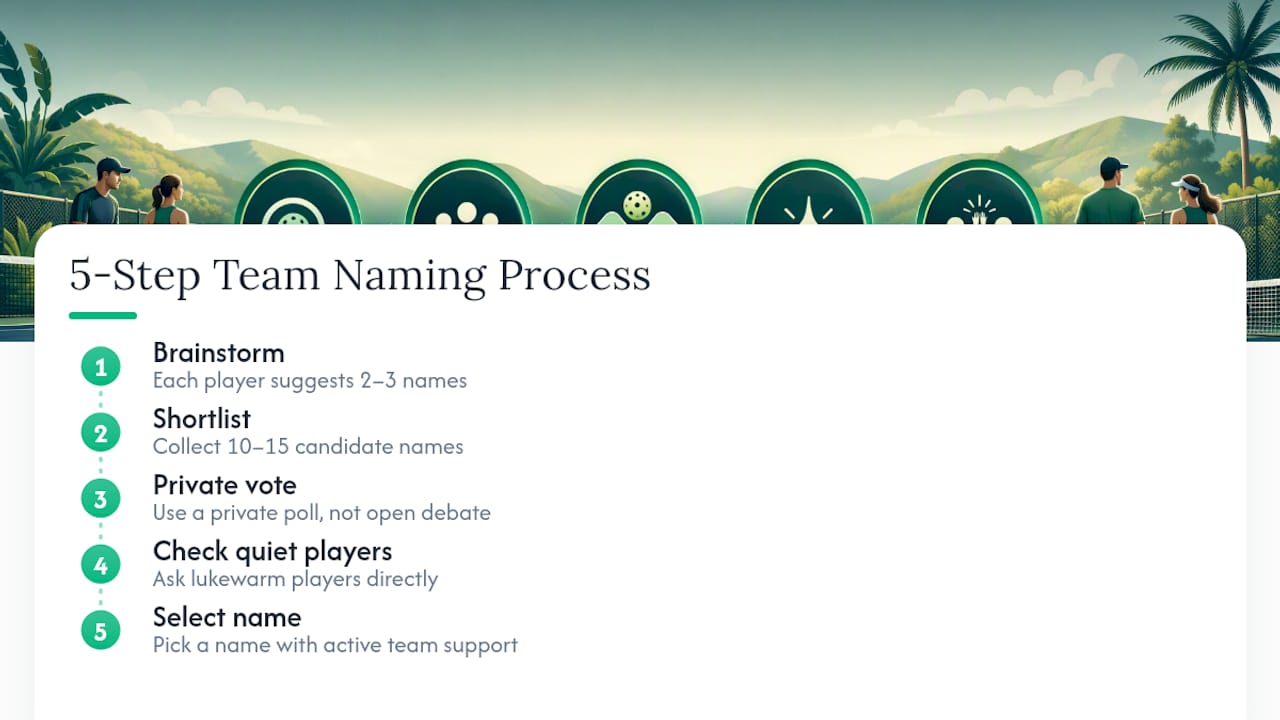
Pay attention to who stays quiet during this process. If one or two players seem lukewarm on the front-runner, ask directly instead of assuming they’ll come around. A name that 80% of the team loves and 20% tolerates is a weaker foundation than one everyone actively chose.
The payoff extends past the name itself. Teams that pick a name together tend to show up with more energy for that first match, because the identity feels earned rather than assigned. That’s a small thing, but it compounds over a season, especially for recreational teams where morale does more work than raw skill.
The Naming Advice Nobody Follows (But Should)
Most naming guides hand you a list and call it done. That’s half the job. The list gets you excited; it doesn’t stop your team name from getting truncated on a scoreboard three weeks into the season, or discovering mid-registration that another team in your division already claimed it.
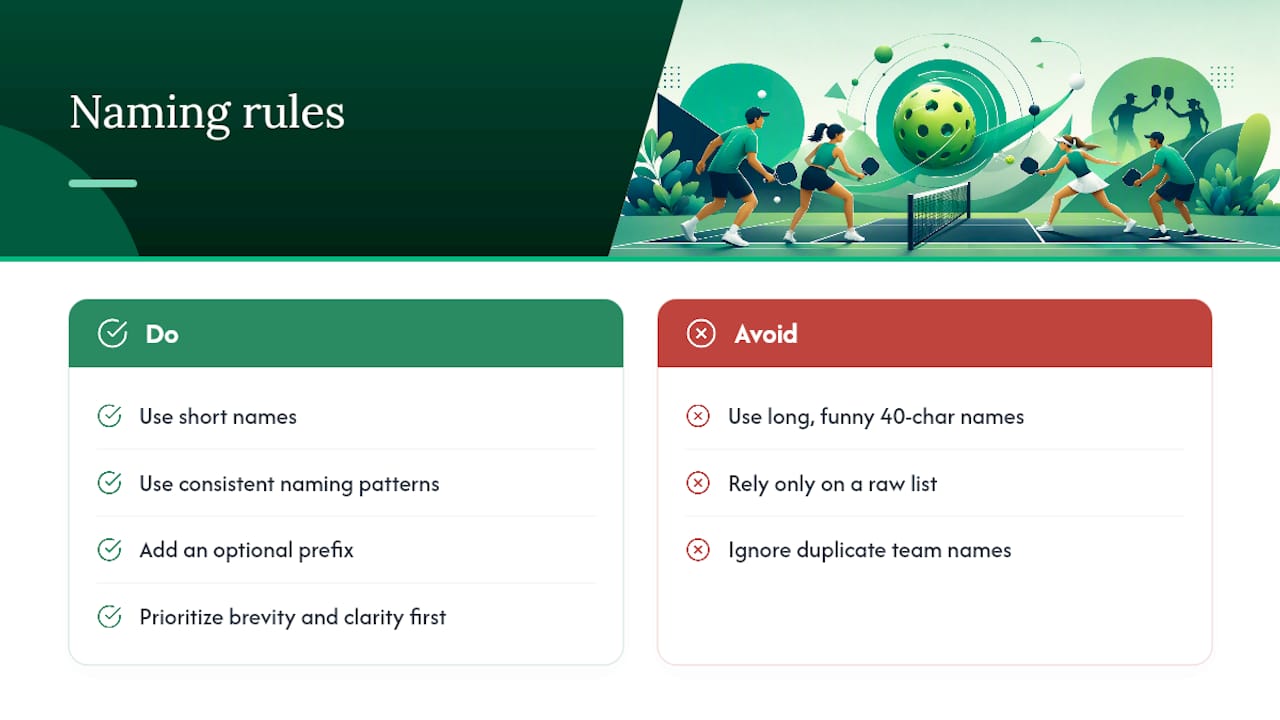
The naming-convention research from places like OSU wasn’t written with pickleball in mind, but it solves a problem every league organizer eventually hits: too many teams, not enough structure, and names that stop being distinguishable once you’ve got forty of them in a spreadsheet. Borrowing that discipline, short names, consistent patterns, an optional prefix, saves real administrative headaches later.
Where I’d push back on conventional wisdom: the internet’s obsession with “the funniest pickleball name” undersells how much a name’s practical survivability matters. A hilarious 40-character name that gets clipped to gibberish on a scoreboard isn’t clever, it’s a liability. Prioritize brevity and clarity first, then let personality follow inside those constraints. The best names on any list do both at once.
— Robert
Run Your League Without the Naming Headaches
Once your team lands on a name, the real test is whether it actually shows up right everywhere it needs to, registration forms, live standings, payment receipts, without someone manually re-entering it three times. That’s the gap most league tools leave open, and it’s the one FlexLeague+ was built to close.
FlexLeague+ lets organizers set up singles, doubles, mixed, or full FLP team leagues with registration, automated scheduling, and DUPR-compatible score reporting all tied to the names teams actually submit. Payments run through Stripe, so a team’s registration fee and its name land in the same system without a spreadsheet bridging the gap. If you’re setting up divisions for the first time, the pickleball league software overview walks through how team names carry across standings, brackets, and rosters without reformatting at every stage. Once names are locked, teams often move on to apparel decisions, and team spirit wear ideas are worth a look before jerseys go to print.
Ready to get your teams registered and your season scheduled? Set up your league on FlexLeague+ and see how quickly a name goes from group chat decision to live scoreboard entry.
Sources
- Microsoft Docs — guidance on naming limits and naming policy
- OSU — Microsoft Teams naming convention guidelines