Pickleball Organizers: Four Line Team League Scoring, DreamBreaker, DUPR
Pickleball Organizers: Four Line Team League Scoring, DreamBreaker, DUPR

Use the four-line dual match format (women’s doubles, men’s doubles, mixed 1, mixed 2), score regular games to 11 with side-out scoring, and break a 2-2 tie with a DreamBreaker to 21 using rally scoring. Map each line result to team points with a simple system like 2/1/0 or one point per line win, publish your tiebreak sequence and score-deadline before week one, and set it all up inside league software like Flex League Plus so lineups, live entry, and DUPR reporting run without spreadsheets.
TL;DR:
- Most leagues use a four-line match format scored to 11 with side-out scoring, and resolve ties with a DreamBreaker to 21 using rally scoring.
- DreamBreaker involves rotating players into a quick, single game, with tiebreakers ordered from head-to-head results to point differential for final resolution.
- Lineup deadlines are typically set 60 minutes before matches, with missed submissions counting as forfeits for that line, and scores entered live or within 48 hours post-match to prevent disputes.
- League scoring methods, such as 2/1/0 points or simple line wins, influence roster strategies and the importance of close wins versus blowouts.
- Organizers should firmly publish rules, enforce deadlines, and use league software to automate scoring, tiebreakers, and results, reducing errors and conflict.
Table of Contents
- What Are the Common Team League Scoring Methods?
- How Do DreamBreaker Tiebreakers Work in Team Leagues?
- How Should Lineups and Match Deadlines Be Set?
- How Should Scores Be Entered and Disputes Handled?
- How Do You Calculate Final Standings?
- What Are Some Simple Scoring Templates to Copy?
- What’s the Fastest Way to Avoid Score Errors?
- How Do You Customize Scoring Rules for Different League Types?
- Does Your Scoring System Change How Teams Build Lineups?
- What Mistakes Do Organizers Make With Team Scoring?
- Author Perspective: Practical Trade-Offs Worth Knowing
- Run Your Scoring Rules Without the Spreadsheet Chaos
- Sources
- FAQ
What Are the Common Team League Scoring Methods?
Most team leagues score results one of four ways, and each one changes how competitive the season feels.
Match wins count how many individual games (or “lines”) a team wins during a matchup, and the team with more lines takes the overall win. Game wins track every game across the season regardless of matchup, useful for leagues that want granular stats. Point differential adds up total points scored versus points allowed, rewarding teams that win big and penalizing teams that lose close. Win percentage simply divides wins by total matches played, which helps rank teams fairly when the schedule is uneven.
- Recreational divisions tend to favor simple match-win counts, since players care more about showing up than parsing a spreadsheet.
- Competitive divisions often add point differential or partial-point systems to reward close losses and separate teams that would otherwise tie.
- Win percentage works best for leagues where teams don’t all play the same number of matches, common in facilities juggling multiple time slots.
The trade-off is straightforward: simpler systems are easier to explain and dispute less, but they can’t distinguish a 4-1 blowout from a 3-2 nail-biter. Pickleball recommends picking one method and locking it before the season starts, not adjusting mid-year.
How Do DreamBreaker Tiebreakers Work in Team Leagues?
DreamBreaker is the tiebreaker format Major League Pickleball uses when a four-line dual match ends 2-2. Instead of replaying a full game, DreamBreaker sends one player from each team’s roster into a rotating, rally-scored game to 21, with players rotating through short segments until the game ends. MLP’s rules treat it as the format’s signature moment, and it’s compact enough to fit into a single time slot without dragging a match past its scheduled window.
Amateur leagues can run a scaled-down version. Require captains to submit a locked four-player rotation order before the final mixed match starts, so nobody can swap in a ringer once the score gets tight.
For a default tiebreak sequence, use this order:
- Head-to-head result between the two teams this season
- Total lines won across all matches
- Total games won within those lines
- Point differential across the season
- DreamBreaker or a short final game if everything above still ties
Decide early whether your tiebreak sequence is a locked preset every division uses or something captains can request changes to. Locking the format is easier to enforce consistently across dozens of teams, while custom tiebreaks only work if your league leadership has the bandwidth to track exceptions.
Pro Tip: Publish your tiebreak sequence in the same document as your match schedule. Captains who see the rules once, in week one, argue about them far less than captains who find out during a tied match in week eight.
How Should Lineups and Match Deadlines Be Set?
A standard team dual runs four lines: women’s doubles, men’s doubles, and two mixed doubles pairings, with rosters typically sized at four to six players to allow substitutions without overloading anyone’s schedule. Most leagues cap how many times a player can appear in mixed doubles per match to prevent one dominant pairing from playing every line.
- Set lineup submission deadlines at 60 minutes before match start, which Pickleball.com’s guide identifies as the standard window most organizers use.
- Make the team captain responsible for building the scoresheet, confirming player eligibility, and submitting the lineup on time.
- Treat a missed deadline as a forfeit for that line, not the whole match, unless your rulebook says otherwise.
- Keep signed paper or digital scoresheets on file for at least the length of your dispute window, since they’re your only proof if a result gets challenged later.
Late arrivals complicate this fast. A common fix: give a grace period of five to ten minutes before defaulting that specific line, rather than the entire matchup, so one late player doesn’t sink four other lineup slots.
How Should Scores Be Entered and Disputes Handled?
Live digital entry, where a captain or scorekeeper enters results on a tablet or phone right after each line finishes, beats paper for one simple reason: standings update automatically and nobody has to retype anything after the fact. When that’s not possible, a photo of the signed scoresheet uploaded to your league platform works as a reliable fallback.
- Set a 48 hour dispute window after scores post, which mirrors what leagues like the Atlanta Team Pickleball League use in their published rules.
- Shrink that window to roughly 2 hours for the final week of the regular season, since playoff seeding can’t wait 48 hours once every team’s schedule is done.
- Require captain confirmation on both sides before a result is marked final, not just one team’s word.
- Post provisional standings immediately after entry, then mark them final only after the dispute window closes.
Pro Tip: Most disputes come from confusion, not bad faith. A visible, provisional standings page that updates in real time cuts complaint volume more than any rule change, because captains can catch a scoring error themselves before it becomes an argument.
How Do You Calculate Final Standings?
Standings math depends on which scoring method you picked, but the mechanics are simple once you commit to one. If you’re using a partial-point system like 2/1/0 per line, add up every team’s points across the season and rank by total. If you’re using straight match wins, count how many dual matches each team won outright.
Here’s a quick example. Team A and Team B split their four lines 2-2 this week. Under a 2/1/0 model with no game-differential bonus, that’s 2 points each for the two team-line wins, so both teams sit tied unless you also weight individual game scores within those lines. That’s exactly the scenario DreamBreaker or your tiebreak sequence exists to resolve.
- Add up season-long line wins first, then apply your published tiebreak order if two or more teams are still level.
- For matches cut short by weather or facility closures, decide in advance whether unfinished lines count as no-contest or get replayed, and put that rule in writing before it happens.
- Time-limited matches (common in facilities running back-to-back time slots) often cap the game at a set score, like 13, if the clock runs out mid-game. Whatever cap you use, apply it the same way across every division.
What Are Some Simple Scoring Templates to Copy?
You don’t need to invent a scoring system from scratch. Two templates cover most team leagues.
- APPL-style 2/1/0: Teams earn 2 points for a line win, 1 point for splitting games within a line, and 0 for a loss, totaled across all lines (often 12 games per matchup in city leagues). This rewards close competition and cuts down on ties, though it takes more math than a straight win/loss count.
- Simple per-line win, 1 point each: Every line win is worth exactly one point, full stop. Recreational leagues favor this because anyone can calculate it in their head.
Quick example: a team wins 3 of 4 lines under the simple model and posts 3 points. Under 2/1/0, that same team might post anywhere from 5 to 6 points depending on how many of those wins were 2-0 sweeps versus split-set wins, which is exactly the kind of gap that triggers a tiebreak review later in the season.
What’s the Fastest Way to Avoid Score Errors?
Most scoring disasters trace back to the same three gaps: no published rules, no enforced deadline, and no record of who confirmed what.
- Before the match: Publish the schedule, confirm both lineups are submitted on time, and make sure your score-entry method (app, tablet, or paper) is ready at the court.
- During the match: Enforce the lineup deadline without exception, enter or confirm each line’s score the moment it finishes, and collect a signed scoresheet as backup.
- After the match: Post provisional standings right away, hold results open through your dispute window, then lock them in as final.
Pro Tip: The captains who cause the fewest problems are the ones who saw your full rulebook before week one, not the ones you’re explaining rules to mid-season.
How Do You Customize Scoring Rules for Different League Types?
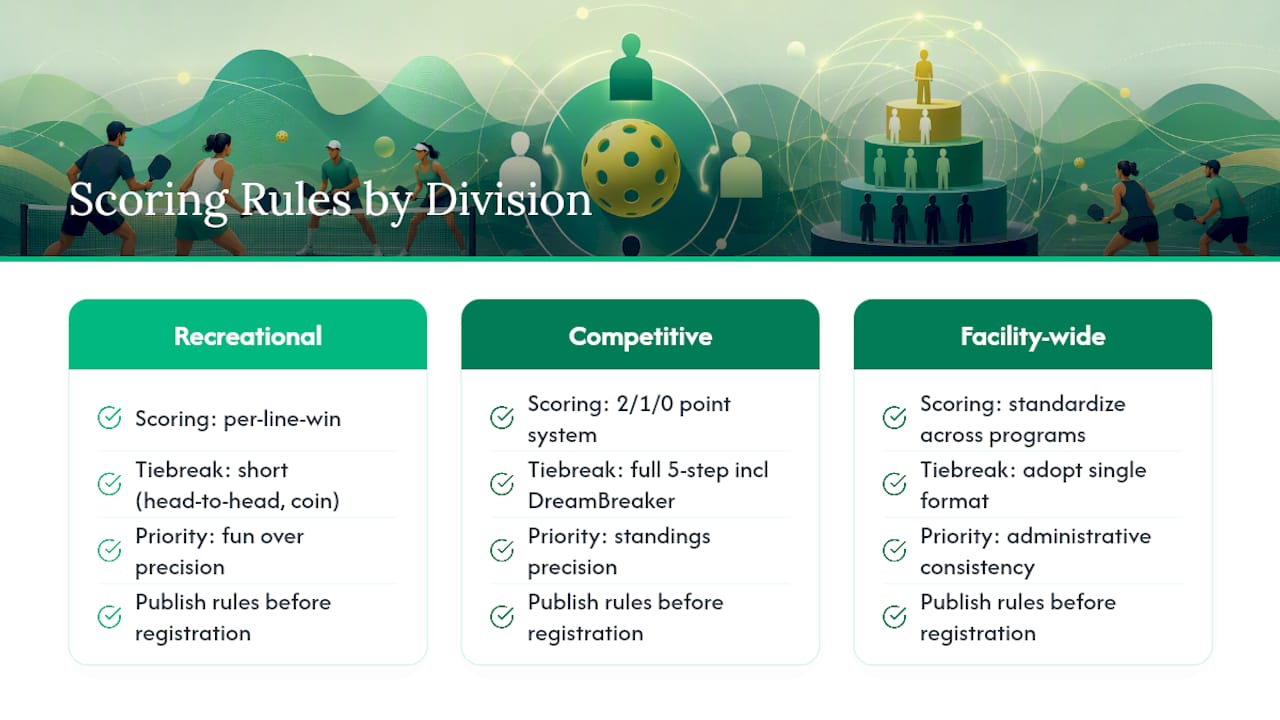
A men’s 55+ recreational league and a competitive mixed division at the same facility shouldn’t necessarily run identical scoring rules, even under one league umbrella. The core structure (four lines, games to 11, tiebreak sequence) can stay consistent for administrative simplicity, but the details underneath it should flex with who’s actually playing.
Recreational divisions generally do better with the simple per-line-win model and a shorter tiebreak sequence, maybe just head-to-head and then a coin flip or short game, because most players there are optimizing for fun over standings precision. Competitive divisions justify the extra complexity of a 2/1/0 point system and a full five-step tiebreak sequence including DreamBreaker, since the players competing for playoff seeding actually care about that half-point difference.
Sport crossover matters too if your facility runs adjacent programs. A club running both pickleball and a rally-scored sport like rally-scoring formats used elsewhere might standardize on rally scoring across the board for consistency, even in pickleball’s traditionally side-out-scored regular games, trading some tradition for administrative ease.
Whatever you customize, write it down separately for each division and distribute it before registration closes, not after the first match gets played. The single biggest customization mistake organizers make isn’t picking the wrong rules. It’s assuming one rulebook fits every division at the facility and only discovering the mismatch when a captain complains.
Does Your Scoring System Change How Teams Build Lineups?
Yes, and this is the part organizers underestimate most. A point-differential or 2/1/0 scoring system pushes captains toward stacking their strongest pairing into whichever line scores the most decisively, because a 2-0 sweep is worth more than a narrow win. A pure match-win system removes that incentive entirely. A blowout and a nail-biter score identically, so captains optimize for winning four close lines instead of dominating one.
DreamBreaker-eligible formats create a different strategic wrinkle. Knowing a 2-2 tie goes to a rotation-based rally game changes how captains build their fourth line. Some captains deliberately save their best doubles pairing for that scenario, betting the match will come down to a tiebreak rather than spreading talent evenly across all four lines.
Mixed doubles rotation limits shape this further. If your rules cap how many times one player can appear in mixed lines, captains have to balance their two strongest mixed players across both mixed slots rather than pairing them together in just one, which usually makes both mixed lines more competitive and less predictable.
None of this is a flaw in any particular scoring method. It’s just a reminder that the system you choose isn’t neutral. It actively shapes the roster decisions your captains make every single week, and organizers who understand that can predict (and sometimes prevent) the lineup complaints that show up later in the season.
What Mistakes Do Organizers Make With Team Scoring?
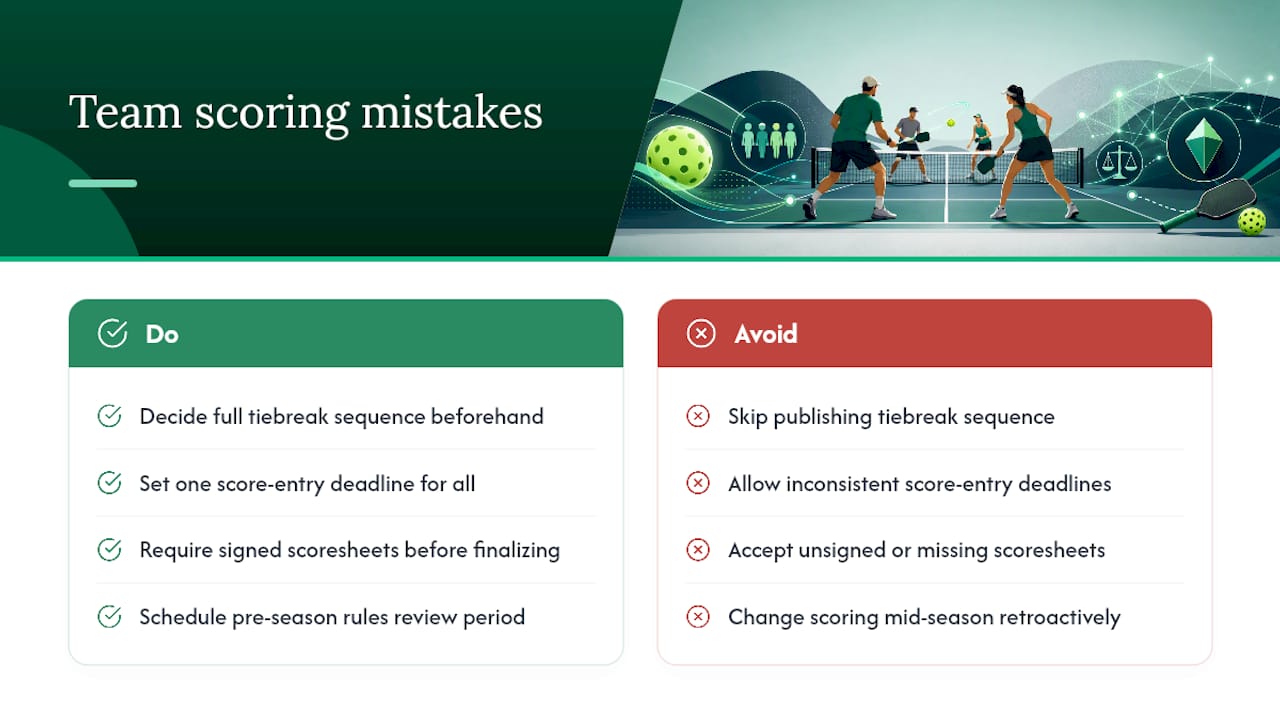
The most common error is publishing match formats but skipping the tiebreak sequence, then scrambling to invent one when two teams tie in week six. Decide the full sequence, including whether you’re using DreamBreaker or a point-differential fallback, before the season starts.
A close second: inconsistent score-entry deadlines. Letting one captain report results two days late while holding another team to same-day entry breeds resentment fast, even when nobody meant any harm by it. Set one deadline, apply it to every team, and only shorten it for final-week matches where playoff seeding depends on quick turnaround.
Unsigned or missing scoresheets cause more disputes than any actual scoring error. When there’s no paper trail, disagreements about what actually happened on line 3 become he-said-she-said arguments with no resolution path. Require a signature, digital or physical, on every scoresheet before it counts as final.
Finally, watch for the “silent rule change” problem: a league that adjusts scoring mid-season because a tiebreak scenario nobody anticipated came up. Even a fair fix, applied retroactively, feels like moving the goalposts to the team it disadvantages. Build in a review period before each season instead of patching rules live.
Author Perspective: Practical Trade-Offs Worth Knowing
Favor clarity over complexity unless your players genuinely expect it. Competitive divisions benefit from DreamBreaker-style tiebreakers because the excitement is real, not manufactured. But the biggest lever isn’t the format you pick. It’s publishing rules early and using league software to enforce them automatically instead of relying on memory.
— Robert
Run Your Scoring Rules Without the Spreadsheet Chaos
Some league software solutions are built for the workflow this article just walked through: configurable match formats, tiebreaker presets you can lock or customize by division, and captain dashboards that make lineup deadlines and score confirmation part of the app instead of a group text thread.

Live score entry updates standings the moment a line finishes, compatible reporting keeps player ratings current without manual uploads, and integrated payment collection handles registration fees so you’re not chasing checks before the season starts. For organizers interested in visualizing playoff progress and standings with analytics tools, consider using Tableau to analyze and visualize the NBA playoffs as a step-by-step guide to enhance your data-driven insights. If you’re running four-line duals with a 2/1/0 point system or planning a DreamBreaker tiebreaker for your competitive division, you can set up those exact rules inside Flex League Plus in less time than it takes to draft a rules PDF. Check out the pickleball league software product page to see how match formats and payment processing work together, or request a demo to walk through your specific scoring setup before your next season opens registration.
Sources
FAQ
What Is the Standard Scoring Format for Team Pickleball Leagues?
Most leagues use a four-line dual match (women’s doubles, men’s doubles, two mixed doubles) scored to 11 with side-out scoring, and a DreamBreaker tiebreaker to 21 with rally scoring if the match ties 2-2.
How Does DreamBreaker Scoring Work?
DreamBreaker activates when a four-line match ties 2-2. Both teams send a rotating four-player lineup into a single rally-scored game to 21, following the same structure Major League Pickleball uses for its tiebreakers.
What’s the Difference Between Match Wins and Point Differential Scoring?
Match wins simply count how many lines a team won, treating every win equally regardless of margin, while point differential tracks total points scored versus allowed to reward decisive wins and penalize close losses.
How Long Should a League Give Teams to Report Scores?
A 48 hour dispute window is common for regular-season matches, with a shortened window of about 2 hours for the final week so playoff seeding can be finalized on time.
Can League Software Handle Tiebreakers and DUPR Reporting Automatically?
Yes. Platforms like Flex League Plus let organizers set configurable tiebreaker presets and submit DUPR-compatible results directly from the app, removing manual score entry and spreadsheet tracking.