Organizers: 4 Ways to Split Pickleball Team Fees Using Stripe RSVPs
Organizers: 4 Ways to Split Pickleball Team Fees Using Stripe RSVPs

Require individual payment at registration or run a platform-controlled pooled wallet with automated payout. Both protect organizers from unpaid balances. RSVP-paid by card wins for reserved-court sessions because it locks in commitment before anyone steps on the court; look for a platform with Stripe processing and DUPR approval as your baseline for trust.
TL;DR:
- Using a platform with automated payout and trust signals like DUPR approval reduces disputes and ensures secure fee collection, especially for competitive leagues.
- For recurring leagues, a pooled wallet managed through a platform with scheduled payouts streamlines payments and improves financial transparency without fronting money.
- Collecting fees upfront via RSVP with Stripe ensures reliable payment confirmation, minimizes late payments, and simplifies enforcement with automatic reminders.
- Small, casual groups can rely on captain-fronted collections, but mixed or drop-in groups benefit from individual, pre-paid sign-ups to avoid administrative headaches.
- Budget for seasonal costs beyond court fees, including equipment and venue variations, to prevent mid-season shortages or surprises.
Table of Contents
- How Do You Split Team Fees for Pickleball?
- Calculating, Collecting, and Enforcing Fees Step by Step
- Choosing Payment Channels Without Losing Money to Fees
- Why Platform Trust Signals Matter for Fee Collection
- Budgeting Beyond the Basic Court Fee
- Resolving Payment Disputes and Late Payments
- Legal and League Rules to Keep in Mind
- Best Practices for Digital Payment Platforms in Pickleball
- An Organizer’s Honest Take on Fee Splitting
- Try Flex League Plus to Run Payments Without the Spreadsheet
- Sources
- FAQ
How Do You Split Team Fees for Pickleball?
There’s no single right way to divide costs, but the method you pick should match your group’s size, trust level, and how much administrative pain you’re willing to absorb. Four models cover almost every situation a captain or league organizer will face.
Captain fronts and collects. One person pays the court reservation or league fee upfront, then chases everyone else via text, Venmo, or cash after the fact. This works fine for a tight group of five regulars who’ve played together for two years and always pay up. It falls apart fast with rotating rosters or drop-in players, because the captain eats the loss when someone ghosts.
Individual registration with paid RSVP. Each player pays their share directly at sign-up, before the session or season starts. This is the model Brunchie recommends for reserved-court groups, since a Stripe Checkout toggle at RSVP time charges players immediately and shows line items before anyone commits. It’s the strongest option when you’re personally on the hook for the court reservation.
Pooled team wallet with platform payout. The organizer sets up a shared wallet inside a management platform, players deposit their share, and the system releases funds to the organizer or league on a set schedule. TeamTab’s model is built exactly this way: players pay their own shares directly, and captains never front money out of pocket. This suits recurring leagues with a season-long cadence rather than one-off pickup games.
Prepaid slots or captain-purchased invites. A captain buys a block of court time or a set number of league slots, then sells or distributes access codes to teammates. It guarantees a seat is held, but it demands upfront capital, so it’s best reserved for travel teams or tournament blocks where seats disappear fast.
Quick rules of thumb:
- Small trusted friend group, casual play: captain-collect is fine.
- Mixed group with strangers or drop-ins: individual paid RSVP.
- Recurring league with weekly sessions: pooled wallet with scheduled payout.
- Travel team or tournament with limited seats: prepaid slots.
Calculating, Collecting, and Enforcing Fees Step by Step
Getting the math right up front kills most disputes before they start. Here’s a working sequence you can copy for your next season.
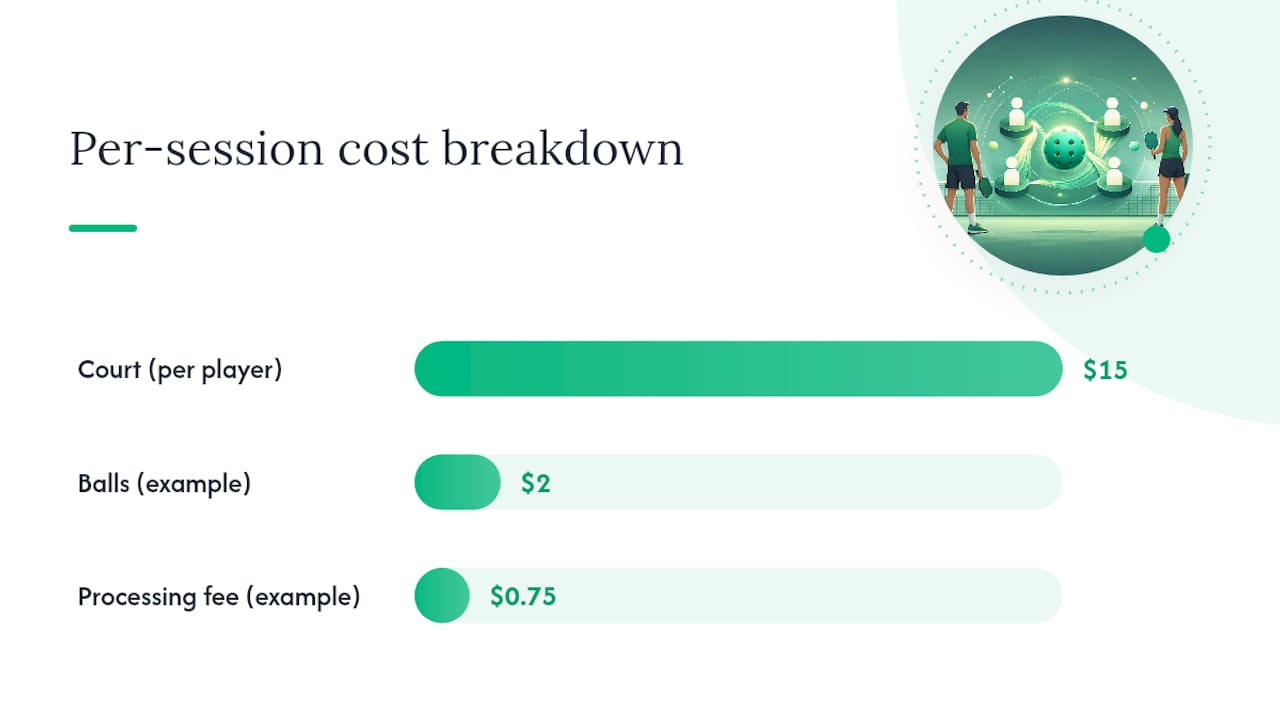
- Calculate the per-player cost. For a single session, divide total cost by confirmed headcount: a $60 court reservation split four ways is $15 per player. Add extras on top, like $8 in balls or a $20 referee fee, then redivide the new total.
- Set a payment deadline. Require payment 48 to 72 hours before the session so you know your real headcount in time to adjust or cancel. For a full season, break the total into two or three installments tied to specific dates rather than asking for one large sum.
- Handle uneven rosters. If a sixth player joins late, prorate their share based on remaining sessions rather than the full season total. Guests or one-time substitutes pay the standard per-session rate, no discount.
- Write a no-show and refund policy before the season starts. A workable version: full refund if canceled 24+ hours ahead, credit toward a future session inside that window, no refund for same-day no-shows unless a substitute is found. Enforce it the same way every time, no exceptions for regulars.
- Communicate the full breakdown up front. Tell players the total cost, any processing fee, the due date, and exactly what “paid” status means inside whatever app or spreadsheet you’re using.
Pro Tip: Send the cost breakdown as a simple line item list, not a lump sum. Players who see “$15 court + $2 balls + $0.75 processing fee = $17.75” argue far less than players who just see “$18.”
A useful enforcement pattern that avoids awkward one-on-one conversations: payment deadline passes, the system auto-marks players as paid or unpaid, a waitlist opens for anyone still unpaid, and a substitute or credit gets applied automatically.
Choosing Payment Channels Without Losing Money to Fees
Your payment channel choice comes down to a tradeoff between convenience and cost, and the right answer depends on how much money moves through your hands each season.
Card payments through Stripe run roughly in the 3% range plus a small fixed fee per transaction, and they’re worth it for the convenience and no-show protection alone. Players pay instantly from their phone, funds settle to a connected account within a couple of business days, and you get a paper trail without lifting a finger.
ACH or bank transfer costs less per transaction but settles slower, sometimes days later. It works well for leagues moving larger seasonal sums where a two or three day delay doesn’t matter, and it’s worth setting up if your league runs ACH payments alongside card options.
Peer-payment apps and cash cost nothing to process but leave almost no paper trail and put the collection burden entirely on you. Reserve these for small, trusted groups where everyone already knows and likes each other.
A few habits separate organizers who never chase money from those who spend every Tuesday texting reminders:
- Issue a receipt or confirmation for every payment, even a $15 one.
- Export payment reports weekly rather than letting a season’s worth of transactions pile up.
- Keep one ledger, whether that’s a spreadsheet or a platform’s built in reporting, and never split records across three different apps.
- Decide up front whether you or the platform absorbs the processing fee, and say so in writing.
Tools like BenchApp build finance tracking directly into team management, which cuts down on the manual chasing that eats up a captain’s Tuesday nights. If your group prefers a model where the platform never holds funds, Court Split generates per-player payment links and shows paid or pending status without a wallet in the middle, which fits casual groups who’d rather settle up peer-to-peer.
Why Platform Trust Signals Matter for Fee Collection
Payment collection only works if players trust the system holding their money. Two signals matter more than any feature list: whether the platform integrates with a recognized processor, and whether it carries any third-party approval that vouches for fair play.
Flex League Plus runs on Stripe for payment processing and carries DUPR approval, which matters for competitive leagues where rating integrity and payment integrity both need to hold up. The platform supports singles, men’s doubles, women’s doubles, mixed doubles, and FLP team formats, so a captain running a mixed doubles ladder and a league director running a full team season can use the same registration and payment flow.
Organizers who move fee collection off spreadsheets and group texts and onto a platform with built-in payment processing consistently report fewer disputes over who paid and who didn’t, simply because the record is automatic rather than remembered.
For step-by-step setup on the registration side, the pickleball league registration guide walks through fee collection and team joining in more detail than fits here.
Budgeting Beyond the Basic Court Fee
Court time is rarely the only cost a team carries, and the teams that get blindsided mid-season are usually the ones that never budgeted for anything else. Balls alone add up: a sleeve of quality outdoor balls runs through fast on hard courts, and most teams underestimate how often they need to restock.
Build a simple seasonal budget with four categories: court or venue fees, equipment (balls, paddles for anyone borrowing gear, first-aid basics), referee or tournament sanctioning costs if you’re running anything competitive, and a small buffer for the unexpected, like a rained-out session that still owes a facility fee.

Collect the equipment and buffer portion once per season rather than session by session. Nickel-and-diming players for an extra dollar every week for balls generates more complaints than a single $15 season equipment fee collected up front. If you’re new to the sport’s gear requirements, a primer like Play On Pickle’s guide to essential fitness and gear helps set realistic expectations for what a team actually needs versus what’s optional.
Venue costs also shift seasonally. Outdoor courts might be free or cheap through a parks department in summer, then you’re paying premium indoor rates come winter. Budget for the higher rate rather than getting caught assuming last month’s price holds all season.
Resolving Payment Disputes and Late Payments
Most disputes trace back to unclear expectations, not bad faith. The fix starts before money changes hands: put the total cost, due date, and refund policy in writing and send it to every player, not just team leads, before the season starts.
When a payment is late, a three-step escalation keeps things calm. First, an automated reminder at the deadline, which a platform handles without you sending a single text. Second, a personal follow-up 24 to 48 hours later if the automated nudge doesn’t work. Third, apply the stated policy consistently: waitlist their spot, offer a payment plan for larger season fees, or drop them to substitute status if the deadline has clearly passed.
Genuine disputes, where a player insists they paid or disputes the amount owed, need a paper trail more than a policy. This is where platform-based payment records beat cash or informal Venmo requests every time. A payment report showing exact timestamps and amounts ends most “I already paid” conversations in seconds, because either the record exists or it doesn’t.
For recurring late-payers, the fairest fix is usually structural rather than personal. Move that player to pay-per-session instead of season billing, or require payment before they’re added to any future roster. That removes the awkward confrontation and replaces it with a policy everyone already agreed to.
Keep venue liability in mind here too. If you’ve personally guaranteed a court reservation, a player’s late payment doesn’t excuse you from paying the facility. That’s exactly why fee-required RSVP before the session, as Brunchie documents, matters more for reserved-court organizers than for pickup games where no one’s individually on the hook.
Legal and League Rules to Keep in Mind
Splitting fees isn’t heavily regulated for casual recreational play, but a few practical considerations still apply once real money and repeat commitments are involved. If you’re collecting fees on behalf of a parks department, YMCA, or other facility, check whether that organization requires fees to run through their own registration system rather than a captain’s personal account. Many public facilities have rules against private individuals collecting money for use of public courts.
If your league operates as a nonprofit or club with a treasurer, fee collection likely needs to route through that entity’s accounts for tax and liability reasons, not through an individual’s Stripe or Venmo account. This matters more as league fees scale into thousands of dollars a season, where personal accounts start raising real accounting and liability questions.
Refund and cancellation policies should be written down and shared before anyone pays, not improvised after a dispute. A clear, consistently applied policy protects the organizer as much as the player, since “I didn’t know” is a much stronger complaint than “I disagreed with a policy I’d already seen in writing.”
Finally, if you’re using a platform to process payments, understand who technically holds the funds and when payout happens. Platforms that route payments through Stripe typically deliver payouts to a connected account within a couple of business days rather than holding funds indefinitely, which matters if you need to pay a venue immediately after collecting fees.
Best Practices for Digital Payment Platforms in Pickleball
The best digital payment setup for a pickleball team does three things well: it collects money before commitment risk kicks in, it tracks who’s paid without manual spreadsheet work, and it hands you a clean report when you need one.
Start by matching the platform to your group size. A five-person weekly pickup game doesn’t need the same infrastructure as a 40-player league running four divisions. Smaller groups do fine with lightweight tracking tools; full leagues benefit from a platform built around registration, scheduling, and payment in one system.
Set your payment window at registration, not at check-in. Collecting money the moment someone signs up, rather than at the court, removes the awkward in-person cash exchange and gives you a real headcount days in advance.
Reconcile weekly, not monthly. A quick five-minute check of who’s paid versus who’s registered catches problems while they’re still easy to fix, rather than discovering a $200 shortfall at season’s end.
Keep processing fees transparent. Decide once whether players see the fee as a line item or whether the team absorbs it into the base price, then apply that decision consistently across every session so nobody feels singled out.
And don’t mix systems mid-season. Switching from Venmo to a platform wallet halfway through creates confusion about who’s paid under which system. Pick one channel before the season starts and stick with it.
An Organizer’s Honest Take on Fee Splitting
Most advice on splitting pickleball fees treats it as a math problem. It isn’t. It’s a trust problem that math happens to solve. The captain-collect model fails not because the arithmetic is hard but because it puts one person in the position of enforcer, debt collector, and friend all at once, and that role burns people out faster than any spreadsheet error ever will.
The overrated fix is manual tracking discipline, telling captains to just “be more organized” with a shared spreadsheet. That advice ignores that spreadsheets don’t send reminders, don’t process payments, and don’t produce a receipt when someone claims they already paid. The underrated fix is removing the human from the collection loop entirely: RSVP-paid workflows through Stripe do the enforcing so the captain doesn’t have to.
If you take one thing from this, prioritize payment timing over payment method. Collect before the session, not after, and most of the disputes covered above never happen in the first place.
— Robert
Try Flex League Plus to Run Payments Without the Spreadsheet
Flex League Plus is the alternative to running your league on spreadsheets and group texts. Every workflow described above, RSVP-paid registration, per-division splits, uneven roster proration, gets handled inside one platform instead of stitched together across five apps.
The platform charges a flat $25 one-time platform fee per division, with no monthly subscription tying you down, and it supports singles, men’s and women’s doubles, mixed doubles, and full FLP team formats. Payments run through Stripe, so players pay by card at registration and you get automatic payout without chasing a single Venmo request. DUPR approval means the same system handling your money also handles verified ratings, so competitive integrity and payment integrity sit in one place instead of two.
If you’re setting up a season right now, start by reviewing the pickleball league software overview to see how registration, scheduling, and Stripe payments fit together, then check current platform pricing before your next signup window opens.
Sources
- How to Collect Court Fees from Players — Brunchie
- Modernizing how teams pay leagues — TeamTab
- Free Pickleball Group Management App | BenchApp
- Court Split — run your group, or find a game
FAQ
What Is the Best Way to Split Pickleball Team Fees?
Individual paid RSVP at registration is generally the safest default, since each player pays their own share before the session and the organizer never fronts money. For recurring leagues, a platform-managed pooled wallet with scheduled payout works just as well and centralizes reporting.
How Do You Calculate Per-Player Court Costs?
Divide the total cost by confirmed headcount: a $60 reservation split among four players comes to $15 each. Add any extras like balls or referee fees to the total before redividing, and reprorate if players join or drop late in the season.
Does Flex League Plus Charge a Monthly Fee?
No. Flex League Plus charges a $25 one-time platform fee per division rather than a recurring monthly subscription, and payments to players run through Stripe.
What Happens When a Player Doesn’t Pay on Time?
An automated reminder should fire at the payment deadline, followed by a personal follow-up within 24 to 48 hours if needed. If the deadline passes without payment, the stated policy, whether that’s waitlisting the spot or requiring pay-per-session going forward, should apply consistently.
Is DUPR Approval Important for a Payment Platform?
DUPR approval itself is about rating integrity, not payment processing, but it signals that a platform meets a recognized standard for competitive play. Combined with Stripe integration, it gives organizers one system that handles both fair competition and reliable fee collection.