Round Robin Pickleball League: An Organizer's Guide
Round Robin Pickleball League: An Organizer’s Guide
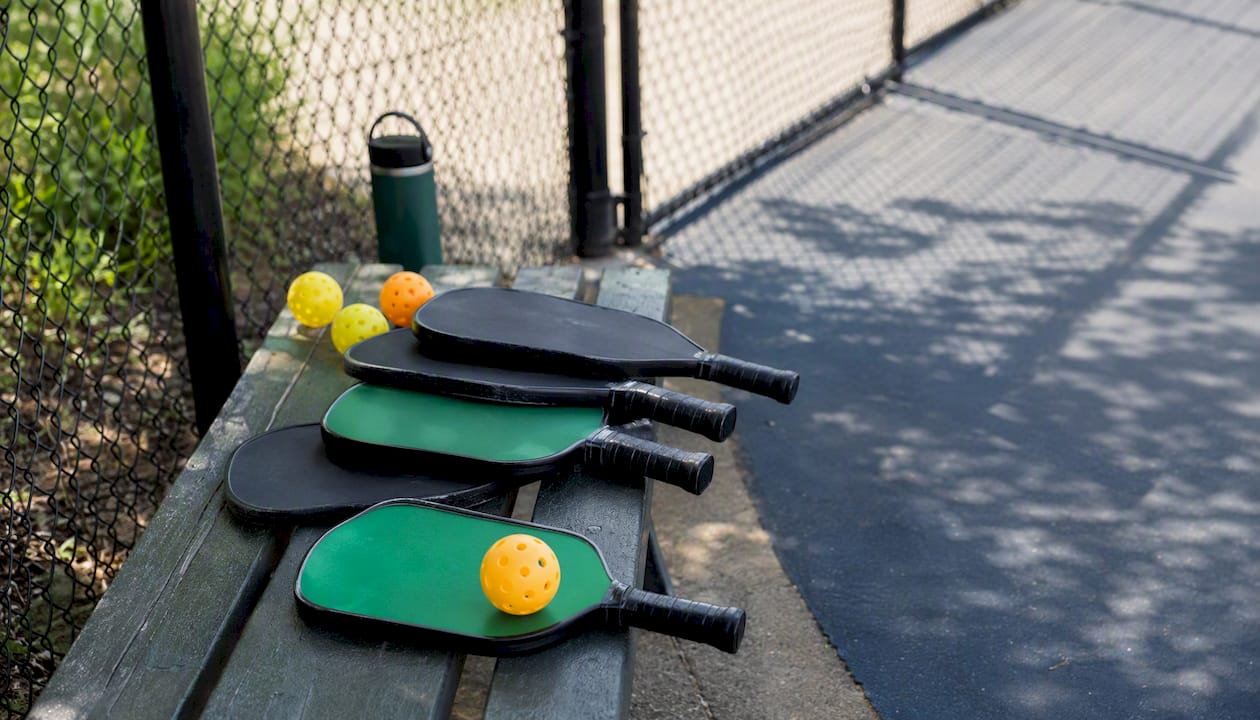
A round robin pickleball league guarantees every player faces every other player or team, with standings built on cumulative wins rather than single-elimination brackets. That structure makes it the default choice for club nights, social mixers, and season-long formats where nobody wants to drive across town for one 15-minute match.
The format works because it solves a specific problem: nobody likes losing once and going home. A round robin spreads risk across multiple games, so a bad first set doesn’t end your night. It also produces cleaner standings for league play, since a full slate of matchups tells you more about a player’s real level than a three-game bracket run.
Here’s where round robins fit best:
- Social mixers and club nights: everyone plays, everyone rotates partners, nobody sits out for an hour.
- Season-long leagues: weekly round robins feed into cumulative standings, similar to how a box league structures short sessions across a longer season.
- Group-stage play in larger tournaments: round robin pools seed players into playoff brackets after preliminary matches.
For a field of eight players, the format guarantees a total number of matches based on the formula total matches equals N times (N minus one) divided by two. At typical match durations of 15 to 20 minutes per rally-scored game, the total event length increases quickly, which is why organizers often split into pools once the field gets larger. USA Pickleball sets the rules organizers should follow for scoring and match structure, and DUPR ratings give you a fair way to group players before a single ball gets served. Tools like FlexLeague+ exist specifically to handle that math and grouping automatically, which matters once you’re running this more than once.
Key Takeaways
A round robin pickleball league works best when organizers match the format to player count and skill spread, then automate scheduling and scoring to eliminate the manual errors that cause most event breakdowns.
| Point | Details |
|---|---|
| Pick the right variant | Match format to your goal: rotating-partner for social nights, fixed-team pools for competitive leagues. |
| Group by DUPR band | Keep skill spread within roughly 0.5 DUPR to avoid one-sided matches and player frustration. |
| Confirm courts and timing | Calculate total rounds against your venue window before opening registration. |
| Publish clear tiebreakers | Use head-to-head, then point differential, then common-opponent points, in that order. |
| Automate the repetitive tasks | FlexLeague+ generates schedules, imports DUPR ratings, and processes registration payments through Stripe. |
Primary Sources and Further Reading
- Round-robin tournament — Wikipedia: the foundational definition and match-count logic behind every format in this guide.
- USA Pickleball: the authority to consult for official scoring rules and sanctioned-event requirements.
- SMPC Round Robin Rules and FAQ: a real club rules template worth adapting for your own registration page.
- Round Robin Play — Bend Pickleball Club: a practical, community-club perspective on running rotating-partner sessions.
- BracketDraw’s Pickleball Round Robin Generator: useful for the circle-method rotation logic and match-duration math behind your timeline planning.
Consult the club rules pages for language you can copy directly into your event page, USA Pickleball for anything touching official scoring disputes, and the scheduling generators for rotation templates once you’re ready to build your first schedule.
Table of Contents
- What Are the Main Round Robin Pickleball League Formats?
- How Do You Plan and Set Up a Round Robin Pickleball League?
- How Does Rotation Work in a Round Robin Pickleball League?
- How Are Winners Decided in a Round Robin Pickleball League?
- What Rules Should a Round Robin Pickleball League Publish?
- Why Use Software Instead of Running a League by Hand?
- What Do Experienced Organizers Say Actually Breaks Round Robins?
- How Do You Keep a Round Robin Safe and Sportsmanlike?
- An Organizer’s Note on Running Round Robins Well
- How FlexLeague+ Automates Round Robin League Management
- Sources
What Are the Main Round Robin Pickleball League Formats?
Not every round robin looks the same, and picking the wrong variant for your group size or skill spread is the single most common planning mistake. The right format depends on three things: how many players you have, whether you want fixed partnerships or rotating ones, and how competitive versus social the event needs to feel.
Here’s a breakdown of the formats you’ll actually encounter:
- Individual round robin: every player rotates through different partners and opponents each round. Best for social nights and mixers where meeting new players matters as much as the score.
- Fixed doubles teams: two players stay paired for the entire event and face a new team each round. This suits competitive league play where partnership chemistry is part of the strategy.
- Rotating-partner mixer: similar to individual round robin but structured so nobody repeats a partner until everyone has played with everyone else once, which the Bend Pickleball Club uses as a core format for its social sessions.
- Pool-based round robin: players split into smaller groups of 4 to 8 based on skill level, each pool runs its own complete round robin, and top finishers may cross over into a short playoff.
- Americano and box-style variants: shorter matches, frequent partner and opponent changes, and points often carried individually rather than by team, which keeps energy high in social settings.
- Gauntlet and popcorn formats: winners stay on court and rotate through new challengers, which works well for drop-in play but produces less balanced match counts than a true round robin.
When to pick each one: social clubs and casual mixers lean toward rotating-partner or Americano styles because they maximize interaction. Competitive leagues and ladder replacements lean toward fixed-team pool-based round robins because consistent partnerships let you track real performance over a season.
Skill spread matters more than most organizers expect. A common rule among clubs is grouping players within a 0.5 DUPR band, which the guidance from RIPL Pickleball backs up as a way to keep matches from turning into blowouts. A 3.0 player and a 4.0 player in the same pool almost never produces a competitive game, and that’s frustrating for both sides.
How Do You Plan and Set Up a Round Robin Pickleball League?
Planning starts with courts and player count, not registration forms. Everything downstream (how many rounds you can fit, how long the event runs, whether you need multiple pools) flows from those two numbers.
Work through this checklist before you open registration:
- Confirm venue hours and how many courts are reserved for the block of time.
- Decide match format: single games to 11, or best-of-three for a more competitive event.
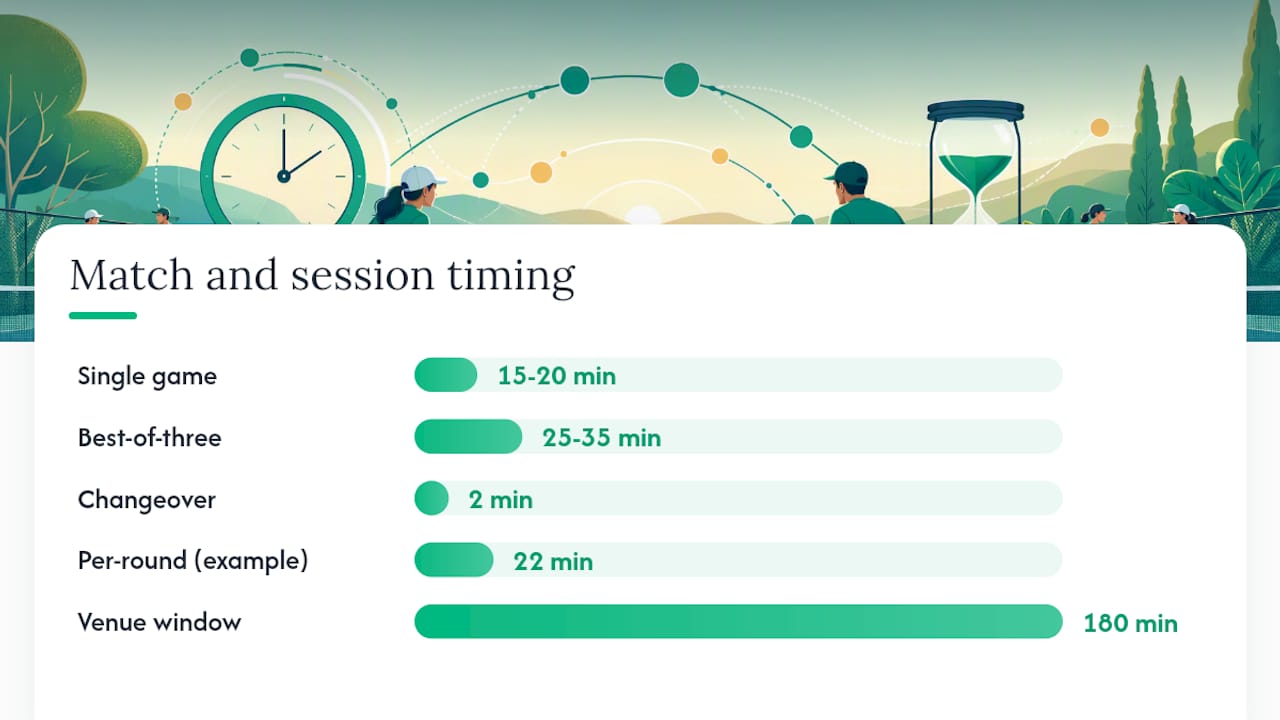
- Estimate match length: 15 to 20 minutes for a single rally-scored game, 25 to 35 minutes for best-of-three, based on duration guidance from BracketDraw’s scheduling data.
- Calculate total rounds needed and confirm they fit inside your venue window, including a warm-up period and buffer time.
- Set a hard finish time and build in at least one break for longer sessions.
Your registration form should collect enough information to actually run the event, not just to count heads. Include these fields at minimum:
- Full name and contact information.
- DUPR rating or self-reported skill level (numeric rating beats “intermediate” every time).
- Preferred partner, if the format allows partner requests.
- Payment confirmation, ideally collected online rather than at check-in.
- Liability waiver acknowledgment.
- Availability window, especially for leagues running across multiple dates.
Working the math backward helps you catch problems before they happen. Say you have 16 players, four courts, and a three-hour window. At roughly 20 minutes per game plus a two-minute changeover, you get about 22 minutes per round. Three hours gives you roughly eight rounds. If your format needs more matches than that to guarantee every player faces every other player, you split into two pools of eight and run parallel round robins instead of one massive single pool. That’s the quick mental checklist: if total required rounds exceeds available time slots, split the field.
On timing, announce the event at least two to three weeks out for anything requiring preregistration and payment. Close registration 48 hours before the event so you have time to build divisions and generate a schedule. Send the finalized schedule to players the night before or morning of, so nobody shows up guessing which court they’re on.
How Does Rotation Work in a Round Robin Pickleball League?
The circle method, sometimes called a Berger table, is the standard way to guarantee every player faces every other player exactly once without manual guesswork. One player stays fixed in position while everyone else rotates around them like spokes on a wheel, and after N minus 1 rounds (for an even number of players), every possible pairing has occurred.
For odd-numbered fields, one player sits out each round on a rotating bye, which keeps the math clean even when your headcount doesn’t divide evenly.
Here’s what that looks like for eight players across four courts, using rotating-partner doubles:
That template scales up simply by adding more courts and running the same rotation logic across a larger field. Printable schedule generators built on this exact method, like the one described by BracketDraw, save you from working this out by hand every week.
Running the session smoothly depends on a short checklist the on-court lead should work through every round:
- Post or hand out scorecards before each round starts, not after players are already on court.
- Assign a court monitor or rotate that duty among players to catch scoring disputes early.
- Keep a visible clock or timer so rounds start and end on schedule.
- Have a plan for late arrivals: slot them into the next open round rather than disrupting an in-progress match.
- Update the scoreboard or standings sheet between rounds, not in a batch at the end of the night.
Pro Tip: Assign one person whose only job is calling “time” and starting the next round. The moment rotation becomes a group negotiation, you lose five to ten minutes per round, and that adds up to an entire missed round by the end of a three-hour event.
How Are Winners Decided in a Round Robin Pickleball League?
Most leagues decide winners by total match wins first, then break ties using point differential rather than raw points scored. That combination rewards players who win consistently while still giving credit to those who play close, competitive matches instead of getting blown out.
The most common tiebreaker sequence, drawn from scheduling guidance at BracketDraw, runs in this order:
- Head-to-head result between the tied players or teams, if they played each other during the round robin.
- Overall point differential (total points scored minus total points allowed across all matches).
- Points scored against common opponents, which surfaces performance quality when head-to-head didn’t happen.
- Coin flip, used only as an absolute last resort when the above three produce no clear separation.
Say two teams finish with identical 4 and 1 records. If they played each other and Team A won that match, Team A takes the higher seed regardless of point differential. If they never played, you move to overall point differential, and the team with the wider margin ranks higher.
Publishing standings in a clean, consistent format keeps players from arguing about placement after the fact. A basic standings sheet needs these columns:
Publish this after every round, not just at the end. Players who can see live standings play harder in later rounds and complain less about outcomes they’ve been tracking themselves.
What Rules Should a Round Robin Pickleball League Publish?
Every recurring round robin needs a written rules page, and the good news is you don’t have to write one from scratch. Community clubs have already worked out language that covers the situations that come up most often, and adapting an existing template beats improvising a ruling in front of twelve annoyed players.
A solid rules template, similar to what the Santa Monica Pickleball Club publishes, should cover:
- Registration deadlines and payment terms, including whether spots are held without payment.
- No-show and substitution policy: how long a partner waits before forfeiting, and whether substitutes are allowed mid-event.
- Late arrival policy: a grace period (commonly 10 to 15 minutes) after which the player forfeits that round.
- Score reporting procedure: who records scores, how disputes get resolved on the spot, and what happens if a scorecard goes missing.
- Sportsmanship expectations: line-call etiquette, volume expectations, and consequences for repeated disputes.
- Safety reminders: proper footwear, hydration breaks in hot weather, and clear court boundaries.
Facility pages, like the round robin guidelines posted by the City of Tustin, also spell out minimum and maximum player counts for an event to run, which is worth stating publicly so players know when an event might get canceled for low turnout.
Here are quick answers to the questions organizers get asked most often:
What happens if someone cancels last minute? Most clubs offer a partial refund or credit toward a future event if canceled 24 to 48 hours out, and no refund inside that window unless a replacement player is found.
Who records the official score? One player from each match typically reports the result to the session lead or through an app immediately after the game ends, rather than waiting until the end of the night.
How are standings published? Post them on a visible whiteboard during the event and share a digital copy afterward, ideally through whatever platform handled registration.
Should DUPR be required for entry? It depends on your goals. Requiring a DUPR rating makes skill-based grouping far more accurate and gives players a reason to keep their rating current, but it can shrink your registration pool if casual players don’t have one yet. Many organizers make DUPR optional but encouraged, then group unrated players conservatively until they’ve played a session or two.
Why Use Software Instead of Running a League by Hand?
Manual round robin scheduling breaks down fast once you’re running more than one event a month. The three tasks that eat the most organizer time are partner rotation, court assignment, and live standings, and those are precisely the tasks software automates well.
Free generators exist that build printable schedules using the circle method, similar to tools referenced by Main Court’s round robin app, and they’re a fine starting point for a single one-off event. But once you’re collecting payment, tracking DUPR ratings, and running the same league week after week, spreadsheets and paper scorecards start costing you more time than they save.
Look for these features before committing to any platform:
- Automated round robin generation that handles the circle method math for any player count, including byes for odd numbers.
- DUPR import and integration, so player ratings feed directly into division assignments instead of requiring manual entry.
- Live scoreboard and standings that update as scores get reported, visible to players on their own phones.
- Printable and CSV schedule exports for organizers who still want a paper backup on court.
- Built-in registration and payment handling, ideally through a processor like Stripe, so you’re not chasing down cash or Venmo requests.
- Mobile-friendly player views so participants can check their next match without asking you every ten minutes.
Pro Tip: Before committing to any platform for a recurring league, run one full test event with your actual court count and player range. A generator that handles eight players cleanly can behave very differently once you’re scheduling 32 players across six courts with three skill divisions.
Ask any potential software provider how mid-event changes get handled. A no-show in round three shouldn’t require you to rebuild the entire schedule by hand.
What Do Experienced Organizers Say Actually Breaks Round Robins?
Most round robin failures trace back to four repeatable problems: mismatched skill bands, not enough courts for the player count, loose timekeeping, and manual score reconciliation that falls apart under pressure.
Skill mismatches are the most common complaint players raise after an event. A pool with too wide a DUPR spread produces one-sided games that bore the stronger player and discourage the weaker one, which is exactly why the 0.5 DUPR band guideline exists in the first place. Court shortages compound quickly too: undercounting how many courts you need for your player total means longer waits between rounds and a schedule that slips further behind with every match.
Timekeeping is the quiet killer. Round robins that run late almost always trace back to rounds that didn’t start on time in the early going, not to any single long match. A five-minute delay in round one becomes a 30-minute delay by round six if nobody’s enforcing the clock.
The time savings from automation are real and specific. Using the match-count and duration formulas from BracketDraw’s scheduling guidance, an organizer manually calculating rounds, courts, and finish times for a 16-player event with three divisions can easily spend 30 to 45 minutes building a schedule that a generator produces in seconds, and that’s before accounting for the time spent manually updating standings between rounds.
Beyond the schedule, three operational habits separate smooth events from chaotic ones:
- Assign one dedicated scorekeeper or check-in person separate from whoever is managing court assignments.
- Send a reminder message the morning of the event with start time, court numbers, and format reminders.
- Send a short post-event recap with final standings within 24 hours, while the event is still fresh in players’ minds.
How Do You Keep a Round Robin Safe and Sportsmanlike?
Safety and sportsmanship rules matter as much as scoring rules, and skipping them is how a fun club night turns into a source of complaints. A few clear expectations, stated up front, prevent most conflicts before they start.
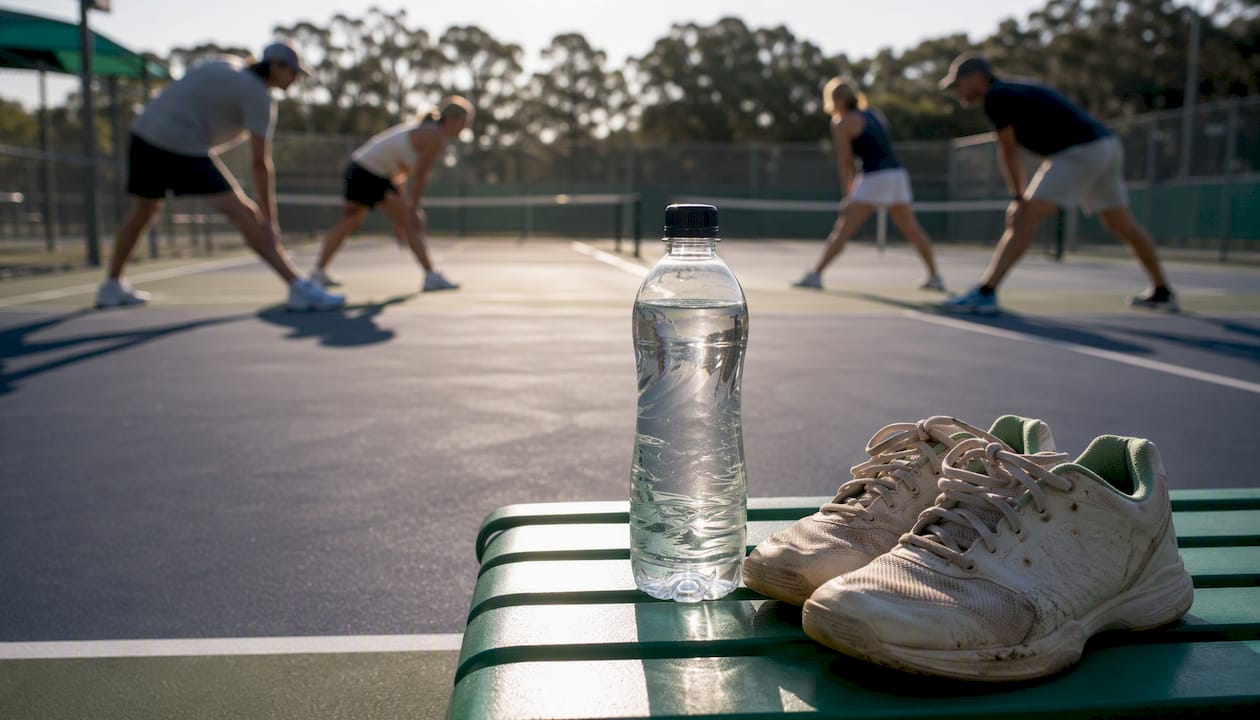
On the safety side, remind players to wear proper court shoes rather than running shoes, since lateral support matters for the quick direction changes pickleball demands. In warm weather, build in water breaks between rounds rather than assuming players will self-manage hydration during a packed schedule. Make sure court boundaries and any shared-space hazards (nearby traffic, uneven surfaces) get called out before play starts, especially at facilities not purpose-built for pickleball.
On sportsmanship, the standard that works best is simple: call your own lines honestly, and if you’re not sure, the point goes to your opponent. That single rule, consistently enforced, prevents the majority of on-court disputes. Encourage players to resolve disagreements quietly between points rather than escalating in front of the group, and give your court monitor or session lead clear authority to make a final call when players can’t agree.
A brief pre-event reminder, whether spoken or printed on the schedule handout, does more to set tone than any written rulebook. Players who hear “let’s keep it friendly and call your own lines fair” before round one behave differently than players who find out the expectations only after a dispute happens.
An Organizer’s Note on Running Round Robins Well
The biggest thing organizers overlook isn’t scheduling. It’s communication cadence. You can build a mathematically perfect rotation using the circle method, and it will still fall apart if players don’t know where to be and when. The events that run smoothly are the ones where someone sent a clear message the night before with start time, court assignments, and a one-line format reminder.
One small rule change that consistently improves the player experience: enforce a hard cutoff for late arrivals instead of letting rounds slide to accommodate stragglers. It feels unkind the first time you do it. But the players who showed up on time notice, and they come back. The players who chronically arrive late adjust their behavior faster than you’d expect once they realize the schedule actually starts without them.
If you’re planning your first event, don’t launch it as a 40-person season league. Run it as a small club night first, work out your rotation template and timing assumptions on a group of 12 to 16, then scale up once you know your real per-round timing and where your bottlenecks show up. Every assumption you make on paper gets tested the moment real players and real weather show up.
How FlexLeague+ Automates Round Robin League Management
Running one round robin by hand is manageable. Running one every week, with payments, DUPR-based divisions, and live standings players actually check, is a different job entirely. FlexLeague+ was built specifically to take the scheduling and scoring math off an organizer’s plate so the event runs itself once players show up.
Here’s how the platform maps directly onto the tasks covered in this guide:
| Organizer Task | FlexLeague+ Feature |
|---|---|
| Building the rotation schedule | Automated round robin generator using circle-method logic |
| Grouping players fairly | DUPR import for accurate skill-band divisions |
| Collecting registration fees | Built-in Stripe payment processing |
| Tracking wins, losses, and tiebreakers | Live standings updated as scores are reported |
| Letting players check their next match | Mobile-friendly player schedules and score reporting |
A typical first run looks like this: import your player list (with DUPR ratings if you’re using them), choose the round robin format that fits your player count and court availability, generate the schedule automatically, and publish a link players can check from their phones. No spreadsheet, no manual bracket math, no chasing down Venmo payments after the fact.
If you’re planning your first automated event, or you’re tired of rebuilding schedules by hand every week, start by creating a league on FlexLeague+ and running one test event before scaling to a full season. The pickleball league software handles the DUPR integration and payment collection from day one, so your second event takes a fraction of the setup time your first one did.
Sources
- Round-robin tournament — Wikipedia
- USA Pickleball
- SMPC ROBIN ROUND RULES and FAQ
- Round Robin Play — Bend Pickleball Club