Organizers: Fix Court Access in 30 Days to Retain Pickleball Players
Organizers: Fix Court Access in 30 Days to Retain Pickleball Players

The highest-leverage way to retain league players is to stabilize court access, pair it with frequent and skill-appropriate programming, and back it with predictable communication. Reserve repeat court blocks before the season opens, run weekly beginner clinics, and send automated reminders so players never have to wonder when or where they play next. This is the retention flywheel in action, and tools like FlexLeague+ exist to run it without the spreadsheet chaos: core player counts grew by 20.4% in 2025, proof that casual interest is converting into regular play when organizers make it easy to stay.
TL;DR:
- Securing recurring court access and scheduling season-long blocks are critical to prevent players from losing interest due to operational uncertainties.
- Matching players by verified skill levels and promoting fair division promotions help maintain competitive balance and reduce dropout caused by mismatched matches.
- Automating communication with reminders and follow-ups drastically cuts no-shows and re-engages players, especially when segmented by skill and attendance history.
- Building social bonding through short, repeatable events fosters a sense of belonging that turns players into regular league participants.
- Using a dedicated league platform that integrates scheduling, payments, and score reporting simplifies administration and supports the retention strategies effectively.
Table of Contents
- Core retention strategies mapped to the retention flywheel
- League programming and formats that increase repeat play
- Onboarding beginners: design the first session to convert players into regulars
- Scheduling and booking reliability: operational fixes and what to automate
- Community and social programming that builds belonging
- Skill progression and competitive pathways: fair placement and promotion
- Communication and automation: templates and cadence that reduce no-shows and re-activate players
- Measure, iterate, and report: the KPIs that tell you retention is improving
- How FlexLeague+ and platform tools operationalize these tactics
- Author Robert’s takeaway: one prioritized action and common pitfalls
- How a league platform can help you keep players coming back
- Sources
- FAQ
Core retention strategies mapped to the retention flywheel
The retention flywheel framework identifies four forces that keep players coming back: access, frequency, skill comfort, and belonging. Miss one and the whole system slows down, no matter how good your programming looks on paper.
Each pillar has a short list of tactics that move the needle fast:
- Access: lock in recurring court blocks and track court utilization rate weekly.
- Frequency: schedule overlapping leagues and clinics so players always have a next session, and watch sessions-per-player per month.
- Skill comfort: group by verified skill level and monitor early dropout after mismatched matches.
- Belonging: build in social time and track referral rate as your proxy metric.
A simple 30/90-day checklist works well here: in the first 30 days, fix access and launch one beginner track; by day 90, layer in belonging programming once attendance stabilizes. Organizers who sequence it this way avoid the common trap of throwing social events at a league that still can’t guarantee a court.
League programming and formats that increase repeat play
Format choice determines whether players show up once or every week. Match the format to the group you’re trying to hold onto.
- Ladder leagues work well for competitive players who want visible progress between tiers; use them for 6 to 8 week cycles.
- Short-season divisions (4 to 6 weeks) lower the commitment barrier for new players testing the waters.
- Social mixers rotate partners every few games, which suits mixed-skill groups and newcomers who don’t yet have a regular partner.
- Hybrid drop-in and season models let casual players sample league play before committing, which is useful for retaining the walk-up crowd.
A sample weekly cadence: Monday beginner clinic, Wednesday ladder night, Saturday social mixer. Seniors tend to prefer daytime slots and slower-paced social formats, while younger adults respond better to evening ladders with clear competitive stakes. For more structure on ladder formats specifically, see this player’s guide to ladder leagues.
Onboarding beginners: design the first session to convert players into regulars
The first session decides whether a player comes back. A clunky sign-up or an awkward first match can undo weeks of marketing effort.
Build the session around this sequence:
- Quick registration with no paper forms or manual tracking.
- A warm, personal welcome from a staff member or volunteer, not just a name tag.
- Partner pairing by skill comfort, not random draw.
- A five-minute primer on rules and etiquette before play starts.
- A clear next-step booking before the player leaves the court.
Use simple skill-check cues from USA Pickleball’s level three guidance to place beginners accurately rather than guessing. Offering a discounted trial session and following up within 24 hours locks in the next booking while the experience is still fresh.
Pro Tip: Ask every new player one question before they leave: “What time works for you next week?” That answer becomes your follow-up message.
Scheduling and booking reliability: operational fixes and what to automate
Unreliable access is the fastest way to lose a league player. If someone shows up to a canceled court twice, they rarely come back a third time.
Fix the operational basics first:
- Reserve repeat court blocks for the full season rather than booking week to week.
- Build a weather-contingency plan with a backup indoor option or a clear rain-check policy.
- Assign rostered session slots so players know exactly where they stand each week.
- Enforce a no-show policy that protects court space for committed players.
Integrated payments and automated receipts remove friction at sign-up and make commitments feel real, since a paid registration is a stronger signal of intent than a verbal yes. When evaluating a booking tool, check for mobile-friendly sign-up, built-in payment processing, roster sync, and calendar integration. Court scheduling platforms like Six-Love offer a useful comparison point for what reliable booking infrastructure should look like.
Community and social programming that builds belonging

Belonging is what turns a league into a habit. Players stay for the people as much as the matches.
Repeatable social touches work better than one-off events:
- Monthly mixers with rotating partners to break up cliques.
- Team nights that give regulars a shared identity beyond individual matches.
- Volunteer roles like score-keeping or welcoming newcomers, which deepen investment.
- A simple member spotlight in weekly communications.
Keep social time short so it doesn’t eat into court hours: a 10-minute post-play ritual, like a quick group photo or a shared scoreboard update, does more for belonging than a separate event most weeks. Track belonging with referral rate, repeat attendance, and an occasional one-question satisfaction check.
Skill progression and competitive pathways: fair placement and promotion
Mismatched competition is one of the quietest reasons players quit. A 3.0 player stuck playing 4.0s every week will eventually stop showing up.
Use USA Pickleball’s skill-level descriptions to place players honestly at sign-up, and build in an easy mid-season re-assignment process when a placement turns out wrong.
- Reward progress with visible promotion mechanics: playoff slots, ladder movement, or a next-tier invite.
- Offer targeted clinics for players moving up a level so the jump doesn’t feel abrupt.
- Keep divisions balanced enough that marginal players still find competitive, fun matches rather than lopsided ones.
Communication and automation: templates and cadence that reduce no-shows and re-activate players
A predictable message cadence does more to prevent no-shows than any single incentive. Build the sequence once and automate it.
- Send a reminder 24 hours before each session, then a shorter one 2 hours out.
- Follow up within an hour after each session with a quick thank-you and next-session link.
- Mark milestones (10th match, first win streak) with a short congratulatory message.
- Run a lapsed-player drip for anyone who misses three weeks, offering a free clinic spot to re-engage.
Use SMS for same-day reminders, email for milestones and newsletters, and app push for schedule changes. Segment by skill level and attendance history so messages feel relevant. Test two subject lines and two send times each month to see which drives more opens and faster responses.
Measure, iterate, and report: the KPIs that tell you retention is improving
Retention only improves when you measure it consistently. A handful of numbers tell most of the story.
- Track 30-day and 90-day repeat-play rate as your core retention signal.
- Watch average sessions per player and no-show rate each week.
- Build a simple cohort retention curve to see where players drop off.
- Monitor lifetime registration revenue per player as a long-term health check.
High 30-day churn almost always points to one fixable problem, usually access or skill mismatch. Run small experiments, a new clinic format or a rebalanced division, for at least two full cycles before judging the result.
How FlexLeague+ and platform tools operationalize these tactics
A league platform earns its keep when it maps directly to the flywheel instead of adding another tool to juggle. This league platform supports integration with player rating systems and payment processing, and covers singles, men’s doubles, women’s doubles, mixed doubles, and team formats.
- Access and frequency: automated scheduling and division management keep court time and matchups consistent.
- Skill comfort: DUPR integration supports verified, fair placement.
- Belonging and communication: live standings and score reporting keep players engaged between sessions.
- Payments: Stripe-powered registration removes manual collection.
A 30-day setup checklist: launch registration, build divisions, schedule the season, enable DUPR sync, and turn on automated reminders. More detail lives on the league software product page.
Author Robert’s takeaway: one prioritized action and common pitfalls

If you only do one thing in month one, fix court access first. Everything else in the flywheel stalls without it.
The two mistakes I see most: launching social events before scheduling is reliable, and placing players by guesswork instead of a skill guide. Fix access, use real placement criteria, and the rest follows.
— Robert
How a league platform can help you keep players coming back
Running the flywheel by hand means juggling spreadsheets, group texts, and manual Stripe invoices every week. FlexLeague+ handles registration, scheduling, payments, DUPR integration, and score reporting in one place, so organizers spend less time on administration and more time on the court.
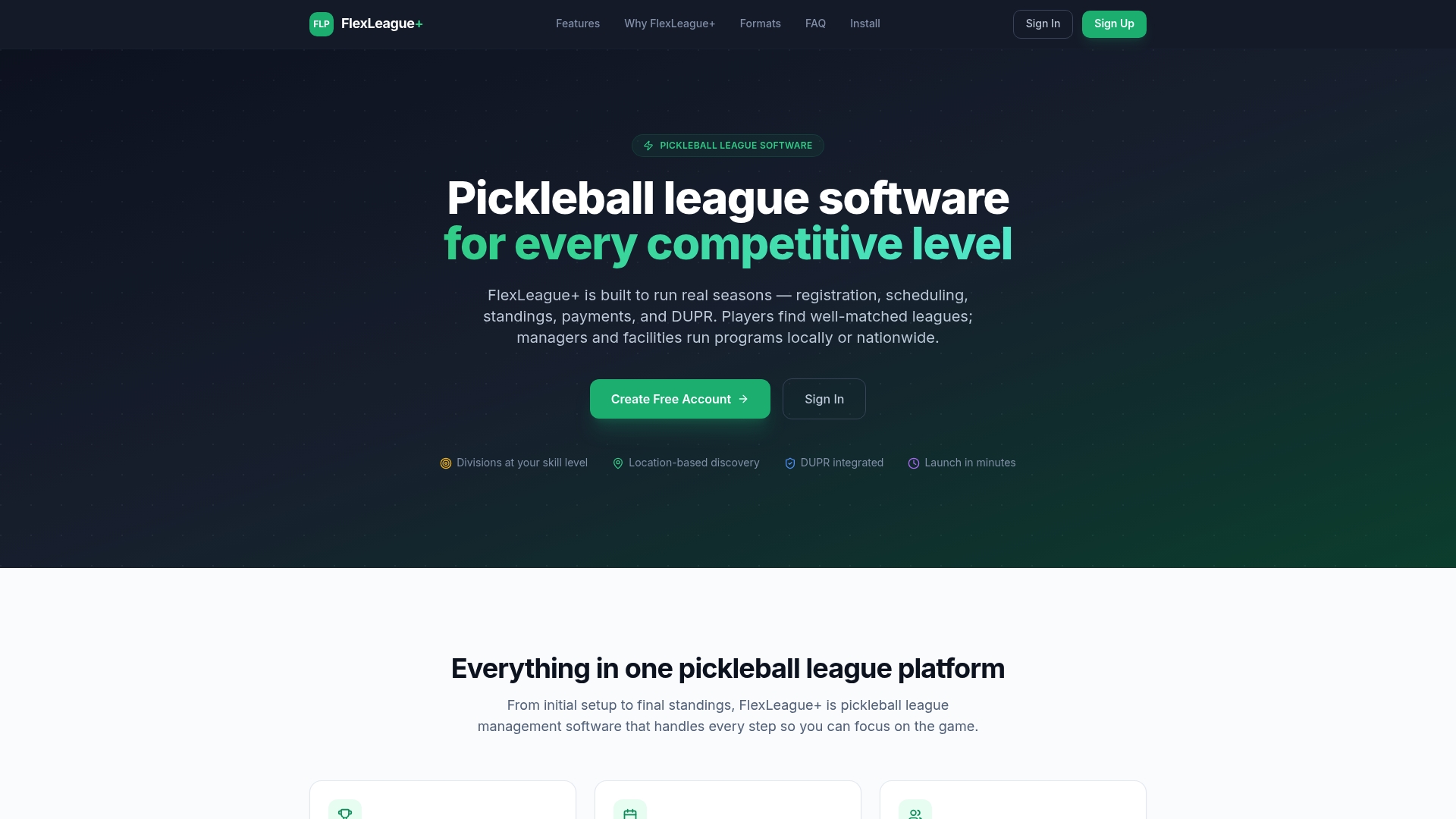
There’s no monthly subscription. Managers pay a $25 one-off league platform fee per division, and players only pay when they register for a season. If you’re ready to put these tactics into practice, check pricing and plans to set up your next season.
Sources
These sources back the tactics above and are worth bookmarking:
- The Pickleball Retention Flywheel: Why Players Stay (or Leave)
- How Many Pickleball Players Are in the US? 2026 Data
- Pickleball Skill Level Three (3) — USA Pickleball
- PlayPickleball — rule guidance
FAQ
How do I know if I’m a 3.0 pickleball player?
A 3.0 player generally shows consistent serves and basic shot control but still struggles with shot placement and sustained rallies against stronger opponents. USA Pickleball’s skill-level guidance outlines these benchmarks in detail for self-assessment or organizer placement.
Is pickleball growing or dying?
Pickleball is growing, not shrinking. Core player counts grew by 20.4% in 2025, showing more players are moving from occasional play to regular participation.
What is the 10-second rule in pickleball?
The server must serve within 10 seconds after the score is called, or it counts as a fault. This serve timing rule keeps league play moving and matches fair for both sides.
Will pickleball popularity decline in 2026?
There is no indication of decline. Recent growth data through mid-2026 shows core player counts rising, and participation research points to continued conversion of new players into regular league members.
What keeps players coming back to a pickleball league?
Reliable court access, skill-appropriate matchups, and consistent communication are the strongest drivers of retention. Programs built around the retention flywheel, access, frequency, skill comfort, and belonging, tend to see fewer dropouts than leagues that rely on one-off events alone.