Best RecDesk Alternatives for Paid Pickleball Leagues
Best RecDesk Alternatives for Paid Pickleball Leagues

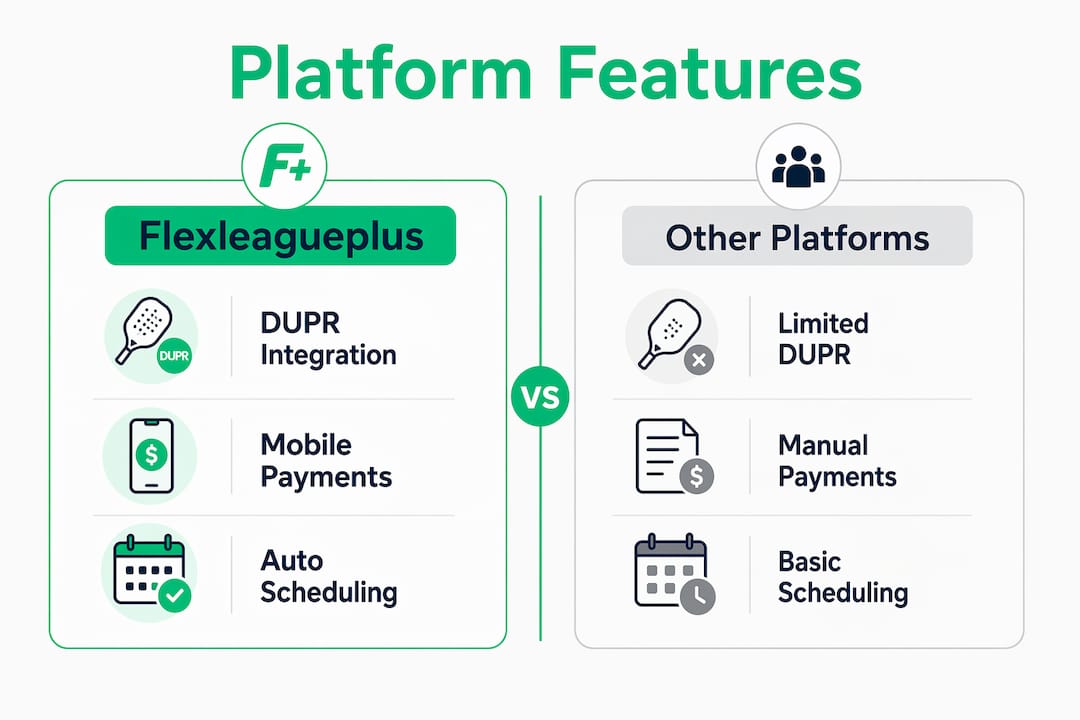
For paid pickleball leagues, Flexleagueplus is the strongest RecDesk alternative available. It’s the only platform built specifically for pickleball formats, with DUPR integration, Stripe-native payment processing, automated scheduling, and a mobile-first player experience baked in from day one. If you’re running singles, doubles, mixed, or FLP team leagues and collecting registration fees, this is where to start.
Why Flexleagueplus stands out:
- DUPR approved — results submit automatically, no manual entry required
- Stripe-powered payments — PCI-compliant checkout, refund handling, and per-registration billing with no monthly subscription required for players
- Automated scheduling — round-robin draws, playoff brackets, and division management generated without spreadsheets
- Mobile-first player experience — players sign up, report scores, and check standings from their phones
- Migration support — onboarding help to move data from legacy systems cleanly
Book a demo at Flexleagueplus to see the platform before committing.
Table of Contents
- How do the top RecDesk alternatives compare for pickleball leagues?
- What features actually matter for running a paid pickleball league?
- How do you pick the right RecDesk alternative for your facility?
- What does switching from a legacy system actually look like?
- Why Flexleagueplus is built for pickleball leagues specifically
- Key Takeaways
- What league managers actually notice after switching platforms
- Flexleagueplus is ready when you are
- Useful sources and further reading
How do the top RecDesk alternatives compare for pickleball leagues?
| Feature | Flexleagueplus | Legacy RecDesk-style system | General parks & rec platform | Sports-first club platform |
|---|---|---|---|---|
| Best for | Paid pickleball leagues, facilities, parks | Municipal rec departments | City parks, multi-sport programs | Club sports, youth leagues |
| League formats | Singles, doubles, mixed, FLP teams | General programs | General programs | Team sports |
| DUPR integration | Yes (approved) | No | No | No |
| Automated scheduling | Yes (round-robin, brackets) | Limited | Limited | Varies |
| Score reporting | Player self-reporting, live standings | Manual/admin-only | Admin-only | Varies |
| Payment processing | Stripe (PCI-compliant) | Varies | Varies | Varies |
| Mobile experience | Mobile-first | Desktop-centric | Responsive | App varies |
| Ledger/reporting | Automated ledger, refund logs | Basic | Moderate | Basic |
| Support | Onboarding + migration help | Self-serve | Self-serve | Self-serve |
| Pricing model | Per-registration, no player subscription | Annual subscription | Annual subscription | Monthly/annual |
| Free trial/demo | Demo available | Varies | Varies | Varies |

Where Flexleagueplus pulls ahead: General parks and rec platforms handle multi-sport programming well but treat pickleball as just another activity. They have no DUPR connection, no pickleball-specific division logic, and payment flows built for class registrations rather than competitive league fees. Sports-first club platforms cover scheduling but rarely handle the financial reconciliation a facility operator needs. Legacy RecDesk-style systems are built for municipal administration, not player-facing competitive leagues. Flexleagueplus is the only option in this group designed around the actual job: running a paid, competitive pickleball league.
What features actually matter for running a paid pickleball league?
Registration and checkout
Mobile-first checkout is table stakes now. Facilities that offer mobile-native payments see higher registration conversion and fewer support calls. Players expect to sign up from their phones in under two minutes. Refund and chargeback handling matters too: Stripe’s dispute workflow is well-documented, but your platform needs to surface refund requests in a manager dashboard, not bury them in a payment processor portal.
Scheduling and match generation
Automated round-robin generation and playoff bracket creation save hours per season. The platform needs to support all four pickleball formats: singles, men’s doubles, women’s doubles, mixed doubles, and team leagues. Court allocation and blackout times should be configurable without calling support.
Scoring and standings
Player self-reporting with live standings is what separates a modern pickleball platform from a glorified spreadsheet. DUPR result submission should happen automatically after score approval, not as a separate manual step. Referee verification is a nice-to-have for competitive tiers.
Payments and ledger
Per-registration billing through Stripe means your revenue scales with participation, not with a fixed annual fee. Automated ledger reporting reduces manual data entry errors and gives you real-time financial visibility. Refund logs and tax/fee breakdowns should export cleanly.
Player-facing UX
In-app match reminders, calendar sync, and push notifications reduce no-shows. Players who can manage their entire league experience from one app come back next season.
Pro Tip: Ask vendors for a sample ledger export during your demo. If it doesn’t map cleanly to your facility’s chart of accounts, you’ll spend hours reconciling every season.
Feature checklist for vendor demos:
- Mobile checkout tested on iOS and Android
- DUPR result submission (automatic, not manual)
- Round-robin and bracket generation for all pickleball formats
- Stripe integration with visible fee breakdown
- Refund workflow accessible from the manager dashboard
- CSV or API export for registrations and financials
- Automated email/push notifications to players
How do you pick the right RecDesk alternative for your facility?
The three factors that matter most: DUPR integration, payment processing model, and automated scheduling. Get those right and most other decisions follow.
Match scale to platform: A community park running two divisions twice a year has different needs than a private club running eight divisions year-round. Aggregated platform comparisons consistently show that small operations prioritize ease of use while larger facilities need deeper integrations and reporting. Know your player count and division structure before you demo anything.
Support model: Self-serve platforms work if you have a tech-comfortable admin. If your facility staff turns over or you’re running leagues part-time, white-glove onboarding and migration support is worth paying for.
Pricing model: Per-registration billing aligns cost with revenue. Annual subscriptions create fixed overhead whether you run one league or ten. Cloud-native platforms are moving toward flexible pricing to avoid multi-year lock-ins.
Questions to ask in every vendor demo:
- How does data migration work, and what format do you accept?
- Is DUPR integration native or a manual export?
- What are the Stripe processing fees, and who pays them?
- Can I export all registrations and financials as CSV at any time?
- How does a player-initiated refund flow through to my ledger?
- What’s your uptime SLA and how are outages communicated?
Red flags that should disqualify a vendor:
- No DUPR integration or manual-only score entry
- Opaque payment fees not shown in the demo
- No clear data export or migration path from your current system
- Desktop-only interface with no mobile player experience
What does switching from a legacy system actually look like?
A phased migration typically runs several weeks to a few months, depending on data complexity and how much historical data you need to preserve. Protecting historical registration records is the step most facilities underestimate.
Migration phases:
- Backup and export — pull all current registrations, payment records, player IDs, and division history from your existing system
- Data mapping — match your existing fields to the new platform’s schema; flag gaps before import
- Pilot season — run one league on the new platform while keeping the old system live
- Validation — confirm historical standings, check refund logs, test DUPR submission end-to-end
- Full cutover — communicate the switch to players at least two weeks in advance
Timeline by operation size:
- Small (1–3 leagues, under 100 players): 4–6 weeks; vendor handles most of the import
- Medium (4–8 leagues, 100–500 players): 6–10 weeks; shared work between vendor and facility admin
- Large (8+ leagues, 500+ players, multi-venue): 10–12 weeks; dedicated migration support recommended
Common pitfalls: Missing historical player IDs breaks DUPR continuity. Inconsistent data hygiene (duplicate accounts, mismatched emails) causes import failures. Not testing the refund workflow before go-live means your first real refund request becomes a fire drill. Skipping player communication about the cutover date generates a wave of confused support tickets.
Why Flexleagueplus is built for pickleball leagues specifically
Flexleagueplus isn’t a general recreation platform with pickleball bolted on. It’s designed around the actual formats pickleball leagues run: singles, men’s doubles, women’s doubles, mixed doubles, and FLP team leagues modeled on the MLP format. That specificity shows up in every part of the product.
Trust signals that matter to pickleball managers:
- DUPR approved — the platform meets DUPR’s technical requirements for automated result submission; mobile apps and payment integrations are cited as critical decision drivers for sports facilities, and Flexleagueplus covers both
- Stripe-native payments — PCI-compliant, transparent fees, and refund handling built into the manager dashboard
- Demo available — you can see the full product before signing anything
- Migration support — onboarding help for facilities moving from legacy systems
Who it fits:
- Municipal parks running pay-to-play community leagues
- Private clubs with competitive divisions and DUPR-tracked players
- Facility operators managing multiple venues and divisions
- League managers who need clean financial reporting for reconciliation
Key Takeaways
For paid pickleball leagues, the platform choice comes down to DUPR integration, Stripe-native payments, and automated scheduling — and Flexleagueplus is the only option that delivers all three in a pickleball-first product.
| Point | Details |
|---|---|
| DUPR integration is non-negotiable | Only platforms with native DUPR approval eliminate manual score submission for competitive leagues. |
| Per-registration billing scales with you | Transaction-based pricing means your costs match your revenue, with no fixed annual overhead. |
| Migration takes 4–12 weeks | Plan a phased switch: export, map, pilot, validate, then cut over with two weeks’ player notice. |
| Mobile-first UX drives registrations | Facilities offering mobile-native checkout see higher sign-up conversion and fewer support requests. |
| Flexleagueplus covers all pickleball formats | Singles, doubles, mixed, and FLP team leagues are all supported with automated scheduling and live standings. |
What league managers actually notice after switching platforms
The first week after switching, the biggest change isn’t the features. It’s the silence. No emails from players asking how to register. No manual score corrections. Automated reminders go out before match days, and players actually show up because they got a push notification instead of a buried email thread.
By month one, the financial picture gets clearer. Stripe payouts reconcile automatically, refund requests show up in a dashboard instead of a payment processor portal, and the ledger export takes minutes instead of an afternoon. The onboarding hiccup most managers hit: importing player data with inconsistent email addresses creates duplicate accounts. Run a deduplication pass on your player list before migration and you’ll avoid 80% of the first-week support tickets.
Flexleagueplus is ready when you are
Running a paid pickleball league means you need payments that work, scheduling that doesn’t require a spreadsheet, and DUPR results that submit without manual intervention. Flexleagueplus delivers all three, with migration support to get you off your legacy system cleanly.
Setup for a small operation typically takes under six weeks. Flexleagueplus’s team provides onboarding guidance and data migration help so your historical records carry over intact. Start with a demo to see the full product, ask your migration questions, and get a realistic timeline for your facility.
Useful sources and further reading
- Flexleagueplus pickleball league software — Full feature overview: registration, DUPR integration, Stripe payments, scheduling, and standings. Start here before any vendor demo.
- Flexleagueplus main site and demo scheduling — Book a demo or request a migration estimate directly.
- CivicPlus Recreation Management — Guidance on integrated platforms for parks and rec departments; useful background on operational benefits and staff time reclamation.
- GetRecPlus parks and rec software — Covers mobile-first design, ledger automation, and data migration features; good reference for evaluating any platform’s technical baseline.
- nextRec (Xplor Recreation) — All-in-one parks and rec platform with automated communication tools; useful comparison point for multi-sport facilities evaluating general-purpose options.
- SoftwareWorld RecDesk alternatives roundup — Aggregated list of RecDesk competitors with use-case notes; helpful for understanding the broader market before narrowing to pickleball-specific options.
- Recreation and fitness platform alternatives overview — Marketplace context for recreation tech buyers comparing platform categories.