Rally Scoring in Pickleball: Rules, Examples, and How It Works
Rally Scoring in Pickleball: Rules, Examples, and How It Works

Rally scoring in pickleball awards a point on every single rally, no matter which team served. Either side can score. That’s the whole idea, and it changes how you play, how you call the score, and how long a match actually runs.
Under the USA Pickleball Official Rulebook, Rule 14.A provisionally approves rally scoring as an option tournament directors can elect for sanctioned play. Here’s what changes compared to traditional side-out scoring:
- Either team scores on every rally, not just the serving team.
- Doubles uses one server per turn — no second server before a side out.
- The score is called as two numbers (server’s score, then receiver’s score), dropping the third server number entirely.
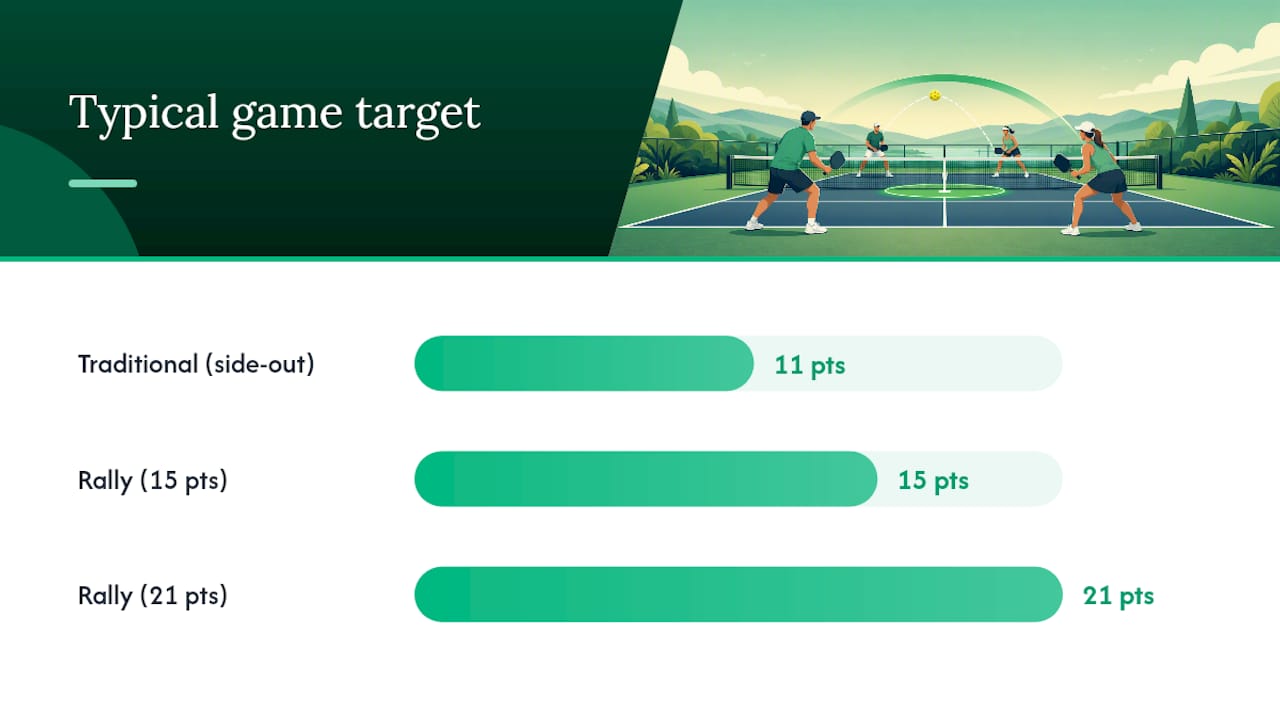
- Games typically use play-to-15 or play-to-21 formats with a win-by-2 margin, though the tournament director sets the exact target.
- Server position (right or left service court) is still determined by the server’s current score — even or odd.
Key Takeaways
Rally scoring awards a point on every rally to either team, uses a two-number score call in doubles, and requires tournament directors to specify game-to targets and win-by margins before play begins.
| Point | Details |
|---|---|
| Point on every rally | Either team scores regardless of who served — the core rule that defines the format. |
| Two-number call in doubles | Drop the server number; call server’s score then receiver’s score only. |
| One server per turn | In doubles, service transfers after one server loses a rally — no second server. |
| Server position by score | Serve from the right when your score is even, left when odd — same as traditional. |
| Confirm format before serving | Always verify game-to points, win-by margin, and any freeze rule with the TD or opponent. |
Table of Contents
- How does rally scoring work in pickleball?
- Worked examples: how scores change rally by rally
- How does rally scoring compare to traditional side-out scoring?
- Where is rally scoring used, and what does USA Pickleball say?
- Scoring cheat sheet: how to call the score and fix common mistakes
- Advantages and disadvantages of rally scoring
- What running leagues taught me about rally scoring
- Sources
How does rally scoring work in pickleball?
Singles
In singles, the serving and scoring mechanics are straightforward. You serve from the right service court when your score is even, the left when it’s odd. Win the rally and you score a point and keep serving. Lose it and your opponent scores and takes the serve. The score is called as two numbers: server’s score first, then receiver’s score. So if you’re winning 7–4 and you lose the rally, the call becomes “4–7” with your opponent now serving.
Doubles
Doubles is where rally scoring makes its biggest structural change. Under Rule 14.A, only one player on the serving team serves before a side out is declared. There is no second server. When the serving team loses a rally, service transfers immediately to the opposing team.

The server’s position follows the same even/odd rule as singles: serve from the right when your team’s score is even, from the left when it’s odd. After each rally the serving team wins, the server switches service courts and continues serving. The partner stays put. When the receiving team wins the rally, they take the serve, and the player whose position corresponds to the new score starts serving from the correct court.
The score call in doubles drops to two numbers. If Team A has 6 points and Team B has 9, and Team A is serving, the call is simply “6–9.” No third number. That simplification is one of the cleaner quality-of-life changes rally scoring brings to referees and self-officiated matches alike.
Pro Tip: Before the first serve of any rally-scoring match, confirm the “game to” number and the win-by margin with the tournament director or your opponent. Some events play to 15, others to 21, and a few use a freeze rule near game point. Getting this wrong mid-match creates real confusion.
Worked examples: how scores change rally by rally
Singles sequences
Example 1 — Basic singles
- Player A serves from the right (score 0–0). Player A wins the rally. Call: “1–0.” Player A moves to the left court.
- Player A serves from the left (score 1–0). Player B wins the rally. Call: “0–1.” Player B now serves from the right (score 0 = even).
- Player B serves from the right (score 0–1). Player B wins the rally. Call: “1–1.” Player B moves to the left court.
Example 2 — Late-game singles, win-by-2
- Score is 14–14, game to 15 win by 2. Player A serves from the right (14 is even). Player A wins. Call: “15–14.” Not over yet — must win by 2.
- Player A serves from the left (15 is odd). Player B wins. Call: “14–15.” Player B serves from the left (14 is even — wait, 14 is even, so right court). Call resets to “15–14” with B serving.
- Play continues until one player leads by 2.
Doubles sequences
Example 1 — Early doubles
- Team A serves (score 0–0, even = right court). Team A wins the rally. Call: “1–0.” Server switches to left court.
- Team A serves from the left (score 1 = odd). Team B wins the rally. Call: “0–1.” Team B now serves. Team B’s score is 1 (odd), so their server starts from the left court.
- Team B serves from the left. Team B wins. Call: “1–1.” Server switches to right court (score now 2 = even).
Example 2 — Win-by-2 doubles finish
- Score is 14–14, game to 15 win by 2. Team A serves from the right (14 = even). Team A wins. Call: “15–14.” Not over.
- Team A serves from the left (15 = odd). Team A wins again. Call: “16–14.” Game over — Team A wins by 2.
How does rally scoring compare to traditional side-out scoring?
The structural differences run deeper than just “who can score.”
| Category | Rally scoring | Traditional (side-out) |
|---|---|---|
| Who scores | Either team on any rally | Serving team only |
| Servers per turn (doubles) | One server, then side out | Two servers before side out |
| Score call (doubles) | Two numbers (server–receiver) | Three numbers (server–receiver–server#) |
| Typical game target | 15 or 21, win by 2 | 11, win by 2 |
| Match length predictability | High — points accumulate steadily | Lower — long side-out runs can extend games |
| Serve as a weapon | Reduced — losing a rally costs a point | Higher — holding serve is structurally rewarded |
The tactical consequences are real. In traditional scoring, a dominant server can hold serve for long stretches without the opponent gaining ground. Rally scoring eliminates that buffer. Every unforced error, every weak return, every miscommunication at the kitchen costs a point directly. That shifts the game toward consistency over aggression, particularly on the return of serve.
Endgame strategy shifts too. In traditional scoring, the receiving team can play loose knowing they won’t give up a point. In rally scoring, every rally carries equal scoring weight — a 14–14 rally is as consequential as a 0–0 one. Some organizers add a freeze rule near game point, where scoring reverts to side-out rules for the final point or two, specifically to restore some of that endgame tension.
Where is rally scoring used, and what does USA Pickleball say?
The 2026 USA Pickleball Official Rulebook treats rally scoring as a provisional option under Rule 14.A. It is not the default format for sanctioned play. Tournament directors must explicitly elect it, and they must publish the format in advance so players know what they’re walking into.
Community discussion and rule-change proposals around rally scoring have been active for years, with advocates pointing to spectator accessibility and simpler serve tracking. The provisional status in 2026 reflects that ongoing debate rather than a full adoption.
Common formats that use rally scoring
- Round-robin events — rally scoring keeps match times tight when courts and time slots are limited.
- Team league play — formats like FLP team events often use rally scoring for individual matches within a team contest.
- Tie-breakers — some leagues play standard scoring for sets and switch to a rally-scoring tie-breaker (often to 5 or 7) to decide a split set.
- Televised or spectator events — predictable match length matters when broadcast schedules are fixed.
Common game targets in practice are play-to-15 or play-to-21, win by 2. Some local organizers allow win-by-1 as a house rule, though that is not the USA Pickleball standard.
Organizer checklist before publishing event rules
Before your first rally-scoring event, confirm and publish every one of these in your registration materials. If you’re managing a league through software like Flexleagueplus, you can attach format rules directly to the event listing so players see them at sign-up.
- Game-to points (15, 21, or other)
- Win-by margin (standard is 2; state if you allow win-by-1)
- Freeze or side-out-at-game-point rule — does it apply, and at what score does it trigger?
- Tie-breaker format — rally scoring to 5 or 7, or a full game?
- Handicap adjustments — if using handicap scoring, specify how points are applied
- Number of games per match — best of 1, 2, or 3?
For a broader look at how these decisions fit into event design, the pickleball tournament formats guide covers scheduling structures in detail.
Scoring cheat sheet: how to call the score and fix common mistakes
Score call formats
| Situation | Call |
|---|---|
| Singles, server leads 5–3 | “5–3” |
| Singles, tied at 10 | “14–14” |
| Doubles, serving team has 6, receiving has 9 | “6–9” |
| Doubles, tied at 14, game to 15 win by 2 | “14–14, game to 15, win by 2” |
| Doubles, serving team wins to reach 15–13 | “15–14, game” |
The USA Pickleball scoring how-to resource covers fundamentals for players new to calling their own matches.
Six common mistakes and how to fix them
- Calling three numbers in doubles. Rally scoring uses two numbers only. Drop the server number. If you catch yourself saying “6–4–2,” stop, reset, and call “6–4.”
- Forgetting to switch service courts after a won rally. The server must alternate courts after every point the serving team wins. If you stay put, you’re serving from the wrong side — stop, correct position, re-serve.
- Treating a 15–14 score as game over (game to 15, win by 2). It’s not. Play continues until the margin is 2. Announce “15–14, still playing” to avoid confusion.
- Applying the old two-server rule. In rally scoring doubles, service goes to the opponent after one server loses a rally. There is no second server. If your partner steps up to serve, that’s a fault.
- Wrong server position on the first serve of a new game. The server’s score is 0 (even) at the start, so the first serve always comes from the right court.
- Skipping the pre-match format confirmation. If neither team confirms the game-to number before the first serve, disputes at 14–14 are almost inevitable. Thirty seconds of conversation prevents it.
Advantages and disadvantages of rally scoring
Why rally scoring works well
- Predictable match length. Points accumulate on every rally, so games rarely drag. Tournament directors running round-robin or team events can schedule courts with real confidence.
- Easier score tracking. Two-number calls in doubles are simpler for players and referees, especially in self-officiated recreational matches.
- Spectator-friendly pacing. Momentum shifts are visible and frequent, which makes matches more engaging to watch.
- Simpler serve rotation. One server per turn removes the confusion around first-server exceptions and second-server tracking.
Where it falls short
- The serve loses tactical weight. A strong server can no longer hold serve without consequence. Losing a rally on your own serve costs you a point directly, which flattens one of pickleball’s most skill-differentiated moments.
- Alters traditional strategy. Patterns built around side-out scoring — playing conservatively as the receiver, taking risks only when serving — don’t translate cleanly. Players who’ve spent years on traditional scoring often find rally scoring disorienting at first.
- Not the default format. Because rally scoring is provisional under Rule 14.A, players entering a rally-scoring event need advance notice. Showing up expecting traditional scoring and getting rally scoring mid-warm-up is a real problem organizers must prevent.
Rally scoring fits best in team leagues, round-robin tournaments, tie-breakers, and any event where schedule management matters. Traditional side-out scoring remains the better fit for recreational play where serve skill and the tactical rhythm of holding serve are part of what players enjoy.
What running leagues taught me about rally scoring
The single most common organizer mistake with rally scoring isn’t the rules themselves. It’s assuming players already know the format. You can publish the rulebook link in your event description and still have half the field show up uncertain about whether they’re playing to 15 or 21, or whether there’s a freeze rule.
The fix is simple: put the game-to number, the win-by margin, and any freeze rule in the first line of your event description, not buried in a PDF. If you’re running a league through a platform like Flexleagueplus, add it to the match instructions field so it appears on every player’s match card. That one operational tweak eliminates most mid-match disputes before they start. For anyone setting up a league from scratch, the how to start a pickleball league guide walks through format decisions like this in sequence.