Promotion and Relegation Explained: How It Works in Sports
Promotion and Relegation Explained: How It Works in Sports

Promotion and relegation is the system where teams finish a season, the bottom performers drop to a lower division, and the top performers from that lower division take their place. It is the default competitive structure for professional football across Europe, South America, and most of the world. In the United States, it has been the exception rather than the rule, but that is changing: the United Soccer League has announced a move to an interconnected three-tier professional structure, USL Premier, USL Championship, and USL League One, making it the most significant American adoption of the system in professional soccer history.
Key Takeaways
Promotion and relegation is the most widely used competitive structure in world football, and its adoption by the USL marks a turning point for American professional soccer.
| Point | Details |
|---|---|
| Core mechanic | Bottom clubs drop to a lower division; top clubs from below take their place, based on season-long points. |
| Common formats | Most leagues use 2–3 automatic spots plus one playoff spot; Italy’s Serie A is a notable all-automatic exception. |
| Main benefit | Every match carries stakes for every club, eliminating incentives to lose for draft positioning. |
| Main risk | Relegated clubs face steep drops in broadcast and sponsorship income; parachute payments are the primary mitigation. |
| U.S. status | The USL has announced a three-tier open structure (USL Premier, Championship, League One) using promotion and relegation. |
| Flexleagueplus | Automates standings, playoff brackets, DUPR checks, and Stripe payments for tiered pickleball leagues. |
Table of Contents
- How promotion and relegation actually works across a season
- Common formats and the typical number of teams that move each season
- Variants and special rules that change how relegation is decided
- Where promotion and relegation is used: football, international tournaments, and beyond
- Why leagues use this system: benefits and the main drawbacks
- Non-playing requirements and what can block promotion
- Typical timelines and economic impacts for clubs that move between tiers
- Controversies and edge cases fans often ask about
- How a recreational or amateur league can implement promotion and relegation
- The case for open systems is stronger than most American sports fans realize
- Flexleagueplus makes running tiered leagues straightforward
- Sources
How promotion and relegation actually works across a season
The core mechanic is simple. Clubs accumulate points across a full season, three for a win, one for a draw, zero for a loss, and the final standings table determines who moves. The top of the lower division goes up; the bottom of the upper division comes down. According to Wikipedia’s overview of the system, this model is the standard for European football and keeps competitive stakes alive for clubs at every level of the table throughout the season.
Promotion zone vs. relegation zone
- The promotion zone sits at the top of a lower division. Clubs finishing there either earn automatic promotion or enter a playoff for the remaining spot.
- The relegation zone sits at the bottom of the top division. Clubs finishing there drop automatically or face a playoff against a lower-division club.
- Automatic spots are guaranteed by finishing position. Playoff spots require an additional match series to decide the final promoted or relegated club.
A typical top flight, like the English Premier League, sends multiple clubs down automatically and promotes several from the second tier automatically. Additional promotion spots may be decided by a playoff among high-finishing clubs in the lower division. Tiebreakers, when clubs finish level on points, usually follow this order: goal difference first, then goals scored, then head-to-head record.
The pyramid knock-on effect matters here. When three clubs drop from the Premier League, three clubs rise from the Championship. That triggers movement in the Championship, which in turn triggers movement in League One below it, and so on down through the pyramid. A single season’s results ripple through every tier simultaneously.
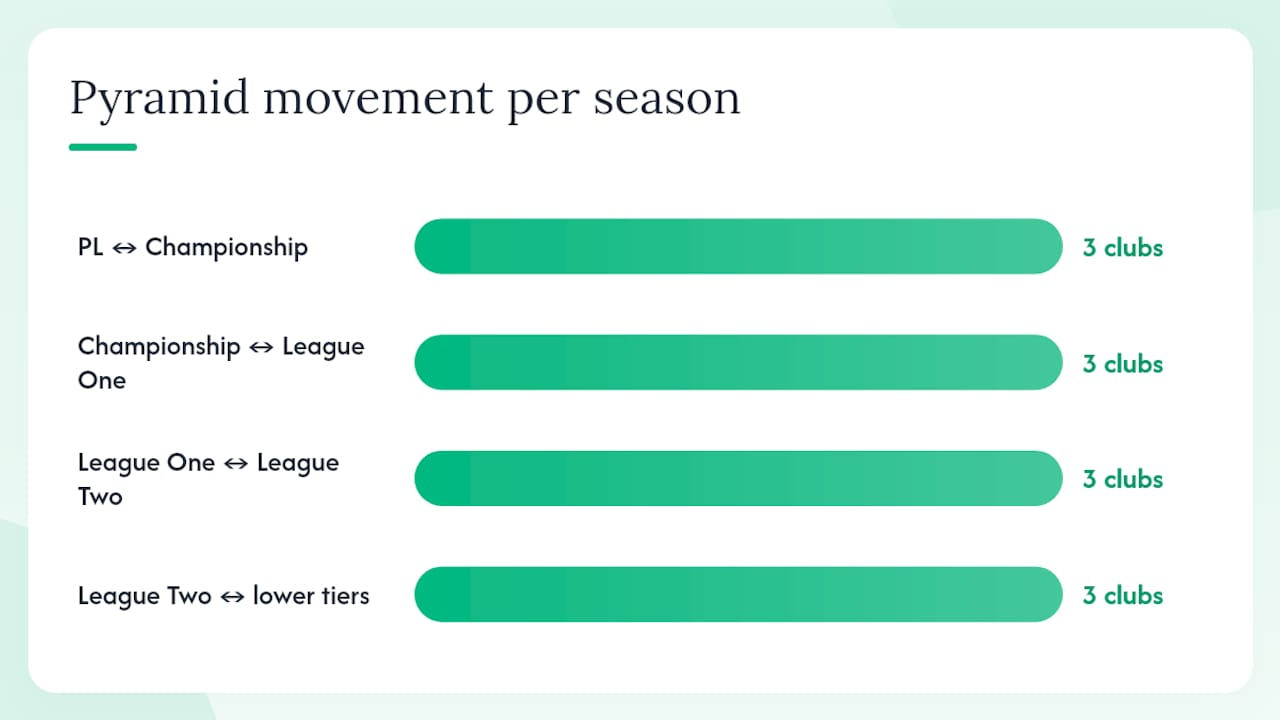
Pro Tip: In two-legged playoff ties, away goals rules have been phased out in most major competitions, so extra time and penalties now decide level ties. Always check the specific competition’s rules before assuming away goals apply.
Common formats and the typical number of teams that move each season
The number of clubs that move varies by league size and national preference. GIS Sport’s global survey documents the most common templates and links the system to positive effects on attendance and competitive incentives.
A few patterns stand out. England uses a multi-team playoff for the final promotion spot, generating significant commercial interest. Germany holds a two-legged playoff between lower-ranked top-flight and higher-ranked second-tier clubs. Italy’s Serie A runs all movements automatically, with no playoffs.
Exceptions alter these counts more often than fans expect:
- League resizing: When a league expands or contracts, the promotion and relegation counts adjust for one or more seasons to reach the target membership.
- Insolvency: A club that enters administration or is expelled mid-season may be replaced by a lower-division club without the normal promotion process.
- Expulsions: A club removed for rule violations can trigger a “knock-on” promotion for a club that otherwise would not have moved.
These adjustments occur periodically in major leagues and can sometimes feel unfair to clubs narrowly missing promotion under standard rules.
Variants and special rules that change how relegation is decided
Not every league uses a single-season table to decide who goes down. Argentina’s Promedios system is the most famous alternative. Rather than ranking clubs on their current season’s points alone, Promedios calculates a coefficient by dividing a club’s total points across the most recent three seasons by the number of matches played in that period. A club that had strong seasons two and three years ago carries that cushion into the current campaign. The practical effect is that historically large clubs with deep point reserves are harder to relegate than newly promoted sides with only one season of data in the calculation. Wikipedia’s entry on promotion and relegation explains the Promedios method in detail and notes how it can protect established clubs while increasing volatility for promoted teams.
Beyond the table itself, leagues impose off-field requirements that can block promotion even when a club finishes in a qualifying position. Common non-playing requirements include:
- Stadium capacity and safety certification: Most top divisions require a minimum seat count and up-to-date safety inspections.
- Financial licensing: Audited accounts, proof of solvency, and sometimes a minimum wage bill or squad value threshold.
- Youth academy standards: Some leagues require a functioning youth setup as a condition of top-flight membership.
- Legal and regulatory compliance: No outstanding tax debts, no unresolved disciplinary sanctions, and compliance with national football association rules.
- Administrative relegation: A club can be relegated, or denied promotion, purely for off-field failures. Point deductions for entering administration are common in English football. Expulsion for match-fixing or financial fraud has occurred in Italy and several other leagues.
A promoted club that fails a licensing check typically has a short window to appeal or remedy the deficiency. If it cannot, the promotion spot may pass to the next-highest finisher in the lower division, or the league may operate with an uneven number of clubs for one season.
Where promotion and relegation is used: football, international tournaments, and beyond
The system is nearly universal in professional football. The English pyramid, built around the Premier League at the top and the English Football League (EFL) below it, is the most studied example: clubs can theoretically travel from the ninth tier of non-league football all the way to the Premier League through successive promotions. La Liga, the Bundesliga, and Serie A all use the same basic model with the format variations shown above.
International tournaments have adapted the concept to their own structures. The UEFA Nations League groups national teams into four leagues (A through D) and promotes the top finishers from each group while relegating the bottom finishers. The CONCACAF Nations League uses the same architecture for North and Central American and Caribbean nations. The Davis Cup, tennis’s premier international team competition, has used promotion and relegation between its qualifying tiers for decades, making it one of the oldest non-football examples of the system in major sport.
Outside football and tennis, the model is spreading. Major League Pickleball’s 2023 format introduced a Premier and Challenger tier structure with explicit movement between levels across seasons, making it one of the clearest American examples of a non-football sport adopting tiered competition. Some eSports leagues, particularly in South Korea and Europe, have used similar systems for years.

The U.S. context deserves its own paragraph. American professional sports have historically operated closed leagues, where franchises hold permanent membership regardless of on-field performance. The USL’s announced three-tier structure breaks that model for professional soccer, creating a pathway from USL League One (Division Three) through USL Championship (Division Two) to USL Premier (Division One) based on results.
Why leagues use this system: benefits and the main drawbacks
The core argument for promotion and relegation is meritocracy. Every match in a season carries stakes for someone. A mid-table club with nothing to play for in a closed system has every incentive to rest players and coast. Under an open system, that same club might be three points above the relegation zone or two points outside a playoff spot. Wikipedia’s analysis identifies this elimination of “tanking” incentives as the system’s primary sporting benefit.
The benefits extend beyond competitive integrity:
- Smaller clubs have a genuine pathway to the top flight, which sustains investment and ambition at every level.
- Fan engagement stays high for clubs at the bottom of the table, not just those competing for titles.
- The system creates natural commercial events, playoff finals, survival days, and promotion parties, that generate media attention and matchday revenue.
The drawbacks are real and well-documented. Stanford’s SIEPR working paper on the economics of promotion and relegation analyzes English football and finds that relegated clubs face steep drops in broadcast income, matchday receipts, and sponsorship revenue, with sustainability risks that can persist for multiple seasons. A club that spends to compete in the top flight and then gets relegated can find itself carrying a wage bill built for one revenue level while operating at a much lower one.
Parachute payments are the main mitigation. In England, relegated Premier League clubs receive multi-year payments from the league’s central broadcast fund to cushion the transition. The payments taper over two or three seasons, giving clubs time to restructure. Not every league offers them, and their size relative to the revenue gap varies considerably.
Non-playing requirements and what can block promotion
Finishing in a promotion position is necessary, but it is not sufficient. Leagues confirm promotion only after a club clears a set of administrative and financial checks, and the timeline for those checks is usually compressed into the weeks immediately following the season.
Common requirements a promoted club must satisfy:
- Submission of audited financial statements showing solvency
- Stadium inspection and safety certification meeting the higher division’s minimum standards
- Proof of a functioning youth development program (varies by league)
- No outstanding disciplinary sanctions or unresolved legal proceedings
- Signed agreement to the higher division’s commercial and broadcast terms
The most common failure point is stadium capacity. A club that has competed in a 3,000-seat ground may need to demonstrate a credible plan to upgrade before it can be confirmed in a division with a 10,000-seat minimum. Leagues typically allow a grace period of one season with a binding upgrade commitment, but that grace period is not guaranteed.
When a club is denied promotion, the spot usually passes to the next-highest finisher in the lower division. That club then faces the same licensing checks on an accelerated timeline, which occasionally produces a second denial and a league operating with an odd number of clubs for one season.
Typical timelines and economic impacts for clubs that move between tiers
The financial impact of promotion or relegation starts before the new season kicks off. Broadcast rights payments are recalculated the moment a club’s divisional status is confirmed, and central fund distributions for the coming season are based on the new tier. Sponsorship contracts often contain tier-specific clauses that trigger renegotiation or automatic termination on relegation.
A rough timeline of financial effects:
- Immediately on confirmation: Broadcast payment tier changes; central fund distribution recalculated.
- Pre-season (weeks 1–12 post-season): Sponsorship renegotiations begin; player contracts with release clauses activate; transfer budget is reset.
- Opening months of new season: Matchday income shifts with the new division’s average attendance and ticket pricing.
- Mid-season: Wage bill pressure peaks for relegated clubs carrying top-flight contracts; promoted clubs face squad investment decisions.
- End of first season in new tier: Full financial picture emerges; parachute payments (if applicable) begin tapering.
Clubs commonly use short-term credit facilities to bridge the gap between the end of one season and the arrival of the new tier’s broadcast payments. Contingency budgets, sometimes called “relegation clauses” internally, are standard practice at clubs operating near the bottom of a division. Player contracts increasingly include automatic wage reductions triggered by relegation, which reduces the worst-case wage bill exposure.
Controversies and edge cases fans often ask about
League resizing is the most common source of unusual promotion and relegation counts. The Premier League’s adjustments in the mid-1990s temporarily changed relegation counts to alter league membership size, serving as a notable example. Wikipedia’s history of the system covers this and similar adjustments in other countries. Clubs that were relegated in a resizing year sometimes argue, with some justification, that they were punished for an administrative decision rather than a sporting one.
Insolvency and expulsion create cascading effects. When a club is wound up mid-season, its results may be expunged from the table, which can change the relegation picture for every other club. A club that was safe before expungement may find itself in the relegation zone once those results are removed.
Promedios controversies center on the system’s protection of historically large clubs. A newly promoted club with one season of data is far more vulnerable to relegation than an established club with three seasons of accumulated points. Critics argue this undermines the meritocracy the system is supposed to deliver.
Closed vs. open systems represent a genuine philosophical divide. MLS, the NFL, the NBA, and most major American leagues operate as closed franchises. No team is relegated regardless of how badly it performs. The argument for closed systems is financial stability: franchise owners can invest long-term without the existential risk of relegation. The argument against is competitive stagnation: a team with nothing to play for in October has no sporting incentive to try. The USL’s move toward an open structure is a direct challenge to the closed-league orthodoxy that has defined American professional sports.
How a recreational or amateur league can implement promotion and relegation
Small-scale promotion and relegation is practical with clear rules, balanced divisions, and a scheduling structure that supports end-of-season movement. The complexity that makes professional leagues hesitate, broadcast contracts, stadium requirements, franchise values, simply does not exist at the recreational level.
Implementation checklist:
- Decide tier sizes. Equal-sized tiers are easiest to manage. Unequal tiers require asymmetric promotion and relegation counts.
- Set promotion and relegation counts. One or two clubs per tier is standard for recreational leagues. More than two creates instability in small divisions.
- Define tiebreakers. Publish them before the season starts: points, then head-to-head, then point differential, then a playoff if still tied.
- Set non-playing qualifications. For pickleball and similar sports, this means rating eligibility. DUPR-based checks are the standard tool, but investigations into rating manipulation show that organizers need manual review alongside automated checks to prevent sandbagging.
- Publish the rulebook before registration opens. Players and teams need to know the rules before they commit to a season.
- Build a playoff window into the calendar. Leave two to three weeks between the end of the regular season and the start of the next registration cycle for playoffs and tier confirmation.
- Automate standings and bracket generation. Manual tracking at scale introduces errors that erode trust in the system.
For pickleball leagues specifically, the anti-sandbagging problem is real. Pickleball Victoria’s 2025 Fair Play Guidelines combine DUPR rating checks with medal-history rules to catch players who have demonstrated performance above their rated level. That combination, automated rating floor plus manual medal review, is the current best practice for protecting division integrity in tiered pickleball competition.
Pro Tip: For small leagues with fewer than 20 players per tier, use a rolling three-match results window rather than full-season standings to determine promotion and relegation. It reduces the impact of early-season scheduling imbalances and keeps movement decisions tied to recent form.
For a detailed walkthrough of how to structure a pickleball league from scratch, the step-by-step league setup guide at Flexleagueplus covers division structure, scheduling, and registration in practical detail.
The case for open systems is stronger than most American sports fans realize
The standard American objection to promotion and relegation is financial: franchise owners cannot invest in a team that might be relegated. That argument is real, but it applies to professional leagues with nine-figure franchise values. It does not apply to recreational leagues, semi-professional structures, or even lower-tier professional leagues where franchise fees are modest.
The more interesting question is whether closed systems actually produce better competition. The evidence from attendance research suggests they do not, at least not at the lower levels. When every match in October is meaningless for a mid-table club, fans notice. The USL’s decision to adopt promotion and relegation is partly a commercial bet that meaningful matches throughout the season will outperform the stability argument.
The pickleball parallel is instructive. Major League Pickleball’s tiered Premier and Challenger format created genuine stakes for teams that would otherwise be playing out the string. The competitive design worked precisely because movement between tiers gave every match a consequence. That same logic applies at the recreational level, where the difference between finishing first and finishing third in a division can mean playing in a higher tier next season.

The practical governance lesson is this: the system works best when the rules are simple, published in advance, and enforced consistently. Leagues that introduce promotion and relegation without clear tiebreakers, published licensing criteria, or a fair appeals process tend to generate more controversy than competitive excitement. The mechanics are not complicated. The governance is where most leagues stumble.
Flexleagueplus makes running tiered leagues straightforward
Running promotion and relegation across multiple tiers means managing standings, playoff brackets, registration, and payments simultaneously, and doing it accurately enough that players trust the results. That is where most recreational league organizers hit a wall.
Flexleagueplus handles the administrative layer automatically. The platform manages live standings across divisions, generates playoff brackets when the regular season ends, and processes player registration fees through Stripe so organizers are not chasing payments manually. DUPR integration means rating checks happen at registration, not after a dispute. For pickleball leagues running singles, doubles, or FLP team formats across multiple tiers, that combination covers the core anti-sandbagging requirement and the tier-management workflow in one place. You can explore the full feature set on the Flexleagueplus league software page and set up your first tiered league without a subscription commitment.
Sources
- Promotion and relegation - Wikipedia
- Promotion & Relegation — United Soccer League (USL)
- How does Promotion and Relegation Work Around the World? | GIS
- The Economics of Promotion and Relegation in Sports Leagues — SIEPR / Stanford
- MAJOR LEAGUE PICKLEBALL UNVEILS DYNAMIC LEAGUE FORMAT FOR 2023 INCLUDING: 24 TEAMS … - Major League Pickleball
- Weeding Out the Buayas: A Deep Dive into Malaysia’s DUPR Sandbagging Problem and How It Is Eroding Trust in Pickleball Tournaments – Pickleball News Asia