Pickleball Points System: Score Calling Scripts for Players and Organizers
Pickleball Points System: Score Calling Scripts for Players and Organizers

Standard pickleball uses side-out scoring: only the serving side can score a point, and games are usually played to 11, win by two. Tournaments sometimes shift the target to 15 or 21, or swap in rally scoring altogether. Once you know who can score and when the serve changes hands, the rest is just practice.
TL;DR:
- Remember the initial serve starts at 0-0-2 in doubles, requiring full score calls to avoid disputes during play.
- Side-out scoring means only the server’s team can earn points, with faults causing a side-out or a point for the opposition if committed by the receiver.
- In singles, the server’s number is omitted, and court position depends solely on whether the server’s score is even or odd.
- Rally scoring allows both teams to score on any rally, with matches often playing best two of three to eleven or higher, especially in tournaments.
- Consistently calling the full three-number score before every serve reduces errors and prevents arguments during casual or league pickleball games.
Table of Contents
- How Does the Points System in Pickleball Actually Work?
- How Do You Call the Score in Doubles Pickleball?
- What’s Different About Singles Scoring?
- What Are the Common Alternate Scoring Formats?
- What Mistakes Do Beginners Make When Scoring?
- Quick Scoring Walk-Throughs You Can Practice Right Now
- How Flexleagueplus Keeps League Scoring Consistent
- Why Getting the Score Call Right Still Matters
- Where to Verify the Official Pickleball Scoring Rules
- Sources
How Does the Points System in Pickleball Actually Work?
Only the serving side can put points on the board. Win the rally as the server and you score. Win it as the receiver and nothing happens on the scoreboard, but the serve passes to your side. That’s a side-out, and it’s the engine driving every traditional pickleball game.
A fault ends the rally: hitting the ball out of bounds, into the net, or violating a rule like a double bounce or a kitchen infraction. If the receiving team causes the fault, the server’s team scores. If the serving side commits it, the serve turns over with no point awarded. That asymmetry is what makes side-out scoring feel slow to newcomers and strategic to everyone else, since serving becomes valuable real estate you don’t want to give away cheaply.
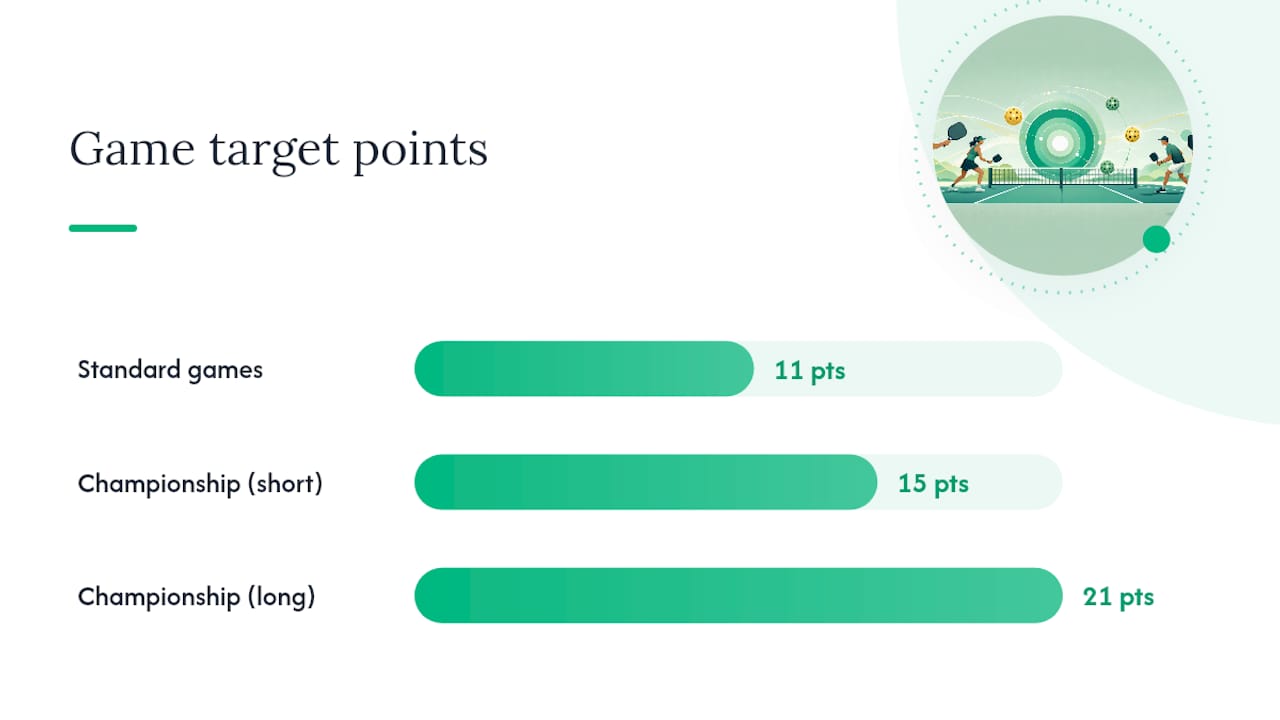
Standard games usually run to eleven points, and the winning side has to lead by at least two. A 10-10 tie doesn’t end at 11-10; it keeps going until someone opens a two-point gap. Tournament directors sometimes stretch that target to 15 or 21 points for championship rounds, but the win-by-two rule almost always holds regardless of the target score.
- Only the server’s team can score a point.
- A fault by the receiving side scores the serving team.
- A fault by the serving side triggers a side-out, no point awarded.
- Games typically end at 11, but require a two-point margin.
How Do You Call the Score in Doubles Pickleball?
Doubles scoring uses a three-number call: serving team’s score, receiving team’s score, server number (1 or 2). If you hear “4-2-1,” the serving team has 4 points, the receiving team has 2, and the first server on that team is up. The official rulebook requires this full call before every single serve, no exceptions.
Here’s the quirk that trips up almost everyone new to the sport: the very first serve of the game starts at 0-0-2, not 0-0-1. Because side-out scoring gives the serving side such a big advantage, the rules dock the first serving team one server for that opening sequence. Only one partner serves before the first side-out; every service turn after that follows the normal pattern.
- Server 1 serves until their team faults, then server 2 takes over (except that opening 0-0-2 sequence).
- Both partners serve in turn before the serve passes to the other team.
- After winning a point, the server switches sides on the court with their partner before serving again.
- When the serving team faults on server 2, that’s a full side-out, and the serve moves to the other team.
Pro Tip: Say the entire three-number score out loud before every serve, even in a casual backyard game. It forces both teams to agree on the count in real time, which is exactly what the rulebook intends and what stops arguments before they start.
What’s Different About Singles Scoring?
Singles drops the server number entirely since there’s no partner to track. You’ll just hear two numbers: the server’s score, then the receiver’s score, like “5-3.”
Court positioning follows the score instead of a rotation. When the server’s score is even, they serve from the right, or even, side. When it’s odd, they serve from the left, or odd, side.
- No server number is called, only two numbers.
- Even server score means serving from the right/even court.
- Odd server score means serving from the left/odd court.
- A server fault still triggers an immediate side-out, same as doubles.
What Are the Common Alternate Scoring Formats?
Rally scoring flips the core rule: either team can score on any rally, server or receiver. It’s common in professional and league play, where matches need to fit a broadcast window or a tight event schedule. Pickleball notes that side-out scoring still dominates recreational courts, while rally scoring shows up more in competitive and league formats where pace matters.
Some rally-scoring formats include a provisional wrinkle worth knowing: game point sometimes only counts when the serving team is the one serving, which prevents a match from ending abruptly on a receiving-team rally. Tournament directors set these details in advance, along with the target score.
- Rally scoring: every rally counts for someone, win or serve.
- Best two of three games to eleven is a common tournament format.
- Single games to 15 or 21 appear in championship or exhibition formats.
- Freeze and MLP-style team formats layer additional endgame rules on top of standard scoring.
For a deeper breakdown of how rally scoring actually plays out point by point, Flexleagueplus has a full rally scoring explainer worth bookmarking.
What Mistakes Do Beginners Make When Scoring?
The single biggest mistake is skipping the server number in doubles, or worse, calling only part of the score. Players also lose track of whether they’re “server 1” or “server 2” after a side-out, which snowballs into arguments a few rallies later.
- Skipping the server number or shortening the score call.
- Losing track of server 1 versus server 2 after a side-out.
- Assuming the score without saying it out loud.
- Forgetting the 0-0-2 exception at the start of the game.
Coaches at the PPA Tour point out that new players consistently misremember the server number, and their fix is simple: over-communicate. Call the full score before every serve, keep a visible scoreboard or app on the sideline, and don’t be shy about pausing play to confirm the count when you’re still learning.
Pro Tip: If you’re new to doubles, tap your chest and hold up one or two fingers as you call your number. It sounds silly until it saves you from a five-minute argument at 8-7-2.
Quick Scoring Walk-Throughs You Can Practice Right Now
- Game start: The score is 0-0-2. Server 2 on the first team serves and wins the rally. New call: 1-0-2. Win again: 2-0-2. Fault: side-out, serve passes to the other team at 0-2-1.
- Deuce at 10-10: Neither team can close it out at 11. Play continues until one side leads by two, whether that’s 12-10 or 15-13.
- Rally scoring at game point: The score sits at 10-9 in a rally format. Either team can win the next rally outright, unlike side-out scoring, where the receiving team would only force a side-out, not a win.
How Flexleagueplus Keeps League Scoring Consistent
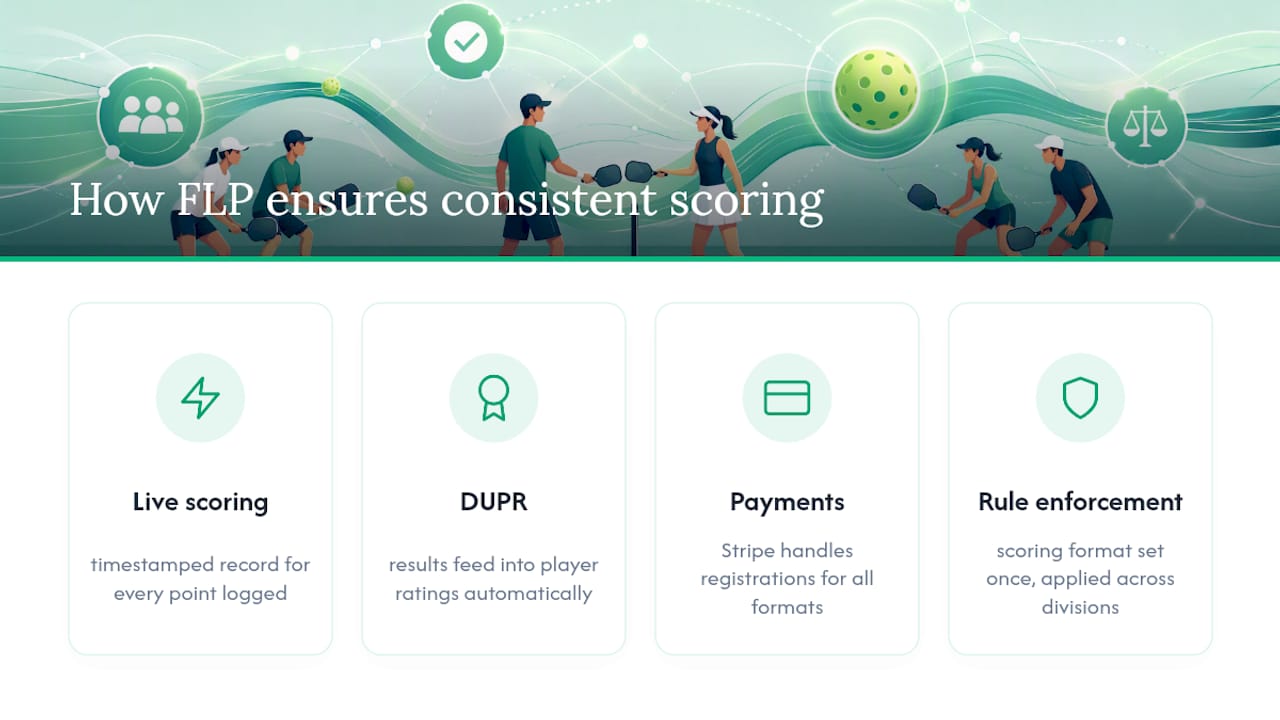
Rulebooks explain the system; software enforces it. Flexleagueplus lets organizers report match scores directly into live standings, so there’s a timestamped record every time a side-out or rally point gets logged. That traceability alone kills most post-match disputes before they start.
The platform also connects to DUPR, so results feed into player ratings without manual entry, and Stripe handles registration payments for singles, doubles, mixed, and FLP team leagues. If you’re running a league and want the scoring format locked in from week one, the Flexleagueplus league management software sets that rule once and applies it across every division automatically.
Why Getting the Score Call Right Still Matters
I’ve watched enough weekend league play to know that scoring disputes rarely come from bad faith. They come from someone forgetting whether they’re server 1 or server 2, or from a score call that got mumbled at 9-8. Fix that one habit, calling the full score every time, and most conflict disappears on its own.
Practice the walk-throughs above until they’re automatic, and if you’re organizing a league rather than just playing in one, look at automated score reporting before your first season starts. It saves arguments nobody wants to have on a Tuesday night.
— Robert
Where to Verify the Official Pickleball Scoring Rules
For the definitive word, go straight to the USA Pickleball official rulebook PDF or the official rules resource page. For plain-language breakdowns, the PPA Tour’s coaching guide and Pickleball.com’s scoring explainer are solid companions, and Athlo’s guide on tracking sports stats without losing your mind offers scorekeeping habits that translate well to pickleball.