Best Playtomic Alternatives for US Clubs & League Managers
Best Playtomic Alternatives for US Clubs & League Managers

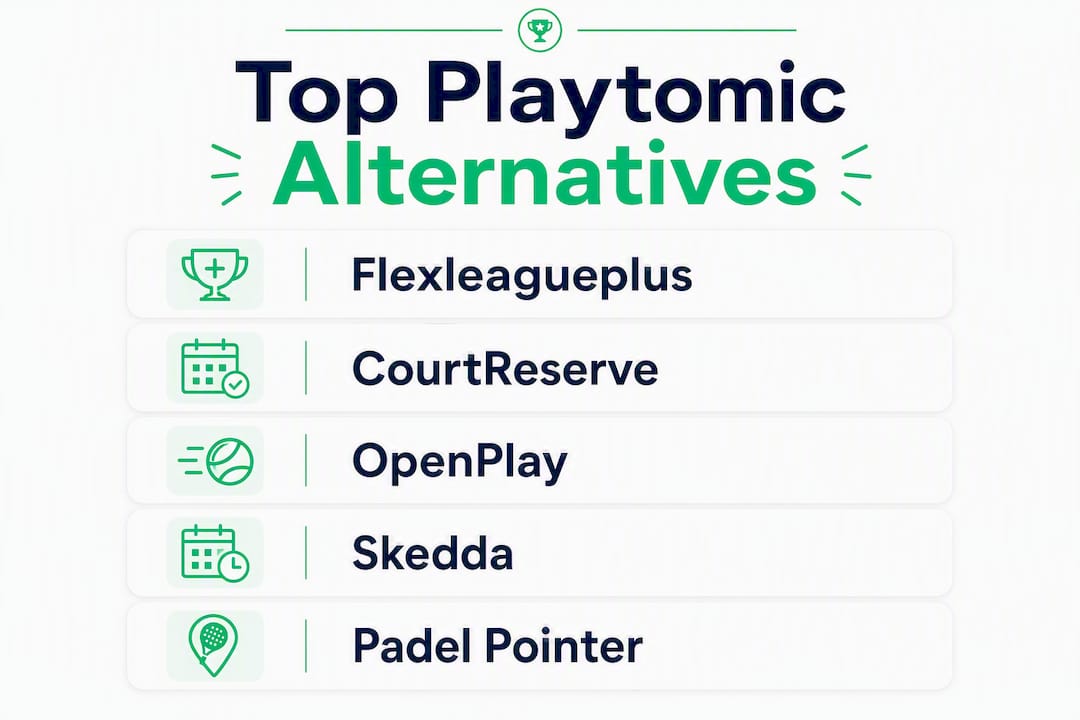
For U.S. league organizers running paid pickleball leagues, Flexleagueplus is the strongest Playtomic alternative, with DUPR-approved score reporting and Stripe-powered registration payments built in. For court booking and venue management, CourtReserve and Skedda cover most U.S. clubs well. If match analysis is the priority, Padel Pointer fills that gap. OpenPlay rounds out the shortlist for multi-sport facility operators.
Here is how each maps to a primary use case:
- Flexleagueplus — paid league management (automated scheduling, DUPR integration, Stripe payments, playoff brackets)
- CourtReserve — court reservation and club management for U.S. facilities
- Skedda — self-service space and court scheduling for private or community venues
- OpenPlay — multi-sport facility and membership management
- Padel Pointer — post-match score tracking and analysis
Start with a Flexleagueplus demo if you run paid leagues and collect registration fees. Book a CourtReserve or Skedda trial if court booking and access control are the priority.
Table of Contents
- What are the best Playtomic alternatives for U.S. clubs?
- What each platform actually does, and who it fits
- How to choose the right platform for your club or league
- How Playtomic’s marketplace model differs from league-first and analysis-first tools
- Why integrations like DUPR and Stripe matter more than they look
- Key Takeaways
- What actually drives the decision to switch platforms
- Flexleagueplus is built for what U.S. paid leagues actually need
- Useful sources for deeper research
What are the best Playtomic alternatives for U.S. clubs?
The table below covers the five most relevant Playtomic alternatives available to U.S. clubs and league managers, scored across the dimensions that actually drive vendor decisions.

| Platform | Primary focus | Pricing model | League features | Payment processing | Rating integration | Platform | Network / discovery | U.S. support |
|---|---|---|---|---|---|---|---|---|
| Flexleagueplus | Paid league management | Transaction-based (no manager subscription) | Automated scheduling, divisions, standings, brackets | Stripe | DUPR-approved | iOS, Android, web | League-specific; no open marketplace | Yes |
| CourtReserve | Court reservation & club management | Subscription (tiered by member count) | Basic scheduling; limited bracket tools | Stripe | Proprietary / none listed | iOS, Android, web | Club-facing; no open marketplace | Yes |
| OpenPlay | Multi-sport facility & membership | Subscription | Membership and session management | In-app payments | None listed | iOS, Android, web | Facility-facing | Limited U.S. presence |
| Skedda | Self-service space scheduling | Subscription (free tier available) | None native | Stripe | None | Web, iOS, Android | Private/community courts | Yes |
| Padel Pointer | Match analysis & score tracking | Free / freemium | None | None | Proprietary match stats | iOS, Android | Player-to-player | Limited |
Bottom line: Flexleagueplus is the clear pick for paid league organizers who need automated scheduling, DUPR reporting, and Stripe-based fee collection. CourtReserve and Skedda suit clubs where court booking and access management come first. Padel Pointer belongs in a player’s toolkit, not a club manager’s.
What each platform actually does, and who it fits
Flexleagueplus
Flexleagueplus is purpose-built for paid pickleball leagues. Managers can create singles, men’s doubles, women’s doubles, mixed doubles, and FLP team formats (modeled on Major League Pickleball). Players register, organize matches, and report scores through the app, with registration fees collected via Stripe and scores fed directly into DUPR.
Pros:
- DUPR-approved integration means scores count toward players’ official ratings, which drives sign-up motivation
- Stripe payment processing handles registration fees with no separate merchant account setup
- Automated scheduling, live standings, division management, and playoff brackets reduce admin time significantly
- No subscription required for managers; costs scale with actual league activity
Cons:
- Focused on pickleball leagues; not a general court booking marketplace
- No open player discovery network for filling spare court slots
Best for: League organizers, parks departments, and facility operators running paid pickleball leagues in the U.S.
Trial/pricing: Transaction-based model with no manager subscription. Visit flexleagueplus.com/pickleball-league-software to request a demo.
CourtReserve
CourtReserve is a U.S.-focused court reservation and club management platform used by tennis and pickleball facilities. It handles court booking, member management, event registration, and basic scheduling under a tiered subscription model priced by member count.
Pros:
- Strong U.S. presence with dedicated support
- Stripe integration for payment collection
- Covers court booking, clinics, and member communications in one dashboard
Cons:
- League scheduling tools are basic compared to a dedicated league platform
- Subscription costs scale with membership size, which can get expensive for larger clubs
- No DUPR integration listed
Best for: U.S. tennis and pickleball clubs that need court reservation and member management as the core function, with league scheduling as a secondary need.
Trial/pricing: Tiered subscription; pricing is available on request via demo.

OpenPlay
OpenPlay targets multi-sport leisure facilities and membership-based venues. It covers facility management, memberships, session booking, and reporting. Its roots are in the U.K. market, which means U.S. support and onboarding can be slower than with domestic alternatives.
Pros:
- Handles multi-sport facilities well (tennis, padel, squash, fitness)
- Membership management and session booking in one platform
- Solid reporting tools for facility operators
Cons:
- Limited U.S. presence and support infrastructure
- No DUPR integration
- League scheduling is not a core feature
Best for: Multi-sport facility operators who need membership and session management across several court types, and who are comfortable with a platform that has stronger European roots.
Trial/pricing: Subscription model; demo available on request.
Skedda
Skedda is a self-service space scheduling tool used by HOAs, residential communities, corporate campuses, and private clubs. It is not a racket-sport-specific platform, but it handles court booking, access rules, and payment collection cleanly. A free tier is available for smaller venues.
Pros:
- Free tier makes it accessible for small private courts and community facilities
- Stripe integration for paid bookings
- Clean, simple interface that non-technical managers can configure quickly
- Strong access-control rules (who can book, when, how often)
Cons:
- No league scheduling, standings, or bracket tools
- No DUPR or rating integration
- Not a player discovery marketplace; works only for closed communities
Best for: HOA-managed courts, residential communities, and private clubs that need self-service booking without marketplace exposure or league complexity.
Trial/pricing: Free tier available; paid plans via subscription. Pricing is publicly listed on Skedda’s website.
Padel Pointer
Padel Pointer focuses on match analysis and score tracking rather than booking or league management. Padel Pointer recommends dedicated match-analysis apps when post-match review and reliable score-tracking are the priority rather than pure booking. It is a player-facing tool, not a club management platform.
Pros:
- Detailed match stats and post-match review tools
- Free or freemium access lowers the barrier for individual players
- Useful for players who want to track performance trends over time
Cons:
- No court booking, league scheduling, or payment processing
- No DUPR integration
- Not designed for club or league managers
Best for: Individual players who want to analyze their game after matches, independent of any booking or league platform.
Trial/pricing: Free or freemium; no subscription required for core features.
Pro Tip: If you run paid leagues AND want players to track their performance, pair Flexleagueplus (for league operations and DUPR reporting) with Padel Pointer (for individual match analysis). The two tools cover different jobs and do not overlap.
How to choose the right platform for your club or league
Questions to ask on every vendor demo
- Does the platform integrate directly with Stripe for payment collection, or does it use a proprietary payment processor with additional fees?
- Is DUPR integration live and approved, or is it on a roadmap?
- Does the platform support automated scheduling that mirrors your specific league format (round-robin, divisions, brackets)?
- Who owns the member data? Can you export it at any time, in full?
- Does the platform offer facility hardware APIs for gate access, court lighting, or lock automation?
- What does the pricing look like at your current scale, and how does it change as your league or membership grows?
- Is there a sandbox or trial environment that includes automated scheduling, not just the booking interface?
Red flags to watch for during a trial
- No transparent pricing on the website; pricing only revealed after a sales call
- Marketplace-only model for a private or residential court (you pay per-booking commissions on courts that were never meant to be publicly listed)
- Missing payment integration, requiring a separate merchant account or manual invoicing
- Scheduling automation that requires manual overrides for basic league formats
- No data export option or vague answers about member data ownership
Commission vs. subscription: which model fits your situation
The right pricing model depends on your venue type and volume.
- Marketplace commission models work well for commercial centers trying to fill spare court time with new players. Transaction fees can reduce venue revenue over time compared with flat-rate alternatives, so they make most sense when discovery value justifies the cost.
- Subscription models (CourtReserve, OpenPlay, Skedda) give predictable monthly costs. They suit clubs with stable membership where filling empty slots via a public marketplace is not the goal.
- Transaction-based SaaS (Flexleagueplus) charges only when a player registers and pays for a league. No activity, no cost. For organizers running seasonal leagues, this often beats a flat monthly subscription.
How Playtomic’s marketplace model differs from league-first and analysis-first tools
Playtomic built its product around court discovery at scale: numerous courts across many countries and a large player base worldwide. That scale is genuinely useful for commercial centers that want to fill empty slots with players they have never met. But that same model creates friction for private clubs, residential courts, and league organizers who do not want their courts listed on a public marketplace.
The four platform types serve different jobs:
- Booking-first marketplaces (Playtomic’s model): best for commercial venues that want public visibility and new player acquisition. Per-booking commissions are the trade-off.
- Club/venue management SaaS (CourtReserve, OpenPlay, Skedda): best for facilities that need member management, access control, and court scheduling without public exposure. Subscription pricing gives cost predictability.
- League-first platforms (Flexleagueplus): best for organizers running structured paid leagues with registration, automated scheduling, standings, and DUPR score reporting. The pickleball league software model is built around the league lifecycle, not the individual booking.
- Match-analysis tools (Padel Pointer): best for players who want to review performance data after matches. No booking or scheduling functionality.
A concrete example: a city parks department running a 12-week paid pickleball league needs registration, automated round-robin scheduling, live standings, and Stripe-based fee collection. A marketplace app built for filling spare court slots is the wrong tool for that job. A residential HOA with two courts and 40 members needs simple self-service booking with access rules and no public listing. A league platform is overkill there.
Regional market fit matters too. In the U.S., Playtomic’s court network is thinner than in Europe, which reduces the discovery advantage that justifies marketplace commissions for American clubs.
Why integrations like DUPR and Stripe matter more than they look
The operational impact of DUPR and Stripe goes beyond convenience.
DUPR (Dynamic Universal Pickleball Rating) is the dominant player rating system in the U.S. When a league platform is DUPR-approved, every match result flows directly into players’ official ratings. That matters for recruitment: players are more likely to join a paid league when they know their scores count. Flexleagueplus carries that DUPR approval, which is a real differentiator against platforms that offer only proprietary or no rating systems.
Stripe handles payment collection in a way that most club managers already trust. It processes registration fees securely, handles refunds, and integrates with existing accounting workflows. Platforms that rely on proprietary payment systems or manual invoicing add friction at the exact moment a player is deciding whether to register.
Facility hardware integrations are the most overlooked factor in vendor selection. Gate access, court lighting automation, and lock control tied to a booking or league platform can cut on-site staffing requirements substantially. When vetting vendors, ask for API documentation and a sandbox environment during the trial period. Platforms that provide test keys upfront are far less likely to surprise you during deployment.
Many clubs start with marketplace apps for visibility but move away after seeing recurring service-fee drag on revenue. The pattern is consistent: early-stage venues value discovery; established clubs value control, data ownership, and predictable costs. The 2026 trend toward no-fee and subscription models among residential communities and small private clubs reflects that shift.
Pro Tip: Before signing any platform contract, ask the vendor to show you a line-item breakdown of what a player pays versus what your venue receives per transaction. The gap between those two numbers is the real cost of a marketplace model.
Key Takeaways
Flexleagueplus is the strongest Playtomic alternative for U.S. paid league organizers, combining DUPR-approved score reporting, Stripe payment processing, and automated scheduling in a transaction-based model with no manager subscription.
| Point | Details |
|---|---|
| Match platform to use case | Booking marketplaces, venue management SaaS, league-first platforms, and analysis tools solve different problems; pick by job-to-be-done. |
| Commission vs. subscription | Marketplace fees reduce venue revenue over time; subscription or transaction-based models suit private clubs and league organizers better. |
| DUPR integration drives sign-ups | DUPR-approved platforms give players an official rating incentive to join paid leagues, which directly supports registration numbers. |
| Ask for Stripe and API proof | Confirm Stripe integration and request facility API documentation during every demo; vague answers here are a red flag. |
| Flexleagueplus for paid leagues | Flexleagueplus covers automated scheduling, DUPR integration, Stripe payments, and playoff brackets with no manager subscription fee. |
What actually drives the decision to switch platforms
The conventional wisdom says clubs switch platforms because of price. That is rarely the whole story. The managers who make the cleanest transitions tend to have one thing in common: they got specific about what job the software needed to do before they started evaluating vendors.
A league organizer running three paid pickleball leagues per season does not need a marketplace. They need a system that handles registration, builds the schedule automatically, tracks standings in real time, and collects fees without a separate payment tool. When that organizer evaluates a booking marketplace, the feature set looks impressive until they realize the scheduling automation does not handle round-robin divisions, the payment flow requires manual reconciliation, and their player data lives on the vendor’s platform.
The analysis-first tools have a similar mismatch problem. Padel Pointer is genuinely useful for players who want to review their match data. But a club manager cannot run a league on it. Conflating “I want players to track their performance” with “I need a league management platform” leads to a second migration six months later.
The platforms that hold their customers longest tend to be the ones that do one job extremely well rather than approximating several jobs adequately. For U.S. paid league organizers, that means a platform with real DUPR integration, real Stripe connectivity, and scheduling automation that mirrors the formats they actually run. The discovery network that makes Playtomic compelling in Europe is simply less relevant in a market where the league organizer already knows their players.
Flexleagueplus is built for what U.S. paid leagues actually need
Running a paid pickleball league means collecting registration fees, building schedules automatically, tracking standings across divisions, and reporting scores to DUPR. Most court booking platforms handle one or two of those jobs. Flexleagueplus handles all of them, with no manager subscription required.
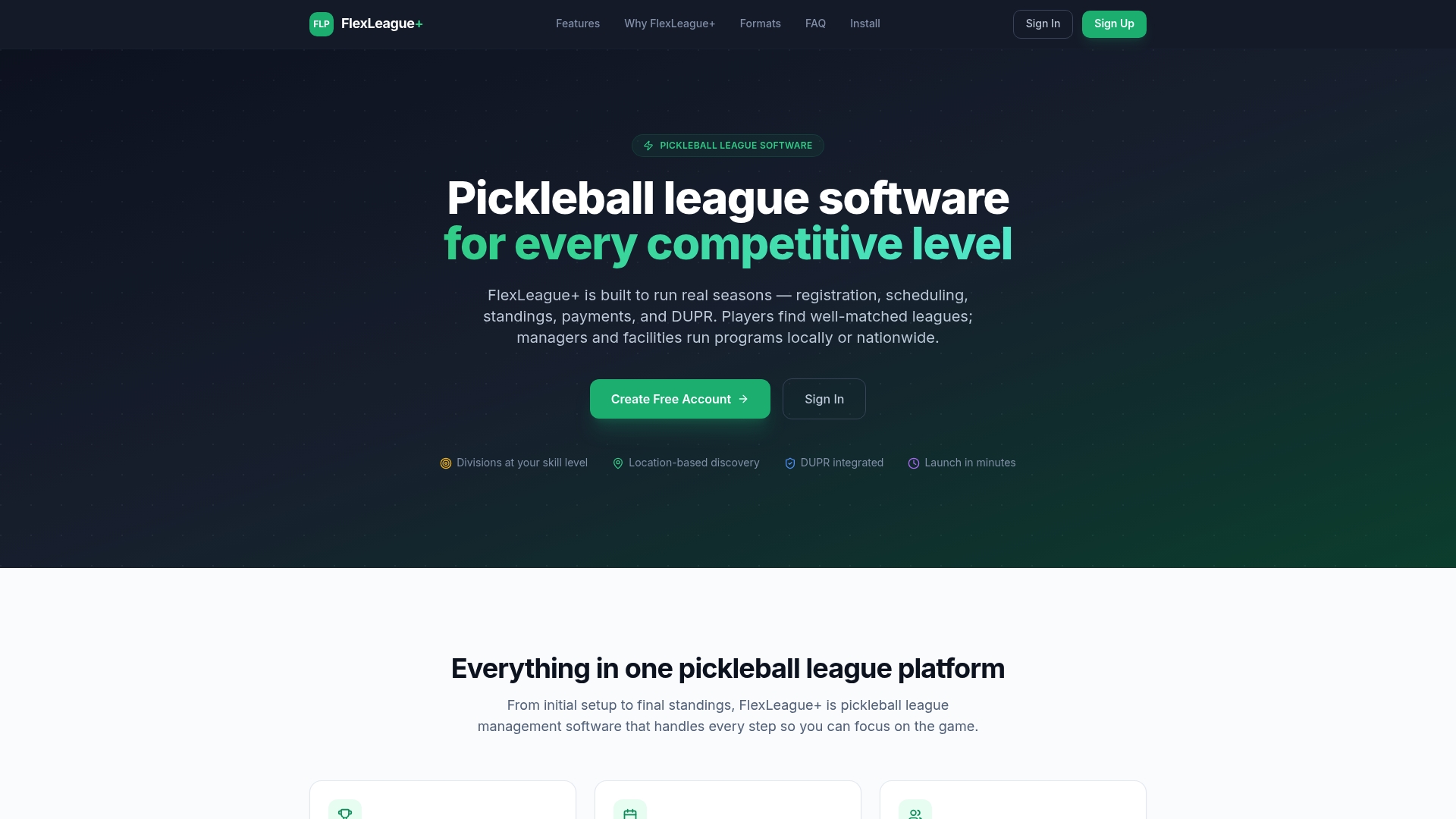
The platform supports singles, men’s doubles, women’s doubles, mixed doubles, and FLP team formats. Stripe processes registration payments directly, so there is no separate merchant account to manage. DUPR approval means every match result counts toward players’ official ratings, which gives players a concrete reason to register and return. Live standings, playoff brackets, and division management are all built in.
For U.S. league organizers who have outgrown a booking app or a spreadsheet, Flexleagueplus is the direct answer. Start with a demo at flexleagueplus.com to see the scheduling and payment flow with your own league format.
Useful sources for deeper research
The claims in this article draw from the following sources. Use them to verify specifics and dig into vendor details before committing to a demo.
| Stat / claim | Source |
|---|---|
| Playtomic: 2M+ players | padelsnipe.com |
| Marketplace fees reduce venue revenue vs. flat-rate models | bookrgo.app |
| Padel Pointer: analysis-first positioning | padelpointer.com |
Vetted sources used in this article:
- Padel Pointer — Primary source for match-analysis tool positioning and score-tracking use cases.
- Padel USA — U.S. padel and racket sport industry context.
- Six-Love: Court Reservation Systems — Technical reference for facility hardware API integration and access control in court booking systems.
- Six-Love Blog: Building the Best Court Booking Software — Development-focused breakdown of booking system features including access control and UX decisions.
- Flexleagueplus Pickleball League Software — Primary product page covering DUPR integration, Stripe payments, and league format support.
- Best Pickleball Scheduling App for League Organizers — Practical scheduling guidance for U.S. league organizers.
- How to Start a Pickleball League — Step-by-step operational guide for new league organizers in the U.S.