Playoff Qualification Rules: 8–16 Teams, Tiebreaker Math, Organizer Checklist
Playoff Qualification Rules: 8–16 Teams, Tiebreaker Math, Organizer Checklist

Playoff qualification rules are the formulas leagues use to decide which teams make the postseason, how they’re seeded, and how ties get resolved when the math gets close. Every major league leans on some mix of division winners, wild cards, and ordered tiebreaker lists. The specifics change by sport: the NFL and NHL still fill brackets with a division-plus-wild-card model, MLB now settles ties with math instead of extra games, and college football leans on a selection committee instead of pure standings. The rest of this guide breaks down each league on its own terms.
TL;DR:
- Teams qualify based on regular-season record and seeding criteria, with league-specific tiebreakers like head-to-head results and strength of schedule.
- The playoff format (single-elimination, series, round robin) depends on league priorities such as TV audience, fairness, or guaranteed games.
- Roster and eligibility deadlines are strict and can disqualify players if missed, with leagues typically publishing clear cutoff dates.
- Postseason structures have evolved to favor more automatic qualifiers and math-based tiebreakers, reducing the need for extra games.
- Discipline rules and sanctions can retroactively affect playoff eligibility, especially in closely contested standings.
Table of Contents
- Playoff Qualification Rules and the Vocabulary Behind Them
- How Teams Qualify for the NFL Playoffs
- MLB’s Postseason Field, Byes, and Tiebreaker Math
- NHL Stanley Cup Playoffs: Division Winners and Wild Cards
- NWSL and Single-Elimination Soccer Playoffs
- College Football Playoff and Other College Selection Methods
- High School Playoff Rules: The CIF Southern Section Example
- Tiebreakers and Roster Deadlines That Decide Fields
- How to Confirm Playoff Eligibility Step by Step
- How Regular-Season Performance Shapes the Playoff Field
- How Qualification Rules Have Changed and Where Exceptions Remain
- Division Standings vs. League-Wide Standings
- When Discipline and Sanctions Affect Playoff Eligibility
- An Organizer’s View on Clear Rules and Fewer Disputes
- Sources
Playoff Qualification Rules and the Vocabulary Behind Them
Before comparing leagues, it helps to know the handful of terms that show up in nearly every rulebook. A seed is a team’s rank within the bracket, which determines who it plays and, often, where. A bye lets a top seed skip the opening round entirely, a reward for a strong regular season. A wild card is a playoff spot awarded on overall record rather than for winning a division or conference.
Formats split into three broad types. Single-elimination brackets end a team’s season with one loss, which the NWSL and most college sports use. Best-of series (best-of-five or best-of-seven) reward sustained performance over a short losing streak, which is why the NHL and MLB use them once the field is set. Round robin and hybrid formats mix pool play with elimination rounds, common in amateur and club tournaments where every entrant needs a guaranteed number of games.
Leagues pick a format based on what they’re optimizing for. A single elimination bracket compresses a tournament into a tight, TV-friendly window. A best-of-seven series smooths out one bad night and rewards the team that’s better over time, which is why the NHL and MLB use it once the field narrows. Round robin pool play, by contrast, guarantees participants a minimum number of games, which matters when teams have traveled and paid to compete.
A few real examples make this concrete:
- The NHL uses top-three-per-division seeding, then fills two extra “wild card” slots per conference to reach 16 teams.
- MLB gives its top two division winners in each league a bye straight to the Division Series.
- The NWSL runs a clean 1-through-8 single-elimination bracket with no byes at all.
- Amateur leagues using pool standings converted into elimination brackets often blend round robin fairness with single-elimination drama.
Pro Tip: If you’re setting up a league bracket yourself, decide your format around your constraint, not your preference. Limited court or field time favors single elimination; a format built to reward consistency favors series play or a round robin group stage.
How Teams Qualify for the NFL Playoffs
Seven teams per conference make the NFL playoffs: four division winners and three wild cards, for 14 teams total across both conferences. That single sentence covers most of what casual fans need to know, but the seeding mechanics are where it gets interesting.
Seeds 1 through 7 in each conference are set by regular-season winning percentage, not raw win totals, which matters in years with a tie in the standings. The No. 1 seed gets the only bye in the current 14-team format, and hosts a home game in the Divisional Round regardless of who wins other matchups. Seeds 2 through 4 always belong to division winners; seeds 5 through 7 go to the top non-division-winning teams by record.
When two or more teams finish level, the NFL works through a published tiebreaker sequence:
- Head-to-head record between the tied teams, if they played each other.
- Best record within their own division (for division ties).
- Best record within the conference.
- Best record against common opponents.
Only if those steps fail to separate teams does the process move into strength-of-victory and strength-of-schedule calculations. The full, official ordered list lives in the league’s operations manual, and it’s worth bookmarking if you follow tight divisional races every December, since the order of these criteria occasionally decides which team hosts a playoff game rather than travels to one.
MLB’s Postseason Field, Byes, and Tiebreaker Math
Twelve teams make the MLB postseason, six per league: three division winners and three wild cards. The top two division winners in each league get a bye straight into the Division Series, while the third division winner and the three wild card teams play a best-of-three Wild Card Series to advance.
Seeding within each league runs 1 through 6 based on regular-season record, with the No. 1 and No. 2 seeds sitting out the opening round entirely. That gap between “in the playoffs” and “playing this weekend” is bigger in baseball than in almost any other league.
The bigger structural change came in how MLB handles ties. The league eliminated Game 163, the old one-game tiebreaker that used to decide division titles and wild card spots on the final day of the season. Now ties resolve through an ordered list of statistical criteria, starting with head-to-head record between the tied teams and moving through intradivision and interleague performance if needed.
By the numbers: MLB’s postseason field size (12 teams, six per league, with the top two division winners in each league earning a first-round bye) has been in place since the 2022 realignment, and the shift away from Game 163 was designed specifically to keep the postseason calendar from sliding.
Series length scales up as the field narrows: the Wild Card Series is best-of-three, and the Division Series, Championship Series, and World Series are all best-of-seven.
NHL Stanley Cup Playoffs: Division Winners and Wild Cards
Sixteen teams reach the Stanley Cup Playoffs: the top three finishers in each of the league’s four divisions, plus two additional wild card teams per conference. That’s the entire qualification question in one sentence, but the bracket construction underneath it rewards paying attention.
Wild card teams don’t get slotted against each other. Instead, the format pits the top wild card team from each conference against the division winner with the best record outside its own division, while the second wild card faces the other top division winner. That rule exists specifically to prevent two strong division rivals from having to face off before the second round, just because they happened to finish 2nd and 3rd in the same division.
Every round, without exception, is a best-of-seven series. There’s no single-elimination round anywhere in the NHL playoff bracket, which is part of why lower seeds occasionally run through the whole thing. Home-ice advantage in each series goes to the team with the better regular-season record, not strictly to the higher seed number, which can produce a wild card team hosting Games 1, 2, 5, and 7 against a division winner with a worse points total.
A few mechanics worth knowing:
- Division standings decide who’s “in” before conference-wide wild card slots are even calculated.
- The two conference wild cards are ranked by overall points, not by division finish.
- Reseeding within a conference happens as teams advance, based on remaining playoff seed rather than fixed bracket slots in some rounds.
NWSL and Single-Elimination Soccer Playoffs
Eight teams make the NWSL playoffs: the top eight clubs in the regular-season standings, seeded 1 through 8, in a straight single-elimination knockout. There’s no group stage and no byes. Seed 1 plays seed 8, seed 2 plays seed 7, and so on, the classic bracket-pairing structure used across most American soccer and many college tournaments.
Hosting is tied directly to seeding. The higher-seeded team hosts every match through the semifinal round, which gives the regular season real teeth. A club that finishes first overall plays every game before the final at home, a meaningful advantage in a league where travel and unfamiliar pitches genuinely affect results. Exceptions can occur when a venue isn’t available on the required date, but those are logistical workarounds, not a change to the seeding rule itself.
Tie resolution in a knockout match follows soccer’s standard procedure: 90 minutes of regulation, then two 15-minute periods of extra time if the score is level, then a penalty shootout if it’s still tied. One quirk worth knowing: the NWSL treats postseason discipline as a fresh slate, meaning yellow card accumulation from the regular season doesn’t carry over into playoff suspensions, which is a different mechanism than the roster deadlines that govern other leagues.
College Football Playoff and Other College Selection Methods
The College Football Playoff doesn’t use a standings formula at all. A selection committee ranks teams using its own criteria, including conference championships, head-to-head results, and strength of schedule, then fills the bracket from that ranking rather than any single statistical cutoff. That’s the single biggest difference between the CFP and every pro league covered above: there’s no tiebreaker math to look up, because there’s no hard numerical formula to begin with.
Conference championship games still matter enormously, since winning one is often the difference between an automatic-adjacent ranking boost and being left on the outside of the field. But a team can, in theory, miss its own conference title game and still get selected if the committee ranks it highly enough on the strength of its overall body of work.
Most other college sports don’t work this way. NCAA basketball, baseball, and soccer tournaments typically combine two paths into the bracket:
- Automatic qualifiers, where a conference’s regular-season or tournament champion earns a guaranteed slot regardless of national ranking.
- At-large selections, where a separate committee fills remaining bracket spots using metrics like strength of schedule, quality wins, and overall record.
That two-path structure, one door based on winning your league and another based on being good enough overall, shows up in some form across nearly every college postseason format, even when the specific formula differs sport to sport.
High School Playoff Rules: The CIF Southern Section Example
Scholastic playoff rules solve a problem pro leagues rarely face: uneven schedules across hundreds of small programs, some of which have no conference at all. The CIF Southern Section Blue Book is a useful real-world example of how that gets managed.
Schools that don’t belong to a qualifying league can enter as freelance teams, but only if they meet minimum scheduling thresholds set by the section, essentially proving they’ve played a real season against real competition. Freelance and at-large teams generally need a .500 record or better to even be considered for a playoff draw, a bar that keeps a team that scheduled a soft slate from crowding out a program that played a tougher one.
When league automatic qualifiers don’t fill an entire bracket, section committees use at-large selection and wildcard contests to fill the remaining spots, weighing strength of schedule and results against comparable programs.
Two eligibility pitfalls trip up scholastic programs more than anything else:
- Transfer rules, which can sideline a player for a set period after switching schools outside standard enrollment windows.
- Residency requirements, which determine whether a student is even eligible to represent a given school’s team at all.
Pro Tip: If you help run a scholastic or club program, treat your section’s eligibility rulebook as a living document. It’s the CIF Blue Book, an NFHS bylaw list, or your governing body’s equivalent, but a five-minute check each August prevents disqualification headaches every October.
Tiebreakers and Roster Deadlines That Decide Fields
Two-team ties are usually simple: head-to-head record settles most of them outright. Three-team and multi-team ties are where things get complicated, because a clean sweep among three tied clubs is rare, so leagues fall back on secondary criteria like intradivision record, intraleague or conference record, and performance over a team’s final games.
MLB’s approach is the clearest illustration of where the sport is heading. Rather than stage an extra game to settle a tie, the league now runs every tied scenario through an ordered statistical list, starting with head-to-head record and moving through progressively broader criteria until one team separates from the pack. That shift wasn’t cosmetic. Standing tiebreaker games created real scheduling risk for a sport that already runs deep into October, and math resolves a tie the moment the regular season ends rather than a day later.
By the numbers: the move away from one-game tiebreakers reflects a broader trend across leagues toward settling standings with statistics rather than an extra contest, largely to protect a fixed postseason calendar from slipping.
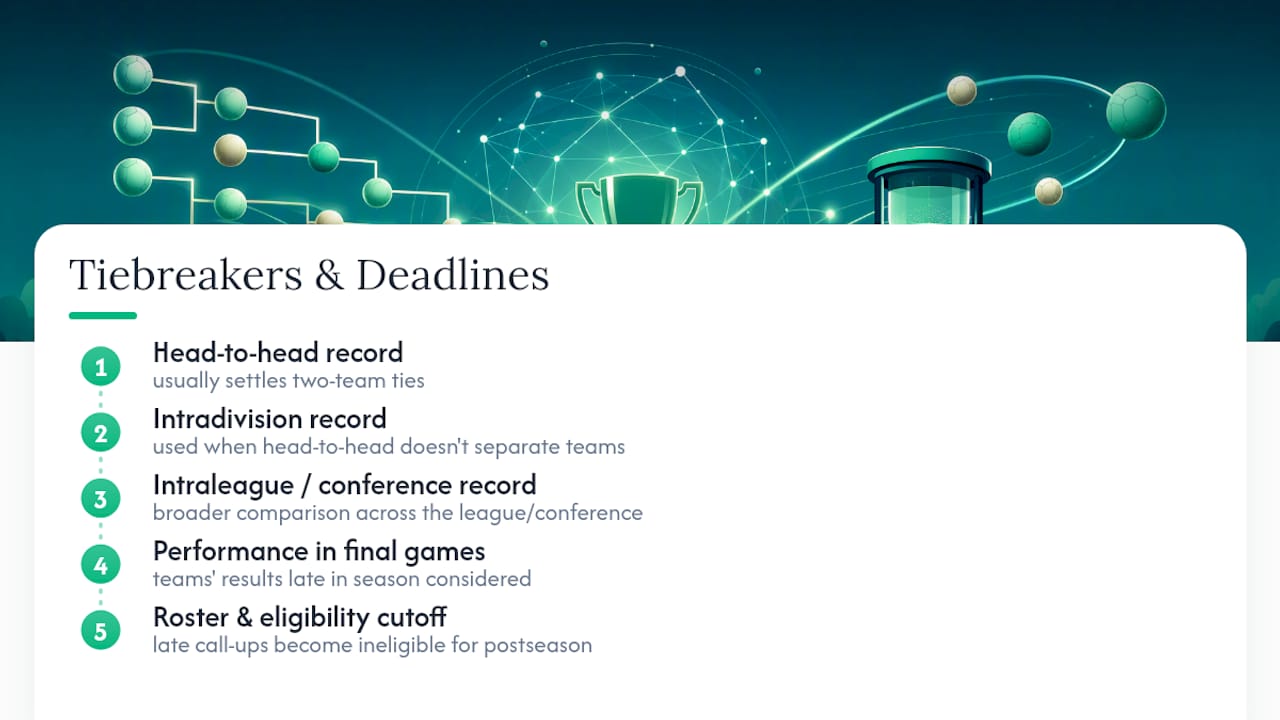
Roster and eligibility deadlines cause disqualifications just as often as standings math, and they get far less attention. In MLB, a player called up after the roster freeze simply isn’t eligible for the postseason roster, no matter how well he played in September. Leagues set these cutoffs to stop teams from stacking a roster at the last minute with players who didn’t contribute to the regular-season push that earned the playoff spot.
How to Confirm Playoff Eligibility Step by Step
- Find the official rulebook. Every league publishes a format page, whether that’s an NFL operations manual, MLB.com’s postseason explainer, or a conference handbook. Start there, not with a forum thread.
- Check the standings cutoff and tiebreaker order. Confirm exactly which record, conference, or division comparison applies to your specific tie scenario.
- Verify roster and registration deadlines. Know the exact date a player or team needed to be on file, not just the date the season ends.
- Document games played and minimums met. Scholastic and amateur leagues especially require proof of a minimum contest count or win percentage.
- Contact the league office with evidence in hand. Bring your documentation rather than asking a general question; specific evidence gets specific answers faster.
Pro Tip: Anyone running a league on a fixed schedule should set standings and eligibility cutoff reminders a full week before the actual deadline, not on the day itself. Deadlines that fall on a weekend catch more organizers off guard than any rule change ever does.
How Regular-Season Performance Shapes the Playoff Field
Regular-season record is the raw material every qualification system is built from, even when the final selection method looks nothing like a simple standings sort. In the NFL, NHL, and MLB, winning percentage sets both who qualifies and where they’re seeded, which is why a team fighting for a division title in September is really fighting for a home game and a bye in a postseason still months away.
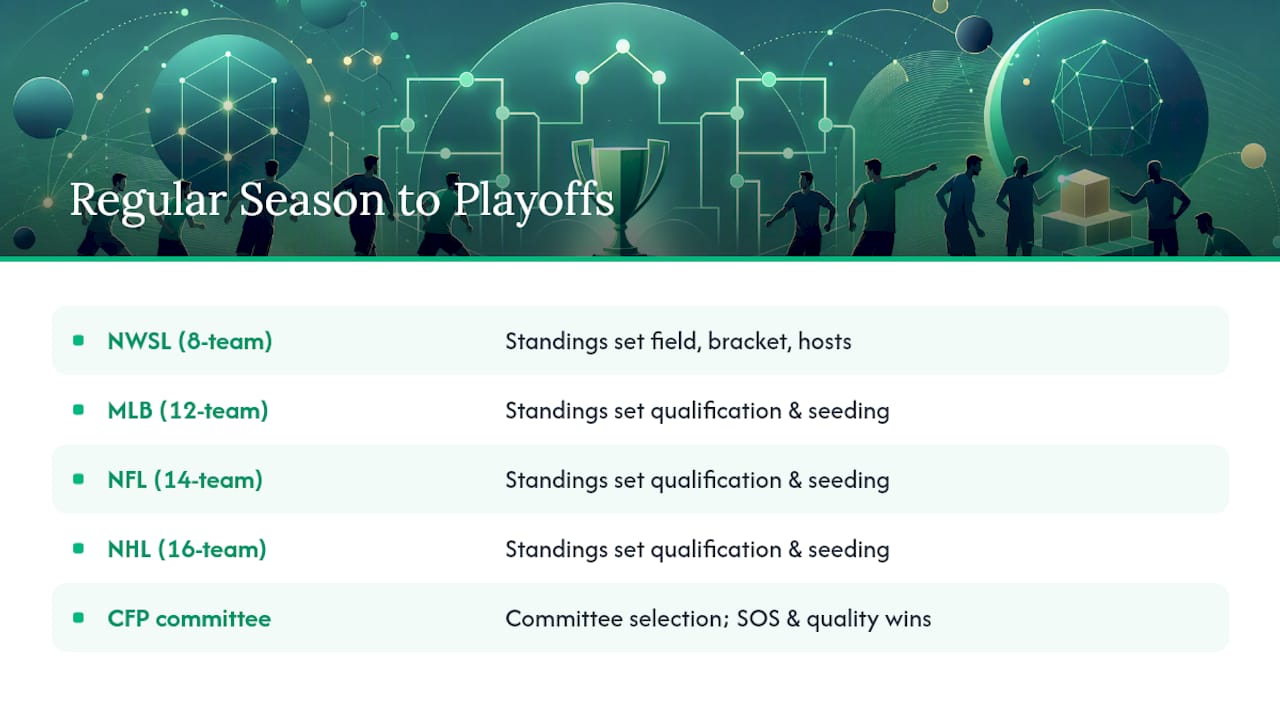
The NWSL makes that link even more direct: the same regular-season points table that determines who makes the eight-team field also sets the entire bracket and every hosting assignment through the semifinal. There’s no committee, no override, no separate ranking system layered on top.
College football is the outlier. A team’s record still matters enormously, but the CFP selection committee can weigh strength of schedule, quality wins, and conference championships in ways that occasionally put a team with a slightly worse record ahead of one with a better one. That’s a deliberate design choice, not a loophole, meant to reward playing a harder schedule over padding a win total against weaker opponents.
Across every system covered here, though, the pattern holds: teams that control their own regular season control their own playoff positioning. Ties and committee judgment only come into play at the margins.
How Qualification Rules Have Changed and Where Exceptions Remain
Postseason formats aren’t fixed. MLB’s field expanded to 12 teams and eliminated Game 163 in the same wave of changes, trading a dramatic one-game playoff for a cleaner, faster path into October. The NFL has expanded its own field over the decades, most recently adding a seventh wild card slot per conference.
Some leagues build flexibility into the format itself rather than changing the rules year to year. Minor League Baseball’s split-season structure lets a first-half division winner and a second-half division winner both qualify, even if one of them had a rough three months elsewhere in the season. That format exists specifically to keep fan interest alive in markets where a team’s playoff hopes might otherwise be mathematically dead by July.
Exceptions inside a single season are rarer but not unheard of. Weather postponements, pandemic-shortened schedules, and expansion team rules have all forced one-off adjustments to minimum games played or standings calculations in recent memory. When that happens, leagues typically publish a supplemental ruling rather than rewrite the core rulebook, which is why it’s worth checking a league’s news page during any unusual season, not just its permanent format rules.
The overall direction, though, is consistent: toward faster resolution (math over tiebreaker games) and toward larger fields (more wild cards, more automatic paths), rather than smaller, more exclusive ones.
Division Standings vs. League-Wide Standings
Almost every major league qualification system runs two standings calculations at once: one within the division, one across the conference or league as a whole. Division standings usually get first claim on a playoff spot. Win your division in the NFL, NHL, or MLB, and you’re in regardless of how that record stacks up against the league’s best team overall.
Wild card and at-large spots exist precisely to catch teams that lose that division race but still outperform most of the league. That’s the entire justification for wild cards as a category: a team finishing second in a brutally strong division might have a better record than a team that won a weak one, and the wild card format catches that team rather than punishing it for playing tougher opponents all year.
The NHL layers this two more ways than most leagues. Division rank determines the top three automatic qualifiers per division, but wild card ranking runs across the whole conference, comparing teams from different divisions directly against each other on points. That’s why a wild card matchup can occasionally look lopsided on paper. The teams being compared didn’t play identical schedules, since divisional imbalance is baked into the wild card format by design, not an oversight.
When Discipline and Sanctions Affect Playoff Eligibility
Discipline rules intersect with playoff eligibility in ways that surprise casual fans, mostly because each league handles accumulated penalties differently. The NWSL treats the postseason as a clean slate for card accumulation, meaning yellow cards racked up across the regular season don’t carry forward into playoff suspensions. A player who was one card away from a regular-season ban starts the postseason with a fresh count.
Other leagues and governing bodies take the opposite approach for serious violations. Suspensions tied to specific rule violations, rather than routine accumulated cards, typically carry their own fixed length and apply regardless of whether the games missed are regular season or postseason. A multi-game suspension for a serious on-field incident doesn’t reset just because the calendar flips to October.
Team-level sanctions are rarer but more consequential. A vacated win, a forfeited game, or a fine tied to a rules violation can shift a standings tiebreaker just enough to swing a playoff spot, particularly in tightly bunched divisional races decided by a single game. Scholastic and amateur leagues see this most often, where an ineligible-player violation discovered late in the season can retroactively cost a team a win it needed for a .500 threshold.
The consistent thread across all of it: disciplinary consequences are a separate track from standings math, but they can still reach into playoff qualification the moment a violation changes a result on paper.
An Organizer’s View on Clear Rules and Fewer Disputes
Most playoff disputes trace back to the same root cause: a rule that existed but wasn’t communicated clearly before it mattered. A player found ineligible after a bracket is set, a tiebreaker nobody double-checked until the final week, an eligibility deadline nobody flagged until it had already passed. None of these are rules problems. They’re communication problems wearing a rules costume.
Publishing deadlines early and tracking standings continuously, rather than reconstructing them the week playoffs start, prevents almost every one of these disputes. That’s a big part of why automated scheduling and standings tracking has become standard for organizers running anything bigger than a casual weekend bracket.
— Robert
Running a fair playoff field starts with a rulebook everyone can actually find. This software builds clarity into league management for pickleball organizers, keeping standings, tiebreakers, and eligibility visible to every player in real time rather than buried in a spreadsheet somebody updates on Sunday nights. If you’re organizing singles, doubles, or FLP team leagues and want automated scheduling, live standings, and playoff brackets that update themselves, the Flexleagueplus pickleball league software handles registration, DUPR integration, and Stripe payment collection in one place, so the only dispute left is who actually earned that final wild card spot.
Sources
- Playoff formats (historical overview) — NHL Records
- Mlb
- Nwslsoccer
- CIF Southern Section blue book — Playoffs (PDF)