Pickleball Tournament Formats: A Guide for Organizers
Pickleball Tournament Formats: A Guide for Organizers

For guaranteed play, choose round robin. For a fast champion, go single elimination with a consolation bracket. For the best balance of both, run a Round-Robin-to-Bracket (Group Knockout) hybrid. Those three decisions cover the majority of U.S. pickleball events.
Here is how each format maps to common event goals:
- Round robin — every player faces every other player in their pool; best for recreational and intermediate events where court time matters most
- Single elimination — clean, fast, bracket-style; best for large fields or tight schedules, but add a consolation bracket when players are traveling to compete
- Double elimination — gives every player a second chance; best for competitive amateur events with a full day and enough courts
- Round-Robin-to-Bracket (Group Knockout) — pools first, then a bracket; the gold standard for balancing guaranteed play with knockout drama
- Swiss — no eliminations, competitive pairings each round; best for DUPR-rated events where rating accuracy matters
- Ladder / team events — ongoing formats for club seasons and league play
Pro Tip: Publish your format, tie-break rules, and scoring method at registration. Players who know the rules before they arrive cause fewer disputes on event day.
Table of Contents
- What are the main pickleball tournament formats?
- How do you pick the right format for your event?
- How many courts and how much time does each format need?
- Why are hybrid formats becoming the standard in the U.S.?
- How do you seed players and break ties fairly?
- How does software simplify running these formats?
- What does a day-of runbook look like?
- Which format should you use for each event type?
- Player eligibility and ranking considerations by format
- Key Takeaways
- The format decision most organizers get wrong
- Flexleagueplus handles the scheduling work so you can run the event
- Further reading and linked authorities
What are the main pickleball tournament formats?
USA Pickleball recognizes six sanctioned formats: single elimination with consolation, double elimination, round robin, pool play, non-pool play, and team play. Here is how each one works in practice.
| Format | Guaranteed matches | Court time required | Scheduling complexity | Fairness / accurate placings | Best for |
|---|---|---|---|---|---|
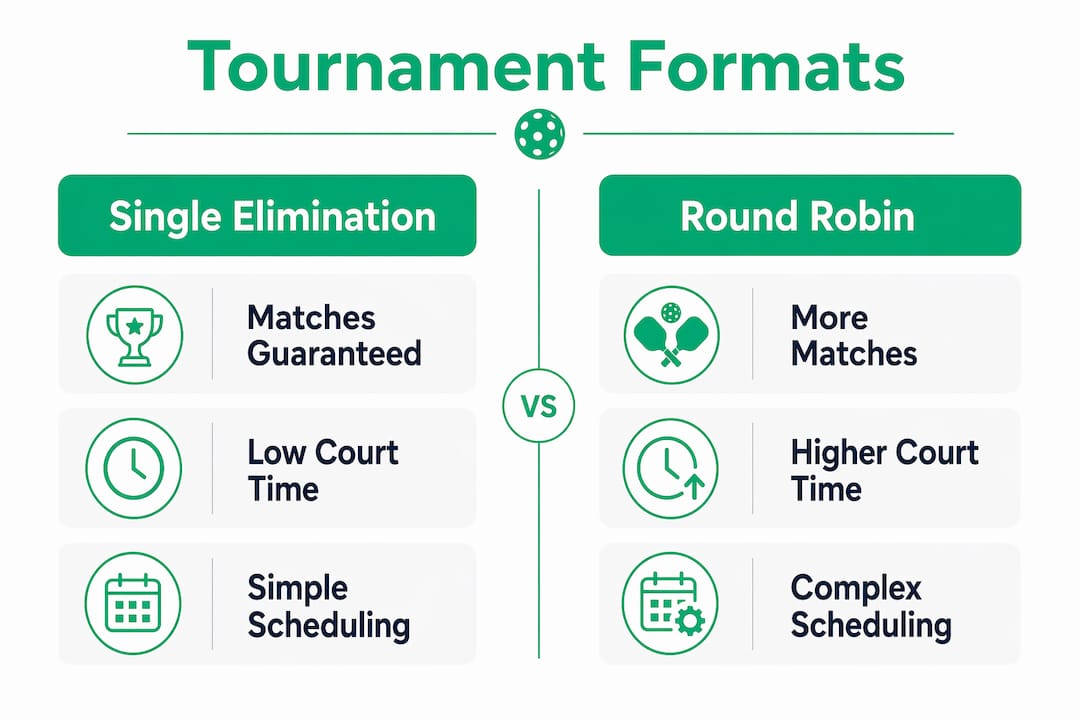
| Single elimination | 1 minimum | Low | Low | Low (one bad match = out) | Large fields, tight schedules |
| Single elim + consolation | 2 minimum | Medium | Medium | Medium | Traveling players, recreational |
| Double elimination | 2 minimum | High | High | High | Competitive amateur, full-day events |
| Round robin | N-1 (full pool) | High | Medium | High | Recreational, intermediate, max play |
| Pool play to bracket | 3+ minimum | Medium-high | Medium | High | Most U.S. events, balanced experience |
| Swiss | 3–5 rounds | Medium | Medium-high | Very high | DUPR-rated, skill-matched events |
| Ladder | Ongoing | Low per week | Low | High over time | Club seasons, ongoing engagement |
| Team events | Varies | Varies | High | High | Club leagues, MLP-style formats |
Round robin produces the most games per player but takes longer and demands careful pool sizing. Double elimination requires significantly more matches than single elimination for the same field size, which creates real scheduling pressure. Scoring choices also affect length: best-of-3 to 11 runs longer than a single game to 15, so pick your scoring format before you build a schedule.
How do you pick the right format for your event?
Run through this checklist in order. Your first “yes” points to the right format.
- Under 3 hours, 8–16 players? Run a partial round robin (3–4 players per pool) or small single elimination with consolation.
- Full day, 16–32 players, 4+ courts? Double elimination or Round-Robin-to-Bracket are both viable.
- Players traveling more than an hour? Add a consolation bracket to any elimination format so no one drives two hours for one match.
- Are matches DUPR-rated? Swiss or pool play produces better rating data than straight elimination.
- Mixed skill levels in the same draw? Round robin or pool play lets you seed divisions accurately before a bracket.
- Prize money or sanctioned event? Follow USA Pickleball sanctioned format rules and confirm your format is on the approved list.
- Club season or ongoing league? Ladder or team events keep players engaged week to week.
Registration caps matter here too. If you cap at 32 players across 4 courts, double elimination will run long. Either add courts, cut the field, or switch to single elimination with consolation.
How many courts and how much time does each format need?
These examples assume a 30-minute average match (single game to 15, rally scoring). Best-of-3 to 11 adds roughly 15–20 minutes per match.
| Field size | Format | Total matches | 4 courts needed | 8 courts needed |
|---|---|---|---|---|
| 8 players | Round robin (1 pool) | — | ~3.5 hrs | ~2 hrs |
| 8 players | Single elimination | 7 | ~1 hr | ~30 min |
| 16 players | Single elim + consolation | — | — | — |
| 16 players | Double elimination | — | — | ~2 hrs |
| 32 players | Single elimination | — | ~4 hrs | ~2 hrs |
| 32 players | Double elimination | multiple matches | several hours | several hours |
Moving from single to double elimination can roughly double your match count, so always build a 15-minute buffer between rounds for score reporting and court turnover. For no-shows, hold the court for 5 minutes, then award a default win and re-slot the court. In pool play, a no-show counts as a forfeit with the score recorded as 11–0 (or your stated default score) so point differential stays meaningful.
Pro Tip: Schedule finals on a dedicated court and keep it clear for 30 minutes before the final round. Nothing kills momentum like a finals match delayed because a semifinal ran long.
Why are hybrid formats becoming the standard in the U.S.?
The Round-Robin-to-Bracket format is now the most common structure at mid-size U.S. events, and for good reason. It solves the two biggest player complaints: “I only got one match” and “the bracket felt random.”
Here is how to run it step by step:
- Divide players into pools of 4–5. Four-player pools produce 6 matches per pool; five-player pools produce 10.
- Run full round robin within each pool. Record wins, losses, and point differential for every match.
- Advance the top 1–2 players per pool into a single or double-elimination bracket. A 4-pool draw with 2 advancing per pool gives you an 8-player bracket.
- Seed the bracket by pool finish. Pool winners go to one side, runners-up to the other, so pool winners don’t meet until the semis.
- Run the bracket to a champion.
For Swiss format, the logic is different. Round 1 pairings are random or seeded by DUPR rating. After each round, players with the same record face each other. No one is eliminated. After 4–5 rounds, standings determine final placings. Swiss keeps matches competitive throughout and every match contributes to DUPR rating calculations, which is why it is gaining traction at rated events.
Pro Tip: In a 5-player pool, if one player no-shows, convert to a 4-player pool and give the affected player a bye. Record the bye as a win with the pool’s average score so point differential stays fair.
How do you seed players and break ties fairly?
Good seeding prevents lopsided pools. Use DUPR ratings as your primary seed when available. For unrated players, use recent tournament results or self-reported skill levels, then manually adjust obvious mismatches before publishing brackets.
Tie-break hierarchy for pool play, consistent with USA Pickleball rules:
- Step 1: Head-to-head record between tied players
- Step 2: Point differential across all pool matches
- Step 3: Head-to-head point differential between the tied players only
- Step 4: Points allowed against the next-highest finisher in the pool
For bracket events, seeding placement follows the same DUPR or rating order. Top seeds go to opposite sides of the bracket so the two strongest players meet in the final, not the first round.
Pro Tip: Post tie-break rules in your registration confirmation email. Players who read them before the event accept outcomes faster than players who hear about them for the first time after a disputed match.
How does software simplify running these formats?
Managing pool math, bracket generation, and score reporting by hand is where most scheduling errors happen. Good tournament and league software handles the parts that go wrong.
Look for these capabilities when evaluating tools:
- Automated bracket and pool schedule generation
- Live standings that update as scores come in
- DUPR score reporting integration
- Registration and payment collection (Stripe or equivalent)
- No-show and forfeit handling built into the scoring workflow
DUPR integration changes format decisions in a practical way. Swiss and pool play generate more rating-meaningful matches per player than straight elimination, so if your players care about their DUPR rating, those formats deliver more value per event. Software that pushes results directly to DUPR removes a manual step that organizers often forget.
Flexleagueplus is a DUPR-approved platform built for exactly this workflow. It supports singles, men’s doubles, women’s doubles, mixed doubles, and FLP team formats, with automated scheduling, live standings, playoff bracket generation, and Stripe-powered registration fee collection. Organizers can run a full league or one-off tournament without managing spreadsheets or chasing down score reports.
Pro Tip: Before your event, test your software’s no-show workflow with a dummy match. Finding out your platform doesn’t handle forfeits cleanly on event day is a bad time to learn that.
What does a day-of runbook look like?
A one-page runbook keeps staff aligned and prevents the most common event-day breakdowns.
- T-60 min: Check-in opens. One staff member at the desk with the player list, court assignments, and pool sheets printed. Confirm each player’s division and collect any outstanding waivers.
- T-30 min: Warm-up windows. Assign courts by pool for 10-minute warm-ups. Keep finals court clear.
- T-0: First matches start. Post the full schedule on a visible board or push it via your app. Announce the score reporting method (paper slip, app, or verbal to a marshal).
- Between rounds: Score collection. Designate one person to collect and enter scores before the next round generates. Do not start round 2 until all round 1 scores are confirmed.
- No-show procedure: Wait 5 minutes, announce the player’s name, then record a default win. Reassign the court immediately.
- Finals: Announce the finalists, clear the designated court, and confirm scoring format with both teams before the match starts.
- Post-event: Submit scores to DUPR if applicable, send results to all players, and archive the bracket.
For a 4-court setup, one marshal per 2 courts is workable. For 8 courts, assign a dedicated score-entry person so marshals stay on the floor.
Which format should you use for each event type?
| Event goal | Recommended format | Why |
|---|---|---|
| Maximum play / recreational | Round robin | Every player faces every opponent; highest match count |
| Fast champion / large field | Single elimination + consolation | Efficient, low court demand; consolation adds value for travelers |
| Competitive amateur / full day | Double elimination | Two-loss safety net; fair placings for serious players |
| DUPR-rated / skill-matched | Swiss | Competitive pairings every round; all matches count toward rating |
| Club season / ongoing | Ladder or team events | Continuous engagement; tracks improvement over weeks |
| Balanced experience (most events) | Round-Robin-to-Bracket | Guaranteed pool play plus bracket drama |
Player eligibility and ranking considerations by format
USA Pickleball sanctioned events define approved age groups and skill level pairings. For sanctioned play, players must compete in their correct skill division, and combined age/skill events must follow the approved pairing structure.
For unsanctioned events, organizers set their own eligibility rules, but a few principles hold across formats. In elimination brackets, mismatched skill levels hurt everyone: strong players cruise through early rounds, weaker players exit after one match. Pool play and Swiss formats handle mixed-skill fields better because you can seed divisions and keep matches competitive within pools.
DUPR ratings give organizers an objective eligibility baseline. A player with a 4.5 DUPR entering a 3.5 division creates problems regardless of format. If your event is DUPR-rated, publish the rating band for each division at registration and enforce it. Players who misrepresent their rating to enter a lower division should be moved or disqualified before the draw, not after.
For league formats specifically, Flexleagueplus supports division management so organizers can cap divisions by rating range and prevent mismatches before registration closes.
Key Takeaways
The single most effective approach to pickleball tournament formats is matching your format to your available courts, time, and player expectations before you open registration.
| Point | Details |
|---|---|
| Match format to resources | Count courts and hours first; double elimination needs roughly double the court time of single elimination. |
| Guarantee minimum play | Add a consolation bracket or use pool play so traveling players get at least 2–3 matches. |
| Publish tie-break rules early | Post the full tie-break hierarchy at registration to prevent disputes on event day. |
| Use DUPR for rated events | Swiss and pool play generate more rating-meaningful matches than straight elimination brackets. |
| Flexleagueplus automates the hard parts | Automated scheduling, DUPR reporting, and Stripe payments reduce the manual work that causes event-day errors. |
The format decision most organizers get wrong
The most common mistake in U.S. pickleball event planning is choosing a format based on what the organizer prefers to watch, not what the players came to experience. Single elimination looks clean on paper and runs fast. But if half your field drove 90 minutes to play one match and lose, they are not coming back next season.
The Round-Robin-to-Bracket hybrid exists precisely because it respects both sides of that tension. Players get guaranteed pool matches. The bracket delivers the drama. And the seeding that comes out of pool play makes the bracket fairer than a randomly drawn single-elimination tree.
Swiss format is still underused at the club level, which is a missed opportunity. For any event where DUPR ratings matter to your players, Swiss produces better data and keeps every match meaningful through the final round. The scheduling is slightly more complex, but software handles that.
The practical lesson: pick the format your players will talk about positively on the drive home, then work backward to make it fit your courts and schedule. That order of operations produces better events than the reverse.
Flexleagueplus handles the scheduling work so you can run the event
Running pool play, Swiss rounds, or a hybrid bracket by hand means hours of spreadsheet work before the first match starts. Flexleagueplus cuts that down to minutes.
The platform supports every format covered in this guide: singles, doubles (men’s, women’s, mixed), and FLP team leagues. It generates brackets and pool schedules automatically, pushes results directly to DUPR, and collects registration fees through Stripe so you are not chasing payments the week of your event. No-show handling, live standings, and division management are all built in.
If tie-break enforcement and score reporting are the parts of your event that go sideways, that is exactly where Flexleagueplus removes the friction. Set up your league or tournament, open registration, and let the software handle the math.
Further reading and linked authorities
“Organizers should select a format that matches participant expectations with available resources — round robin for maximum court time, elimination brackets when efficiency and a clear champion matter.” — Pickleball.com Organizer’s Guide
- USA Pickleball Sanctioned Tournament Formats — approved format list, age/skill divisions, and eligibility rules for sanctioned U.S. events
- 2025 USA Pickleball Rules, Section 12 — tie-break procedures, scoring options, and sanctioned tournament policies
- Pickleball.com Organizer’s Guide — practical guidance on format selection, scheduling, and hybrid formats
- MyPickleballConnect Format Guide — Swiss format explanation and consolation bracket recommendations
- PaceCourt Brackets Guide — bracket types, scoring formats, and match-length planning
For sanctioned events, always verify your format against the current USA Pickleball approved list before opening registration. If DUPR rating outcomes matter to your players, use Swiss or pool play and confirm your software supports direct DUPR reporting.