Pickleball League Rules: A Guide for Organizers & Players
Pickleball League Rules: A Guide for Organizers & Players

Use the Official USA Pickleball Rulebook as your league baseline and publish any league-specific modifications before play begins. That single decision prevents most disputes before they start.
Here is what you can change from the baseline, and what you should leave alone:
- Match format and scoring (best-of-3, single game, rally scoring, team-play lines)
- Time limits (45-minute match caps, finish-in-progress rules)
- Eligibility thresholds (DUPR rating caps per division, minimum matches played)
- Substitution and roster policies (roster size, mid-season additions, playoff eligibility minimums)
- Score reporting procedures (submission deadlines, evidence windows, standings tiebreakers)
Everything else — serve mechanics, the double-bounce rule, kitchen restrictions, fault definitions — stays exactly as the rulebook writes it. Your action plan: adopt the rulebook, write a concise league rules addendum covering only those five categories, and distribute it to every player before the season opens.
Table of Contents
- What the official USA Pickleball Rulebook actually covers for leagues
- Match formats and scoring systems leagues commonly adopt
- Core gameplay rules every league must communicate
- Equipment standards and wheelchair pickleball rules for your handbook
- Operational rules: scheduling, time limits, forfeits, and score reporting
- What league organizers can change and sample clauses to copy
- How Flexleagueplus helps you enforce and manage these rules
- How to track USA Pickleball rule changes and keep your league current
- Key Takeaways
- The rules that actually make a league work
- Flexleagueplus makes running a league this clean actually doable
- Authoritative sources and where to link them
What the official USA Pickleball Rulebook actually covers for leagues
The Official USA Pickleball Rulebook is structured in four parts, and knowing which parts apply to your league saves real confusion. Parts I and II cover all pickleball play — recreational, social, and organized league. Part III adds rules that apply only to USA Pickleball sanctioned tournaments. Part IV covers players with disabilities.
For a non-sanctioned recreational or club league, Parts I and II are your governing document. You do not need Part III unless you are running a sanctioned event. Part IV still applies whenever a player with a disability participates.
The rulebook’s stated purpose: “to provide pickleball players with the rules necessary for standard play (recreational, social, organized league), and tournament play.” Parts I and II apply to all play; Part III modifies those rules for sanctioned tournaments only. — Official USA Pickleball Rulebook
Beyond the main rulebook, two additional documents belong in every league handbook:
- The Equipment Standards Manual — lists approved balls, paddle specifications, and net dimensions.
- The USA Pickleball Sanctioned Tournament Formats guide — useful when borrowing tournament-style brackets or scoring options for league play.
USA Pickleball publishes a Rulebook Change Document each year that details every new and revised rule, the reason for each change, and the effective date. The 2026 edition notes that the new rulebook publishes on or about December 15 each year, with changes taking effect January 1. Check it before each season opens and update your addendum accordingly.
Match formats and scoring systems leagues commonly adopt
The standard tournament scoring is best 2-of-3 games to 11 points, win by 2. That is also the most common format for recreational leagues because it balances fairness with predictable match duration. Other approved options include best 3-of-5 games to 11, one game to 15 or 21, and one game to 11 (used in round-robin events with six or more teams).
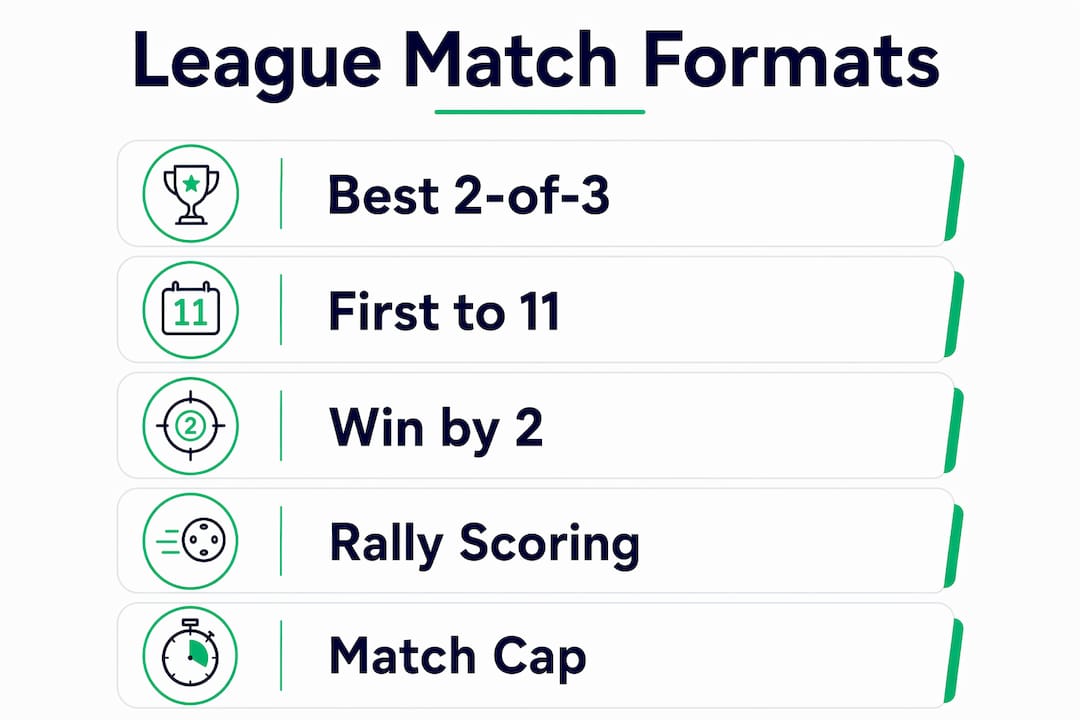
Rally scoring is a provisional option under Rule 14.A. A point is scored by whoever wins the rally, regardless of who served. It speeds up matches and suits spectator-friendly formats, but requires a referee brief and a clear scoreboard template so captains understand when points are awarded and how side changes work.
| Format | Typical Duration | Best For | Trade-off |
|---|---|---|---|
| Best 2-of-3 to 11 | Moderate duration | Most leagues | Possible longer matches if close |
| Single game to 15 | Shorter matches | Time-capped courts | Less margin for comebacks |
| Single game to 21 | Longer matches | Recreational/social | Potentially long running times |
| Best 2-of-3, rally scoring | Shorter spectator-friendly events | Spectator events | Requires extra briefing |
| Team play (multiple lines) | Longer matches | Club team leagues | Complex scheduling |
Key operational points for organizers:
- Tiebreakers: All scoring options require win by 2, except team play where win by 1 is allowed.
- Caps: Set a point cap (e.g., 15 when playing to 11) so a single game cannot run indefinitely.
- Round-robin tiebreakers: The 2026 rulebook added a fifth tiebreaker — highest total points scored across all matches — for round-robin events where pool sizes are equal.
Pro Tip: If your facility has courts booked in 90-minute blocks, best 2-of-3 to 11 with a 45-minute match cap gives you buffer time for warmup and court transitions. Single-game formats work better when courts turn over every hour.
Core gameplay rules every league must communicate
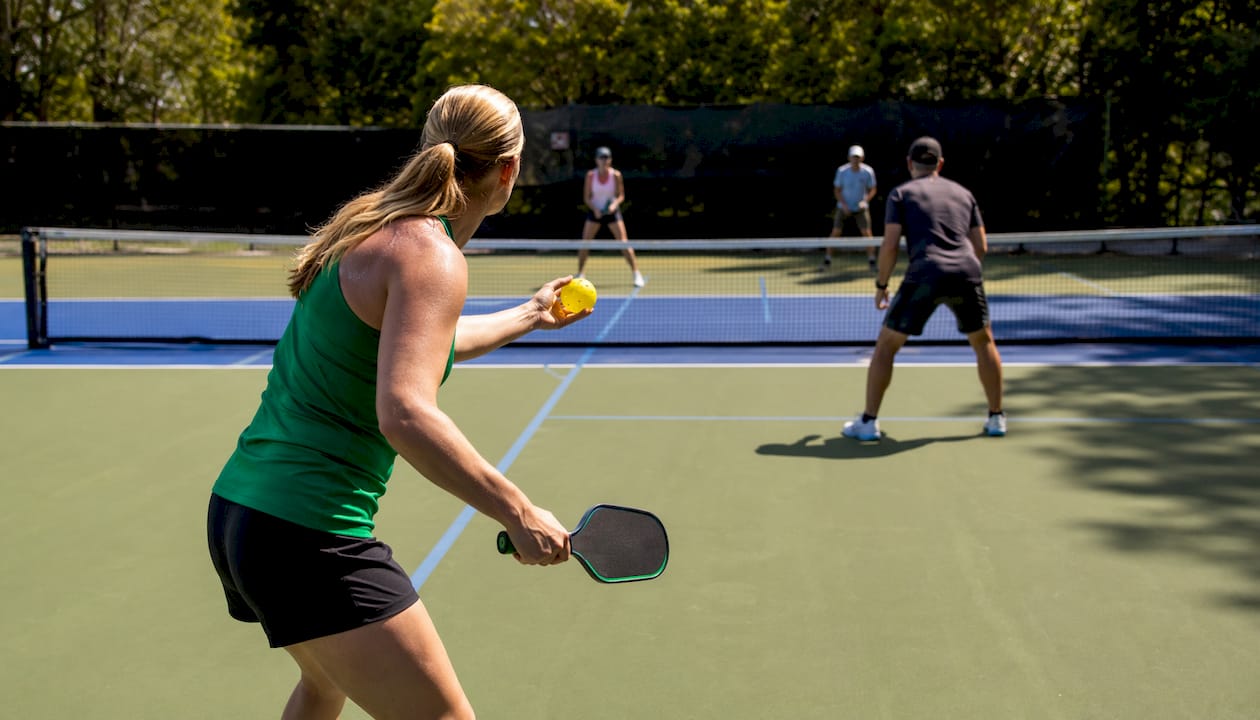
Serve mechanics trip up more new players than any other rule. The server must call the score before serving, stand behind the baseline in the correct service court, and hit the ball with an upward arc (the 2026 rulebook clarifies this as Rule 7.E). The served ball must clear the non-volley zone and land in the diagonally opposite service court. A ball landing outside that court is a fault against the server.
The double-bounce rule and kitchen restrictions
The double-bounce rule (also called the two-bounce rule) requires that after the serve, each side must let the ball bounce once before volleying. The receiving team lets it bounce on the return; the serving team lets the return bounce before they can volley. After those two bounces, either team may volley freely — except from the non-volley zone.
The non-volley zone, or “kitchen,” is the 7-foot area on each side of the net. Players may not volley the ball while standing in the kitchen or touching the kitchen line. Stepping into the kitchen after a volley is also a fault, even if the ball is already dead.
Common misunderstandings to address in your handbook
Q: Can a player stand in the kitchen during a rally? Yes — as long as they do not volley from there. Players may enter the kitchen to play a ball that has bounced.
Q: What is the 10-second rule? Once the score is called, the server has 10 seconds to serve. Failure to serve within that window is a fault. Leagues should note this explicitly because recreational players often ignore it, and it becomes a source of disputes when enforced mid-match for the first time.
Q: What happens on a let serve? Under current USA Pickleball rules, let serves are played — there is no replay. The ball is live if it clears the kitchen and lands in the correct service court.
Handbook language to copy: “The server must call the score audibly before each serve and must serve within 10 seconds of the score being called. Failure to do so is a fault. Let serves that land in the correct service court are live and in play.”
Publish these clarifications in your league handbook before the season. Captains who brief their teams on the kitchen rule, the 10-second rule, and let-serve policy will run far fewer referee disputes.
Equipment standards and wheelchair pickleball rules for your handbook
Every player should know what equipment is legal before they show up to match one. The USA Pickleball Equipment Standards Manual lists approved balls, paddle specifications (surface texture, size, and deflection limits), and net dimensions. Link it directly from your league handbook rather than paraphrasing it — the specifications update, and a direct link keeps your handbook accurate automatically.
Pre-match equipment checklist for organizers and officials:
- Paddle is on the USA Pickleball approved list or meets current specifications (no added texture, no anti-skid paint, no rubber surface).
- Ball is an approved outdoor or indoor ball appropriate for your court surface.
- Net height is 36 inches at the sidelines and 34 inches at the center.
- Court dimensions are 20 feet wide by 44 feet long, with kitchen lines at 7 feet from the net on each side.
- Players in wheelchairs have confirmed their chair meets the equipment rules in Part IV.
Wheelchair pickleball adaptations
Part IV of the rulebook covers players with disabilities. For wheelchair players, the key modifications are:
- The ball may bounce twice before the player must return it (one bounce inside the court, one outside is permitted).
- The non-volley zone rule is modified: the front wheels of the wheelchair may touch the kitchen line during a volley, but the rear wheels may not.
- Serving rules adapt so the player serves from a stationary position in the correct service court.
The 2026 rulebook also introduced Adaptive Standing Play (Rule 25.B) for players with significant mobility, balance, or coordination impairments who are not wheelchair users. Eligibility may be verified by self-declaration. Leagues should note this category in their handbook and confirm with players during registration.
Pro Tip: Link the GPF Official Rulebook as a secondary reference if your league includes international players — the GPF edition is derived from USA Pickleball standards and clarifies adaptations used by international federations.
Operational rules: scheduling, time limits, forfeits, and score reporting
A well-run league lives or dies on its operational rules. Gameplay rules tell players how to play; operational rules tell everyone how the season runs.

Scheduling and time limits
Most organized leagues schedule matches weekly or biweekly, with time slots of 90 minutes per court block. A typical match cap used by leagues is around 45 minutes. When a time limit expires mid-game, the standard approach is to finish the current game (not start a new one) and count the result. Publish this rule explicitly — “finish in progress” versus “stop immediately” is a common source of confusion.
Warmup time is often defined as a few minutes. Many leagues consider a no-show or unready player after a certain delay as a forfeit according to their policy.
Forfeit and substitution policies
Forfeits are recorded as losses with a defined score to maintain consistent standings calculations. Substitutions during a match are generally not allowed in doubles play unless injury forces a retirement. For team-play formats, publish a clear lineup submission deadline (typically 15 minutes before match start) and a stacking rule if your league uses line-based scoring.
Roster eligibility for playoffs commonly requires players to have participated in a minimum number of regular-season matches. Set this threshold before the season and enforce it at registration.
Score reporting and standings
Require both teams to confirm and submit scores within 24 hours of match completion. A 48-hour dispute window after submission gives losing teams a chance to flag errors before standings update. Standings should calculate in this order: win-loss record, then head-to-head results, then point differential. For court scheduling and score-tracking workflows, having a defined submission process prevents the most common end-of-season disputes.
What league organizers can change and sample clauses to copy
Major League Pickleball uses the USA Pickleball rulebook as its baseline and layers on rally scoring, unique tiebreakers, and team-play line structures. Amateur leagues can borrow the same approach — keep the rulebook intact, then publish a short addendum covering only what you are changing.
Items you may modify:
- Scoring format (best-of-3, single game, rally scoring)
- Match time limits and finish-in-progress rules
- Roster size and mid-season addition windows
- Playoff eligibility minimums (matches played)
- DUPR rating thresholds per division
- Tiebreaker sequence for standings
Sample clauses ready to copy into your handbook:
- “All matches are played best 2-of-3 games to 11 points, win by 2. A point cap of 13 applies.”
- “Match time limit is 45 minutes from the scheduled start. At time, the current game is completed and no new game begins.”
- “A team that fails to field the required number of players within 15 minutes of the scheduled start time forfeits the match. Forfeits are recorded as 0–11, 0–11.”
- “Players must have a verified DUPR rating at or below [X.XX] to register for Division [X]. Ratings are verified at registration and are not re-checked mid-season.”
- “A player must appear in a minimum of three regular-season matches to be eligible for playoff competition.”
- “Scores must be submitted by both teams within 24 hours of match completion. Disputes must be filed within 48 hours of score submission.”
Pro Tip: Require players to acknowledge the league rules addendum during registration — a checkbox in your registration form creates a clear record that every player received and accepted the rules before the season starts. This single step eliminates most “I didn’t know” disputes.
How Flexleagueplus helps you enforce and manage these rules
Software does not replace good rules, but it does enforce them consistently. Flexleagueplus maps directly to the operational rules covered in this guide.
Registration and eligibility: DUPR integration lets organizers set rating thresholds per division and verify them automatically at registration — no manual checks, no mid-season protests. Stripe-powered payment collection handles registration fees in the same workflow.
Scheduling: Automated scheduling generates match schedules based on your format, court availability, and time caps. Organizers set the parameters once; the system handles the calendar.
Score reporting and standings: Players submit scores through the app. The system calculates live standings using your tiebreaker sequence (win-loss, head-to-head, point differential) and updates playoff brackets automatically.
Team play: Flexleagueplus supports FLP team formats similar to MLP, including line-based scoring and mixed doubles, men’s doubles, and women’s doubles lines in a single team match.
A sample workflow: create a season → set your rule template (format, time cap, eligibility thresholds) → publish the schedule → collect registrations and payments → players report scores → standings and brackets update live. The dispute and score-reporting workflow is cleaner when players know exactly where to submit and what the deadline is.
How to track USA Pickleball rule changes and keep your league current
USA Pickleball publishes rule changes once a year. The new rulebook goes live on or about December 15, with changes effective January 1. That gives organizers roughly two weeks to review changes before the new year — not much runway if you are running a January season.
A simple update protocol:
- Assign one person (league director or head referee) to review the annual Change Document each December.
- Compare your league addendum against any changed rules and update clauses that reference modified sections.
- Send a brief “rule update” notice to all registered players before the season opens, noting any changes from the prior year.
- Keep a rule-change log in your handbook (a simple table: rule, change, effective date) so returning players can see what is different at a glance.
Pro Tip: Subscribe to USA Pickleball’s official communications at usapickleball.org so the Change Document lands in your inbox each December. Do not rely on social media or third-party summaries — the Change Document is the authoritative record, and it links directly to the rule database entry for each change.
Key Takeaways
The most important thing any league organizer can do is adopt the USA Pickleball rulebook as the baseline, publish a concise addendum covering only the items they are modifying, and get player acknowledgment before the season starts.
| Point | Details |
|---|---|
| Use USA Pickleball as your baseline | Parts I and II of the Official Rulebook govern all league play; Part III applies only to sanctioned tournaments. |
| Publish your addendum before play | Cover match format, time limits, eligibility thresholds, substitution rules, and score reporting in writing. |
| Set DUPR eligibility at registration | Verify rating thresholds automatically at sign-up to prevent mid-season protests and division imbalance. |
| Require timely score reporting | A 24-hour submission window and 48-hour dispute window keeps standings accurate and disputes manageable. |
| Use Flexleagueplus to enforce it all | DUPR integration, automated scheduling, score reporting, and Stripe payments handle the operational rules in one platform. |
The rules that actually make a league work
Most league disputes do not come from players misunderstanding the kitchen rule. They come from organizers who never wrote down what happens when a team is five minutes late, or who forgot to publish the playoff eligibility threshold until someone got left off the bracket.
The USA Pickleball rulebook is thorough and well-maintained. The gap is almost always in the operational layer — the 15 sentences that cover your specific league’s time limits, forfeit policy, and score submission deadline. Those sentences are what players actually argue about, and they are entirely within your control to write clearly before the season opens.
One thing that genuinely changes how a league feels to play in: requiring score submission within 24 hours. When standings update in near-real time, players stay engaged across the full season. When standings sit stale for a week because nobody submitted, the league loses energy fast. It is a small operational rule with an outsized effect on player experience.
Flexleagueplus makes running a league this clean actually doable
Running a league by the book takes real infrastructure: verified rosters, a published schedule, a score-submission system, live standings, and payment collection. Doing all of that manually is where most organizers burn out.
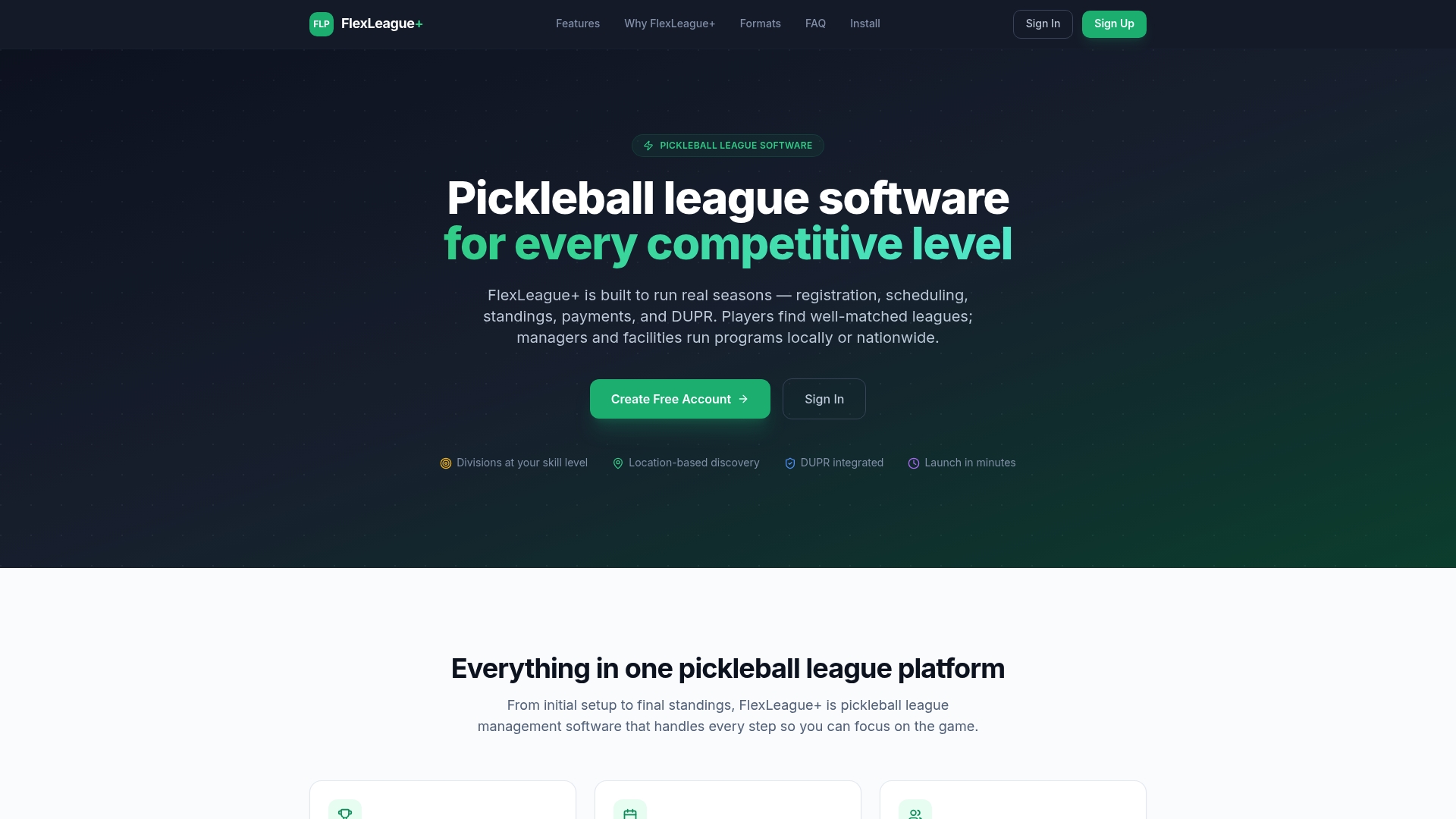
Flexleagueplus handles the full workflow in one platform. DUPR integration verifies player ratings at registration so your divisions stay balanced. Stripe-powered payment collection processes registration fees without a separate tool. Automated scheduling builds your match calendar based on your format and court availability. Players submit scores through the app, and standings update live with your tiebreaker logic already built in.
- DUPR-approved rating verification at registration
- Automated scheduling with time-cap support
- Score reporting with live standings and playoff brackets
- Stripe payment processing for registration fees
- FLP team-play support (men’s doubles, women’s doubles, mixed doubles, singles)
Start your league on Flexleagueplus and spend your time running a great season instead of chasing down scoresheets.
Authoritative sources and where to link them
Every league handbook should link the primary sources directly rather than paraphrasing them. When rules update, a direct link keeps your handbook accurate without a manual rewrite.
| Source | What It Covers | Required or Optional |
|---|---|---|
| Official USA Pickleball Rulebook | Baseline rules for all league play (Parts I–II) | Required |
| USA Pickleball Rulebook PDF | Full text including Section 14 format variations and rally scoring | Required |
| Sanctioned Tournament Formats | Approved scoring formats and tiebreaker options | Recommended |
| Rulebook Change Document | Annual rule changes with reasons and effective dates | Required (review annually) |
| GPF Official Rulebook | International federation edition derived from USA Pickleball | Optional |
| Flexleagueplus League Software | Software workflows for registration, scheduling, scoring, and payments | Recommended for organizers |
Link the USA Pickleball Rulebook as your baseline citation. Link the Change Document in your annual update notice. Link Flexleagueplus when explaining your score-reporting and registration workflow to players.