Pickleball League Management Tips for Organizers
Pickleball League Management Tips for Organizers

A pickleball league runs well when you decide the rules before registration opens, keep divisions small and level, and give every player one place to find schedules and scores. Most problems managers hit in week three (no-shows, disputed scores, lopsided divisions) come from choices made in week zero. This guide walks through those choices in the order you make them.
TL;DR
- Fix the season shape first: number of weeks, match day, court count, fees and refund policy. Then open registration.
- Build divisions by skill level and cap their size, so every player gets competitive matches and the schedule fits your courts.
- Pick the format from the group size: round robin for small groups, pools plus playoffs for larger ones.
- Use one scoring standard, publish tiebreakers before week one, and send short, regular updates.
- Track registrations, unscheduled matches, unreported scores and standings in a single manager dashboard instead of spreadsheets and group texts.
Table of Contents
- Decide the season shape before you open registration
- Registration and divisions: get the field right
- Choose a format that matches the group size
- Build a schedule people will actually follow
- Scoring, standings and tiebreakers
- Communicate briefly and on a rhythm
- What a manager dashboard should show you
- Our perspective: leagues are an administration problem first
- Run your next season on FlexLeague+
- FAQ
- Sources
Decide the season shape before you open registration
The most useful habit in league management is writing down the season on one page before anyone can sign up. That page answers six questions:
- How many weeks will the regular season run, and is there a playoff?
- Is play on a fixed day and time, or do players schedule their own matches within a weekly window?
- How many courts can you rely on, and for how many hours?
- Which skill levels and match types will you offer (singles, men’s doubles, women’s doubles, mixed doubles, teams)?
- What does it cost, and what is the refund policy?
- Which rules apply?
USA Pickleball’s event operator guide follows the same logic for sanctioned events: choose events, set participant limits and registration dates, and decide fees and refund policy before you enable online registration, waivers and payments. A league is a longer commitment than a one-day event, so the up-front clarity matters even more.
If you are launching your first season, our step-by-step guide to starting a pickleball league covers the groundwork in more detail, and The Pickleball League Handbook for Managers is a good reference to keep open all season.
Work backward from your courts
Court time is the real limit on league size. Count the courts and the hours you have, then work out how many matches fit in a night. A division of eight players playing doubles with a rotating partner needs a very different number of courts than eight players playing singles. Decide the maximum number of players per division from that arithmetic, not from how many people say they are interested.
A useful rule of thumb: if a division needs more matches than your courts can host in the weekly window, shrink the division or add a second one. A smaller, tighter division is almost always better received than a crowded one where players wait around.
Registration and divisions: get the field right
Registration is where you collect everything you will need later: name, contact details, skill rating, partner preference, waiver and payment. The official guidance is to enable online registration, waivers and payments, send confirmations, help players find partners, check ratings and membership where applicable, and manage entries so brackets do not end up too large or too small (USA Pickleball).
A few practical points:
- Set a registration deadline and hold to it. Late additions break schedules. If you allow them, cap them at the first week.
- Collect payment at sign-up. A player who has paid is far more likely to show up. A player who has not paid is a maybe.
- Collect the waiver in the same flow. Do not chase signatures on court. Our guide to registration waivers for pickleball leagues explains what to include and how to store them.
- Ask for a rating, and verify it if you can. A self-reported 3.5 can mean anything. A verified rating from a recognized system keeps divisions honest.
- Offer a partner-finding option for doubles, so solo registrants are not left out.
The full walkthrough is in our pickleball league registration guide.
Build divisions by skill, then check them
Divisions are the single biggest driver of player satisfaction. People forgive a late start. They rarely forgive being crushed every week, or crushing everyone else.
Split the field by rating bands that make sense for your player base. If you have enough players, separate beginners and low intermediates from advanced players rather than lumping them together; our article on pickleball league divisions shows how to split 2.5 from 4.0 and above.
USA Pickleball recommends seeding brackets after registration closes and using a knowledgeable committee that represents different skill levels. It also says to check whether your chosen format still suits the final field and to tell players about any changes before play begins (USA Pickleball). Apply that to a league: close registration, look at the actual numbers, then finalize divisions. Do not publish a schedule built around a field you only expected.
When a division ends up with too few players, merge it with an adjacent level and tell both groups why. When it ends up too large, split it. Either is better than running a bad division for ten weeks.

Choose a format that matches the group size
Format is a function of how many players you have and how many weeks you have. Here is a simple guide.
| Group size | Format that usually works | Why |
|---|---|---|
| 4 to 6 players | Single round robin, or double round robin if the season is long | Everyone plays everyone; no playoff needed |
| 7 to 10 players | Single round robin with a short playoff for the top finishers | Rewards the regular season and gives a finale |
| 11 to 16 players | Two pools, round robin within each pool, crossover playoffs | Keeps the match count manageable |
| Teams | Team match days with set lineups across several match types | Fits club, facility or city team play |
The thing to calculate before you commit is the number of matches. A single round robin with n players needs n(n − 1)/2 pairings. Eight players means 28 pairings, ten means 45. In a doubles league with fixed partners, count teams rather than players. If the number of pairings is larger than the number of weeks times the matches you can host per week, the format will not fit, so reduce the group or move to pools.
For a deeper look at bracket and pool options, see our guide to pickleball tournament formats. Many of the same structures work for a league finale.
Keep the format boring
The fanciest format is rarely the best one. Players should be able to explain in one sentence how the season works: “You play everyone in your division once, top four make the playoffs.” If you need a paragraph, simplify.
Build a schedule people will actually follow
There are two common scheduling models, and both work if you commit to one.
Fixed-night leagues. Everyone plays on the same day and time each week. This is easiest to communicate and builds a social atmosphere. The cost is that you need enough courts for the whole division at once, and a missed night is harder to make up.
Flexible-window leagues. Each week, matchups are published and players arrange a time and court within the window, such as Monday to Sunday. This suits busy players and facilities with limited prime-time courts. The cost is chasing unscheduled matches, so you need a clear deadline and a visible status for every match.
Scheduling tips that save headaches
- Publish the full season at the start, not week by week. Players plan around it.
- Build in a catch-up week near the middle and before playoffs for weather, injuries and rescheduled matches.
- Rotate court assignments and start times so no group always gets the least desirable slot.
- Set a reschedule rule in writing: how much notice, who contacts whom, and the last day a match can be played before it is recorded as a forfeit.
- Name a backup plan for outdoor courts. Say what happens in rain or extreme heat, and who decides.
- Leave a few unscheduled court slots each week. They absorb the unexpected.
Hand-built schedules fall apart the first time a player drops out. Automated scheduling pays for itself here, because removing a player means regenerating pairings, not redoing a grid by hand.
Scoring, standings and tiebreakers
Pick one scoring standard and use it everywhere. Under standard USA Pickleball scoring, only the serving side can score a point, and the first side to 11 points, leading by two, typically wins the game. Provisional rally scoring awards a point on every rally (USA Pickleball Official Rulebook). Many leagues play to 11, some play to 15 or use timed matches, and either can work, as long as it is announced before week one. Our explainer on rally scoring in pickleball helps if your players are mixed on the difference.

The same rulebook covers standard play, including organized league play, and non-sanctioned events may use it as a guideline (USA Pickleball). Telling players that official rules apply, and where to read them, settles most on-court arguments before they start.
Write the tiebreakers down
Standings are where leagues create conflict. Publish the order of tiebreakers before the season:
- Match wins (or points per match, if you award them)
- Head-to-head result between the tied players or teams
- Point differential across the season
- Points scored, or a playoff game if the tie decides a playoff spot
Keep it short. Whatever you choose, apply it the same way to every division. Players will accept a tiebreaker they disagree with. They will not accept one invented after the fact.
Make score reporting easy and consistent
The biggest cause of stale standings is late score reporting. Fix it with a simple rule: the winner reports the score within 24 hours, and the opponent confirms or disputes it. Anything disputed goes to you. Set a clear consequence for matches with no score after the deadline.
Train players to call scores clearly on court so the reported result matches what happened. Our guide to pickleball score-calling scripts gives players and organizers a common language.
Communicate briefly and on a rhythm
The group text is where league management goes to die. Messages get buried, new players are never added, and nobody can find the schedule. USA Pickleball’s guidance on event communication is to send short, accurate emails covering the schedule, brackets, fees, waivers, partners who have not registered and registration deadlines, and to state that official rules apply (USA Pickleball).
A workable rhythm for a league:
- Before the season: a welcome message with the schedule, rules, tiebreakers and who to contact.
- Weekly: one short message with this week’s matchups, the deadline to report scores and any changes.
- Mid-season: a standings snapshot and a reminder of the playoff cutoff.
- Before playoffs: the bracket, the dates and any seeding rules.
- After the season: final standings, thanks and the date registration opens for the next one.
One channel for announcements, one place for the schedule. If players have to ask where something is, the system is not working.
What a manager dashboard should show you
Whether you use software or a spreadsheet, the manager view should answer five questions at a glance:
| Question | What to look at |
|---|---|
| Who is in? | Registrations per division, paid versus unpaid, waivers signed |
| Are divisions balanced? | Player counts and rating spread per division |
| Is play happening? | Matches scheduled, played and overdue, by week |
| Are results current? | Scores awaiting reporting or confirmation, open disputes |
| Where does everyone stand? | Live standings, tiebreaker status, playoff qualification |
If you can see those five things in one place, you can manage a season in a few minutes a day. If you have to open three files and a text thread, you will fall behind, and the players will notice before you do.
Two habits make the dashboard useful. First, check it on the same day each week and act on the exceptions: the unpaid player, the overdue match, the unreported score. Second, close the loop by messaging only the people who need a nudge, not the whole league.
Our perspective: leagues are an administration problem first
Most people start a pickleball league because they love the game, and most burn out because of the admin. Chasing payments, rebuilding schedules after a dropout, reconciling scores from texts and refereeing standings disputes: none of that is pickleball.
That is why we built FlexLeague+ around the full season, not just sign-up. Registration, automated scheduling, division management, live standings, playoff brackets and score reporting live in one place. Because the platform is DUPR approved, ratings can support fair, verified competition, and Stripe handles payments, so organizers keep control of their registration revenue.
We also think the pricing should not get in the way of running a league. There is no monthly subscription for players or managers. A manager pays a one-off platform fee per division, and everything else is the registration fee you set.
Our advice is the same whether you use us or not: decide the rules early, keep divisions tight, and stop doing by hand what software can do for you. But if you want a season that runs itself a little more each week, that is what we built this for.
Robert
Run your next season on FlexLeague+
If you are running a league for a club, a facility or a city parks department, our pickleball league software lets you set up singles, men’s doubles, women’s doubles, mixed doubles or team leagues, collect registration fees through Stripe, and manage schedules, standings and playoffs from one dashboard. The platform fee is $25 one-off per division, with no monthly subscription.
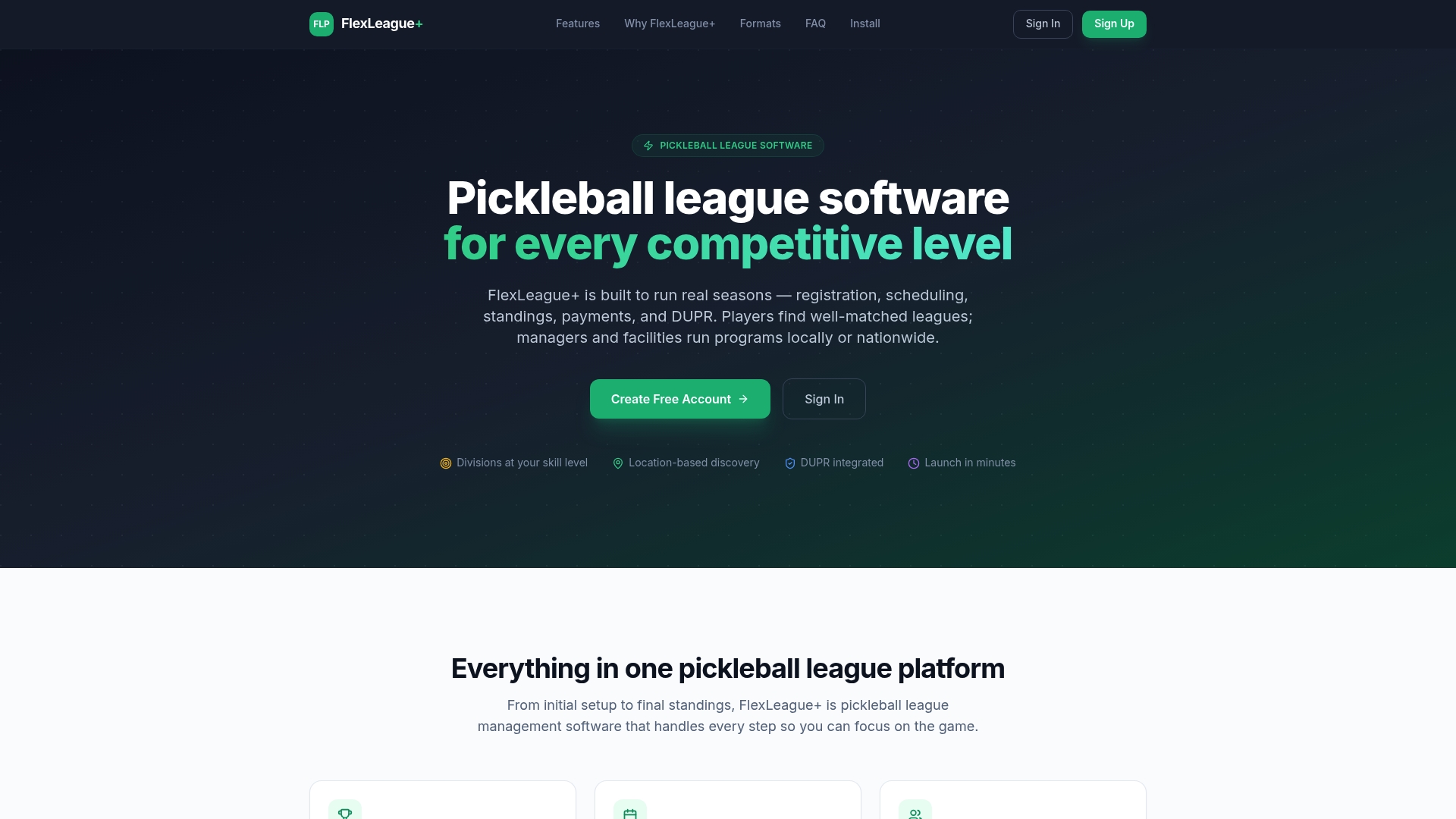
You can see how it works on the FlexLeague+ home page and read more manager guides on our blog.
FAQ
How many players should be in a pickleball league division?
There is no official number, so work from your courts and your format. For a round robin, six to ten players is a comfortable range because every player can face everyone within a typical season. Go larger only if you split into pools, and cap the size before registration opens so you are not forced to turn people away or shrink matches later.
How do I handle a player who drops out mid-season?
Decide the policy before the season and put it in your welcome message. Common approaches are to void the dropped player’s matches, or to keep results that were already played and record the remainder as forfeits. Whichever you choose, apply it to every division, and update the schedule and standings the same day so remaining players are not left guessing.
What is the best way to settle score disputes?
Prevent most of them by having the winner report the score and the opponent confirm it within a set time. For anything disputed, make the manager’s decision final and base it on the posted rules. USA Pickleball’s rulebook is the standard reference, and telling players up front that its rules apply keeps the discussion short (USA Pickleball Official Rulebook).
Do I need software to run a pickleball league?
Not for a very small group, but a spreadsheet and a group text stop scaling once you have several divisions, paid registration and playoffs. Software that handles registration, payments, scheduling, score reporting and standings saves the most time where mistakes cost the most: money and results.