Pickleball Ladder League: Your 2026 Player's Guide
Pickleball Ladder League: Your 2026 Player’s Guide

A pickleball ladder league is a ranking-based competition format where players move up or down a live standings board based on match results, creating skill-matched play every session. Unlike one-off tournaments, a ladder league runs continuously across a season, so every match carries real consequences for your position. Sessions commonly run 6–8 weeks, with fees ranging from free at community centers to $70 for state-sanctioned events. The format rewards consistency, punishes complacency, and builds the kind of tight-knit court community that casual open play simply cannot replicate.
How does a pickleball ladder league work?
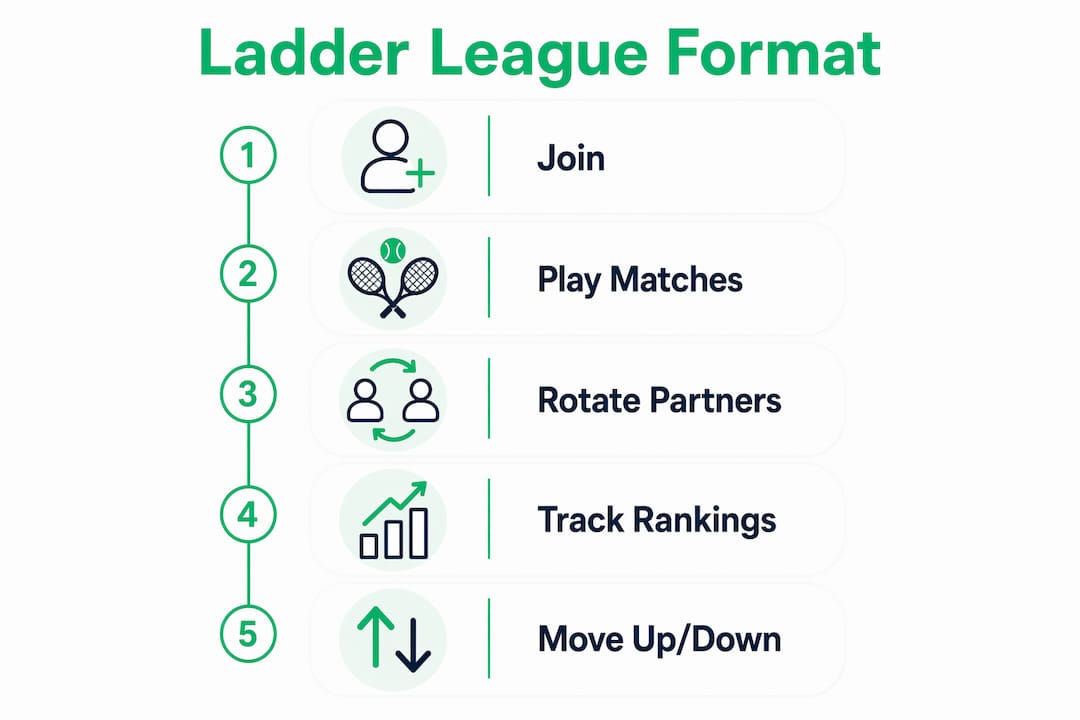
The core mechanic is simple: win and move up, lose and move down. Players are grouped by skill level into tiers of four to five, using rating systems like ELO or DUPR to seed the initial standings. That seeding matters because it prevents a 3.0-level player from being crushed by a 4.5 in week one.
Within each session, players rotate partners after every round. This rotation is intentional. It forces you to adapt your game to different playing styles, which accelerates skill development faster than fixed-pair formats. A typical weekly session runs a round-robin within each tier, so every player gets multiple competitive matches before the standings update.

The ranking algorithm does more than track wins and losses. Scoring systems reward wins over higher-ranked opponents more heavily, meaning a narrow upset of the top seed earns more ladder points than a blowout of the bottom player. This nuance keeps competition honest and discourages sandbagging.
One underappreciated rule in most ladder formats is the “sparing” option. Players can spare up or down temporarily without affecting their home division standing. Sparing up triggers an automatic temporary promotion if you win enough matches; sparing down carries no penalty. This flexibility lets players test higher competition without the risk of losing their earned position.
- Winners move up the ladder at the end of each round or session cycle.
- Losers move down, but only within their current tier unless a promotion or relegation cycle triggers.
- Partner rotation happens after each round, keeping matches fresh and skill exposure broad.
- ELO or DUPR ratings seed initial placement and adjust after every match.
- Sparing rules allow temporary cross-division play without permanent standing consequences.
Pro Tip: If you are new to a ladder league, request placement in the middle of your tier rather than the top. Starting mid-tier gives you winnable matches early, which builds confidence and earns you real data on your actual skill level before you face the division leaders.
What are the common formats and styles of ladder leagues?
Individual mode and team mode are the two primary structures, and they serve different goals. Individual mode suits players who want to meet new opponents and track personal skill progression. Team mode locks pairs together, tracking a collective rating across the season. Choosing between them depends entirely on whether your priority is socializing and growth or stable competitive partnership.
Multi-division structures add a promotion and relegation layer that makes the format feel like a real sports league. At the end of each cycle, top finishers in a lower division move up, and bottom finishers in a higher division drop down. Promoted players enter near the bottom third of their new division; relegated players land near the top third of the lower one. This placement logic preserves realistic competition and prevents a newly promoted player from immediately dominating.
Session length varies by organizer. Six-week cycles are the most common because they give enough matches for the standings to reflect true skill without dragging on long enough to lose player interest. Some leagues run seasonal schedules tied to indoor court availability, particularly in northern states where outdoor play stops in november.
The ladder format also differs meaningfully from a round-robin tournament. A round robin is a single event with a fixed bracket. A ladder league is an ongoing system where your ranking carries over week to week. Round robins reward peak-day performance; ladder leagues reward sustained consistency.
- Individual mode: rotating partners, personal ranking, best for skill growth and meeting players.
- Team mode: fixed pairs, collective rating, best for competitive partnerships.
- Multi-division: promotion and relegation cycles at season end.
- Single-division: simpler structure, better for smaller clubs with fewer players.
- Seasonal scheduling: tied to court availability, often 6-week cycles with optional renewal.
How does ladder league software improve organization?
Manual paper grids and spreadsheet tracking create errors, slow down results, and frustrate players who want instant feedback. Digital platforms increase player engagement and return rates by providing live standings and complete match histories accessible from any device. That transparency is what keeps players coming back week after week.
Automated scheduling tools generate balanced round-robin rotations instantly, assign courts, and update rankings the moment scores are submitted. An organizer who previously spent two hours on manual scheduling can redirect that time to player communication and court maintenance. The administrative burden drops sharply.
The best ladder league software also handles features that manual systems cannot replicate at scale. Inactivity decay automatically lowers the ranking of players who stop showing up, keeping the standings accurate. Public standings pages let players check their position between sessions, which drives competitive motivation. Rating algorithm transparency, where players can see exactly why their ranking changed, builds trust in the system.
Flexleagueplus is a DUPR-approved platform built specifically for pickleball leagues. Organizers can run singles, men’s doubles, women’s doubles, mixed doubles, and FLP team formats from a single dashboard. Players sign up, organize matches, and report scores directly through the app. Stripe integration handles payment processing, so fee collection requires no separate system.
- Automated standings: rankings update instantly after score submission.
- Court rotation scheduling: balanced assignments generated without manual input.
- Inactivity decay: inactive players drop in ranking automatically, keeping standings current.
- DUPR integration: ratings sync with the national DUPR system for accurate seeding.
- Payment processing: Stripe-connected fee collection built directly into the platform.
Pro Tip: Set your league’s inactivity decay threshold at two consecutive missed sessions before applying a ranking penalty. One missed session is often a scheduling conflict; two signals genuine disengagement and warrants a standings adjustment.
How to join or organize a pickleball ladder league
Joining a ladder league is straightforward, but knowing what to look for saves time and frustration.
- Find a league near you. Search your local recreation center, YMCA, or community pickleball club. State-sanctioned leagues link participation to regional tournament points and use standardized DUPR ratings for seeding, which matters if you plan to compete beyond the local level.
- Get your DUPR rating before registering. Most ladder leagues use DUPR or ELO to place you in the right tier. Entering without a rating means the organizer has to estimate your level, which often leads to misplacement in week one.
- Pre-register and pay the session fee. Fees vary widely. Community center leagues are often free; state-sanctioned events run up to $70 per session. Confirm the session length, weekly time commitment, and cancellation policy before paying.
- Show up consistently. Ladder leagues reward attendance. Missing sessions not only stalls your ranking progress but can trigger inactivity decay in software-managed leagues, dropping your position even without a loss.
- Communicate with your organizer. If you need to spare up or down, or if a scheduling conflict arises, contact the organizer before the session, not after. Most leagues have formal rules about late withdrawals that affect other players’ match counts.
For organizers, the setup process has its own priorities. Define your division structure before launch. Decide whether you will run individual or team mode, how many tiers you need based on registered player count, and what your promotion and relegation rules will be. Publish the pickleball ladder rules clearly before the first session so players understand exactly how standings move. Use ladder league software from day one rather than starting with spreadsheets and migrating later. Migration mid-season creates data errors and player confusion.
Key takeaways
A pickleball ladder league is the most effective format for consistent skill development and community building because it combines skill-matched competition, ongoing rankings, and regular partner rotation in a single structured program.
| Point | Details |
|---|---|
| Core mechanic | Winners move up, losers move down, with ELO or DUPR ratings driving accurate tier placement. |
| Format choice | Individual mode builds social connections and personal skill; team mode suits stable competitive pairs. |
| Software advantage | Automated platforms reduce organizer workload and keep players engaged through live standings and instant score updates. |
| Joining a league | Get your DUPR rating first, register early, and attend consistently to avoid inactivity decay penalties. |
| Organizing a league | Define division structure, publish rules before launch, and use dedicated software from the first session. |
Why ladder leagues changed how I think about competitive pickleball
Most players assume that open play is enough to improve. It is not. Open play is comfortable. You gravitate toward people at your level or slightly below, you avoid the awkward challenge matches, and your game plateaus within a few months. Ladder leagues remove that comfort zone by design.
What surprised me most when I first ran a ladder league was how quickly the community formed. Players who had never spoken to each other were texting about match strategy by week three. The standings board created a shared reference point that open play never provides. Everyone knew where they stood, and that transparency motivated effort in a way that casual games simply do not.
The software question is not optional for organizers. I have seen leagues try to run on shared Google Sheets, and the results are always the same: disputed standings, missed score entries, and frustrated players who stop showing up. Ladder leagues that enhance skill and community only deliver on that promise when the administrative layer works reliably. Manual systems fail at scale.
My recommendation for newcomers: start in individual mode, not team mode. You will meet more players, expose yourself to more playing styles, and build a realistic picture of your actual skill level before committing to a fixed partner. Team mode is excellent once you know the community and have found a partner whose game complements yours.
— Robert
Flexleagueplus: built for pickleball ladder leagues
Running a ladder league well requires more than enthusiasm. It requires a system that handles the details automatically so organizers can focus on the players.
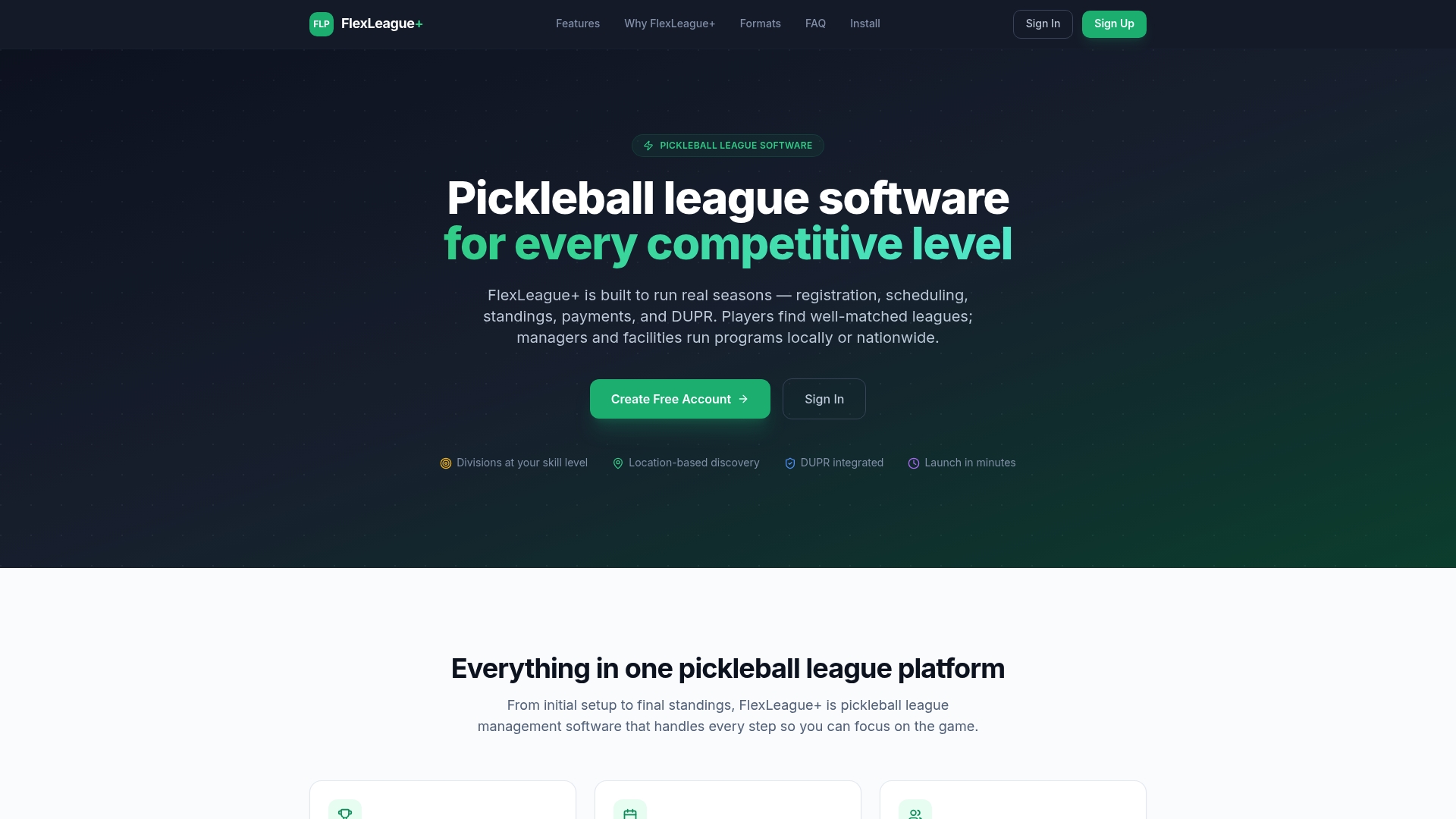
Flexleagueplus is a DUPR-approved platform built specifically for pickleball. Organizers can create and manage singles, men’s doubles, women’s doubles, mixed doubles, and FLP team formats from one dashboard. Automated scheduling, live rankings, and Stripe-connected payment processing handle the administrative work that kills manual leagues. Players sign up, report scores, and track their standings without chasing down an organizer. If you are ready to run a league that players actually return to, explore Flexleagueplus and see how the platform fits your format.
FAQ
What is a pickleball ladder league?
A pickleball ladder league is a ranking-based competitive format where players move up or down a standings board based on match results across a multi-week session. It groups players by skill level using systems like DUPR or ELO to keep matches competitive.
How long does a pickleball ladder league session last?
Most sessions run 6–8 weeks, with weekly play dates and standings that update after each session. Some leagues tie their schedule to seasonal court availability.
What is the difference between individual and team ladder mode?
Individual mode uses rotating partners and tracks personal rankings, making it better for skill growth and meeting new players. Team mode locks pairs together and tracks a collective rating across the season.
Do I need a DUPR rating to join a ladder league?
Most organized ladder leagues use DUPR or ELO ratings to place players in the correct tier. Entering without a rating is possible, but the organizer will estimate your level, which can lead to misplacement early in the session.
What does ladder league software do for organizers?
Ladder league software automates scheduling, court rotation, score tracking, and standings updates, cutting the administrative time required to run a session. Platforms like Flexleagueplus also handle payment processing and integrate with DUPR for accurate rating syncing.