MLP Format Pickleball: The 2026 Season Explained
MLP Format Pickleball: The 2026 Season Explained

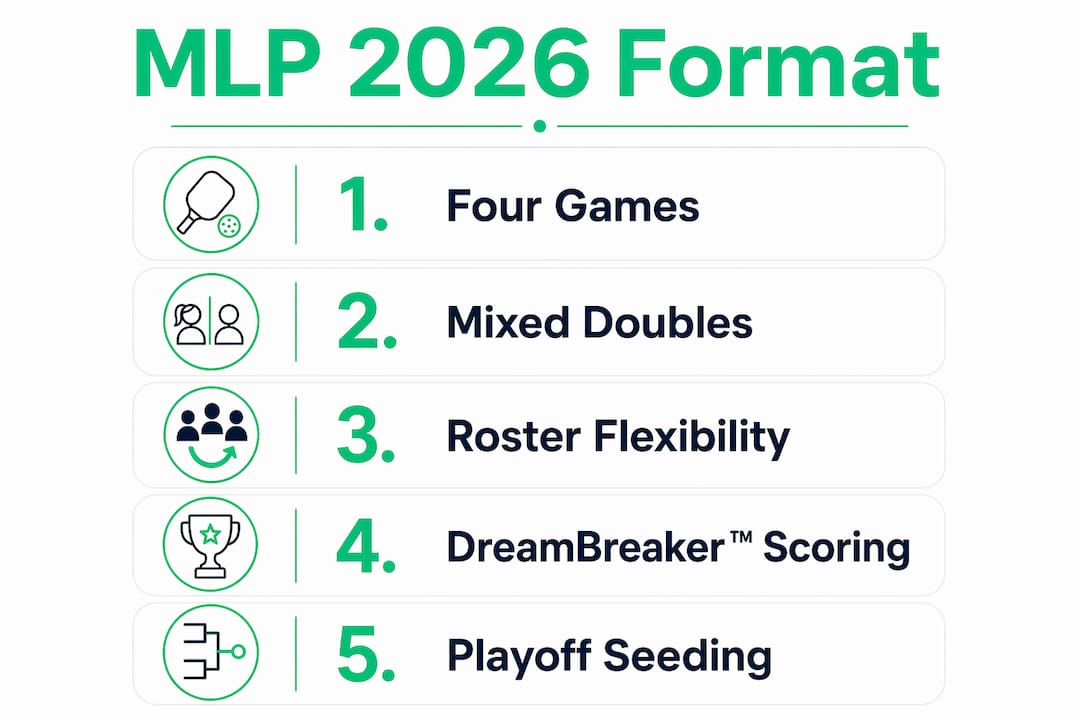
Major League Pickleball runs on a format unlike anything else in racket sports. Each team match consists of four games played in fixed order: women’s doubles, men’s doubles, then two mixed doubles, every game to 11 points with side-out scoring. If the match ends 2-2, a DreamBreaker™ tiebreaker settles it with rally scoring to 21. That structure, governed by the MLPlay™ ruleset, is what separates MLP from every other professional pickleball format.
Here is the quick-reference breakdown before diving deeper:
- Four games per match: women’s doubles, men’s doubles, mixed doubles #1, mixed doubles #2
- Scoring: side-out to 11, win by 2, for all four regulation games
- DreamBreaker™: rally scoring to 21, triggered only at a 2-2 tie
- Rosters: six players per team, three men and three women
- Court setup: USA Pickleball approved balls and paddles, with certified officials on court
- Match flow: all four games always run to completion during regular-season pool play
How the MLPlay™ format works in detail
The fixed game order is not arbitrary. Women’s doubles opens every match, followed by men’s doubles, then the two mixed doubles games. Teams switch ends when one team reaches 6 points within each game. Side-out scoring means only the serving team can score, so momentum shifts matter more than in rally-scored formats.
“MLPlay™ is an innovative gameplay format that brings men and women together on a level playing court… teamwork as a skill is just as critical as speed or technique on the court.” — Major League Pickleball FAQ
One of the sharpest strategic wrinkles: no player may compete in both mixed doubles games. Player A can take Mixed 1 or Mixed 2, not both. That single rule forces coaches to spread their roster and think carefully about matchups before the match even starts.
For 2026, all six players on a roster are eligible to appear in any game. Earlier seasons had a starter/substitute distinction that limited flexibility. That restriction is gone, giving coaches real lineup depth across all four games.

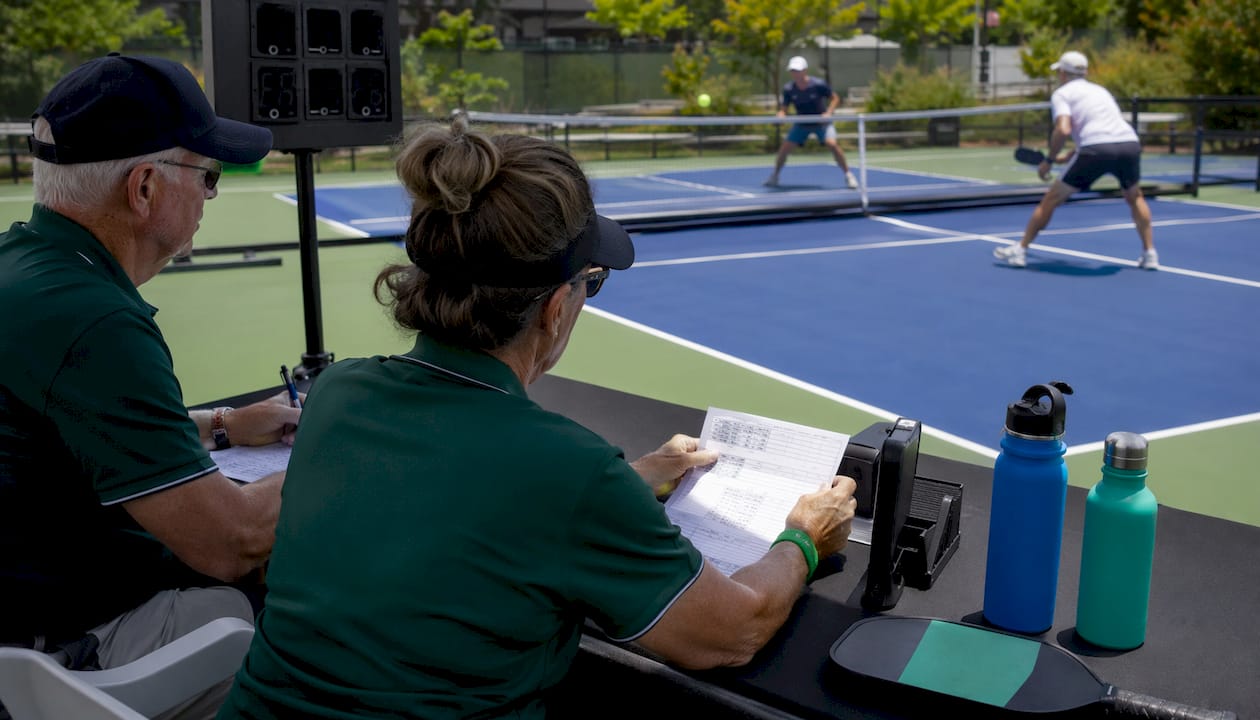
Substitution and officials: Certified referees enforce match protocols throughout, including lineup submissions and substitution timing. Equipment standards require USA Pickleball approved balls and paddles at every MLP event, no exceptions.
The DreamBreaker™ explained
When a match reaches 2-2, the DreamBreaker™ kicks in. It is rally scoring to 21, win by 2, meaning every rally produces a point regardless of who served. Each team rotates all four competing players through singles rallies, with each player serving for four consecutive points before the rotation advances.
Serving side follows score parity: a player serves from the right side when their team’s score is even, from the left when it is odd. At game point, a freeze rule applies: the scoring team must win the final point on their own serve. That detail alone creates some of the most tense moments in professional pickleball.
Pro Tip: In the DreamBreaker, coaches now submit lineups after the final doubles game rather than the night before. Use that window to read how the opposing team’s players are performing on the day, then set your rotation accordingly.
What the 2026 MLP season structure looks like
The 2026 season includes 20 teams competing across 13 total events: nine regular-season events, one Mid-Season Tournament, and three playoff weekends, with the Finals held in New York City’s Central Park.
Each event runs thursday through sunday, split into two phases:
- Thursday through Saturday: round-robin group play, with the 20 teams divided into two groups of roughly 10 teams each
- Super Sunday: top four teams from each group advance to knockout matches for standings points
During group play, all four games in every match run to completion, even if one team has already won three. Point differential matters for tiebreakers, so teams compete hard through every game. The standings points structure rewards regulation wins with three points, DreamBreaker wins with two points, and DreamBreaker losses with one point.
| Phase | Days | Format | Advancement |
|---|---|---|---|
| Group stage | Thursday–Saturday | Round-robin within groups | Top teams per group to Super Sunday |
| Super Sunday | Sunday | Knockout bracket | Standings points awarded |
| Mid-Season Tournament | Single weekend | All 20 teams | Bonus standings points |
| Playoffs | several weekends | Bracket play | Finals in New York City |
Broadcast presentation follows the event structure closely. MLP streams matches live, with Super Sunday receiving the most prominent coverage as the highest-stakes day of each event.
Pro Tip: For organizers replicating this format, court scheduling software built for multi-court events will prevent the bottlenecks that kill amateur MLP-style tournaments. A four-game match with a potential DreamBreaker runs longer than most recreational players expect.
How MLP standings and playoffs determine the champion
Standings points accumulate across all nine regular-season events. Results from Event 1 carry forward into Event 2, and so on through the final regular-season weekend. A team that consistently wins DreamBreakers builds a standings cushion that a single strong late-season event cannot easily erase.
“The cumulative structure creates meaningful decisions around the DreamBreaker: converting a 2-2 regulation tie into a DreamBreaker win earns two points instead of one. Winning in regulation earns three. That one-point gap compounds significantly over nine regular-season events.” — pickleballus.org
Playoff seeding flows directly from regular-season standings. The first playoff round features seeds 5 through 12, with winners advancing to the quarterfinals. The bracket then runs through semifinals and Championship Sunday. Playoff matches follow the same MLPlay™ format: four games always played, DreamBreaker if needed. Teams that managed roster depth across the regular season arrive at playoffs with a clear advantage, since the six-player roster must cover all four game slots without the luxury of leaning on two stars.
Tie-breaking in standings relies on point differential across all games played, which is exactly why the four-game-always rule during pool play matters so much. Every point in every game feeds into that calculation.
What MLP’s format means for team strategy and event organizers
MLP’s franchise team model creates a competitive environment that traditional bracket tournaments simply cannot replicate. Teams build identities, fans follow rosters across a full season, and the cumulative standings create storylines that last months rather than a single weekend.
For organizers running MLP-style amateur events, the practical challenges are real:
- Match length: a full four-game match with a potential DreamBreaker takes longer than a standard recreational game. Block court time accordingly.
- Gender balance: rosters require equal men and women. Recruiting and registration need to account for this from day one.
- Lineup strategy: the mixed doubles restriction forces coaches to think about player roles before the event, not during it.
- Equipment standards: professional team uniforms and approved equipment raise the perceived legitimacy of the event and improve player satisfaction.
- DreamBreaker serving rotation: coaches who drill their players on the four-point rotation before the event arrive with a measurable tactical edge.
MLP’s unique combination of men’s, women’s, and mixed doubles in a fixed order enforces gender balance and diverse tactical play. Amateur leagues that replicate this structure tend to generate stronger community engagement than open-bracket formats, because every player on the roster has a defined role and a stake in the outcome.
Key Takeaways
The MLP format’s fixed four-game structure, combined with cumulative season standings, makes roster depth and DreamBreaker execution the two most decisive factors in winning a league championship.
| Point | Details |
|---|---|
| Four games, fixed order | Every match plays women’s doubles, men’s doubles, then two mixed doubles, always to 11 points. |
| DreamBreaker™ rules | Rally scoring to 21, players rotate every 4 points; lineups submitted after the final doubles game in 2026. |
| 2026 season scale | Twenty teams compete across 13 events: nine regular season, one mid-season, three playoff weekends. |
| Standings accumulate | Points from all nine regular-season events stack; DreamBreaker wins earn two points vs. three for regulation wins. |
| Roster management | No player may appear in both mixed doubles games; all six roster players are now eligible per match in 2026. |
Running an MLP-style pickleball league takes more than good intentions. You need registration, automated scheduling, live standings, playoff brackets, and a payment system that actually works. Flexleagueplus handles all of it, including FLP team leagues that mirror the MLP format, with DUPR integration and Stripe-powered payment collection built in. No subscription required.

Whether you are organizing a local team league or scaling up to a multi-event season, Flexleagueplus’s league software gives you the tools to run it cleanly from day one.