Organizers: 4 Steps to Fair Mixed Doubles Placement With DUPR
Organizers: 4 Steps to Fair Mixed Doubles Placement With DUPR

Mixed doubles pairs one male and one female player on every team, and in rated divisions the higher-rated partner sets the team’s rating. Most organizers default to best 2-of-3 games to 11, win by two, as this scoring format balances fairness with court turnover. Place teams by DUPR rather than gut feel, and stacking complaints mostly disappear.
TL;DR:
- Stacking players above their rated division is common but can undermine fairness, so set clear maximum team rating caps based on DUPR during registration.
- Round robin and dual match formats promote fairness but require more court time, while flex leagues and ladders prioritize flexibility and retention over competitiveness.
- Verifying DUPR IDs upfront and publishing division caps before registration helps prevent sandbagging and reduces disputes mid-season.
- Score reporting deadlines within 24 to 48 hours ensure current standings, with tie-breaks based on head-to-head results and point differential.
- Automating registration, payments, scoring, and standings through dedicated league software reduces administrative workload and keeps the league running smoothly.
Table of Contents
- Which league format fits mixed doubles best?
- What USA Pickleball rules govern mixed doubles?
- How do you place mixed doubles teams fairly?
- How should you schedule mixed doubles sessions?
- How do you handle registration and fees?
- How do you manage scoring, standings, and playoffs?
- What should organizers finalize before week one?
- What I learned running mixed doubles divisions
- Run your mixed doubles league without the spreadsheet chaos
- Sources
Which league format fits mixed doubles best?
The format you pick shapes everything downstream, from court scheduling to how players feel about fairness. Mixed doubles behaves differently depending on the structure you wrap around it.
- Round robin: Every team plays every other team in the division. It produces the fairest standings because nobody’s ranking depends on a lucky bracket draw, but it eats court time fast. Best for committed groups of 8 to 16 teams who show up weekly.
- Flex league: Players report matches on their own schedule within a window, which suits working adults who can’t commit to a fixed night. Flex leagues reduce attendance pressure but generate less of the shared energy a fixed game night builds.
- Ladder: Teams challenge others near their rank and move up or down based on results. Good for ongoing leagues with rolling registration, less useful for a clean season with a defined champion.
- Dual match: Teams face off across multiple courts in a single night, similar to a tennis dual meet. Works well when you have exactly two clubs or facilities competing.
- Social/random rotation: Partners and opponents rotate every game or two. New leagues often start here before graduating to tiered round robin once the player pool stabilizes.
Round robin and dual match maximize competitive fairness for mixed doubles. Flex and ladder maximize flexibility and retention. Pick based on whether your player base values a tight schedule or a loose one.
What USA Pickleball rules govern mixed doubles?
Mixed doubles has one non-negotiable rule: each team fields one male and one female player. That’s not a house preference, it’s written into the USA Pickleball Official Rulebook, and enforcing it consistently keeps your league sanction-compliant if you ever move toward rated play.
Statistic to know: In skill-rated mixed doubles, the higher-rated partner determines the team’s overall rating, not an average of the two. A 4.5 player paired with a 3.0 player creates a 4.5 team for placement purposes.
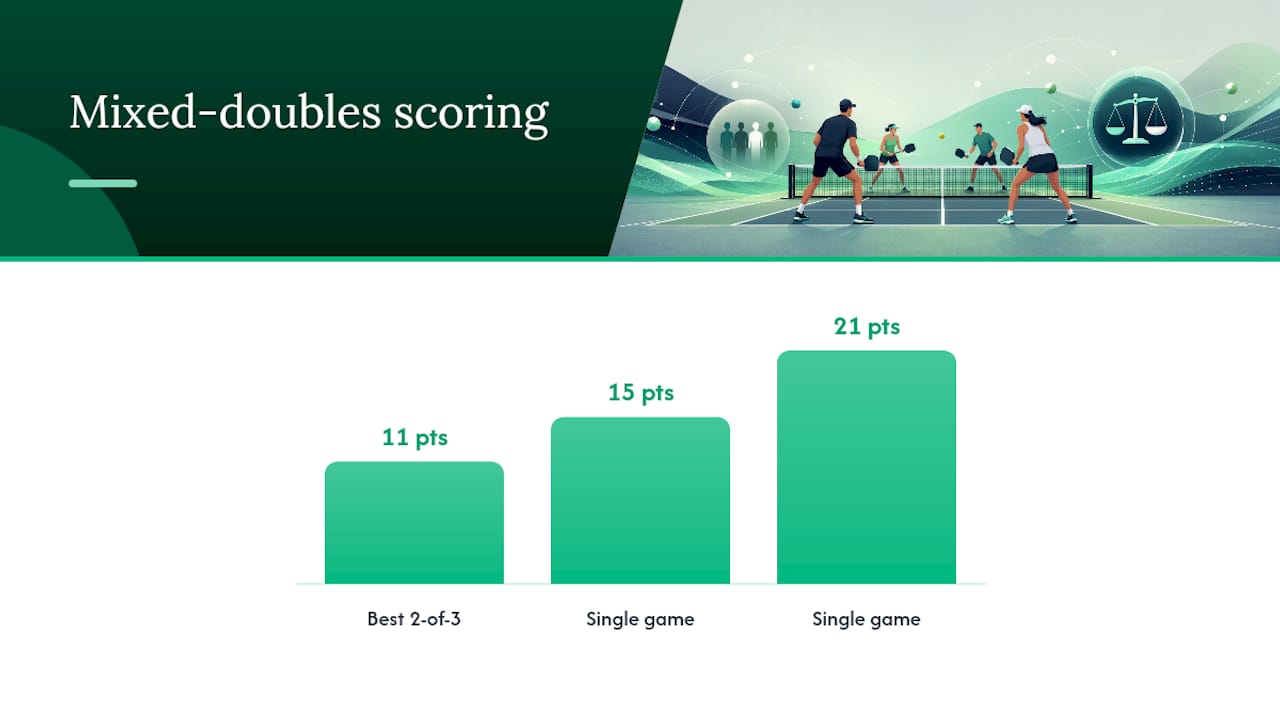
For scoring, USA Pickleball gives organizers three standard paths:
- Best 2-of-3 games to 11, win by 2 (the common league default)
- Single game to 15 or 21, win by 2 (faster, used when court time is tight)
- Provisional rally-scoring formats, which some directors use to shorten match length, though adoption is inconsistent across regions
Service and side rules follow standard doubles mechanics. Call the score before every serve as server score, receiver score, server number (1 or 2).
How do you place mixed doubles teams fairly?
Since a team’s rating rides on its stronger player, a 5.0 stacked with a 2.5 partner still plays as a 5.0 team. Ignore that reality and your “intermediate” division quietly becomes a dumping ground for sandbaggers. Setting clear division boundaries tied to a rating system is the single most effective fix organizers have.
- Set a max team rating per division. A 3.5 division caps at the higher-rated partner’s DUPR number, full stop, no exceptions for “but they’re really a 3.2 that day.”
- Consider a roster-average cap as a secondary filter. This catches teams that technically qualify by the higher-partner rule but still feel mismatched.
- Verify DUPR IDs at registration, not after complaints start. Checking DUPR ratings during signup instead of trusting self-reported skill level closes the loophole before it opens.
- Build a simple appeals process. Let a team request reassignment if a rating changed significantly since registration, but require documentation, not just a claim.
Pro Tip: Publish your division caps before registration opens, not after. Players who see the rule up front rarely argue with it; players who discover it mid-season after being bumped almost always do.
How should you schedule mixed doubles sessions?
A best 2-of-3 to 11 match typically runs about half an hour to under an hour depending on skill level and how close the games are. Budget court time accordingly rather than guessing.
- 6 players, 1 court: Round robin singles/doubles rotation, roughly 60 to 90 minutes total.
- 12 players, 2 to 3 courts: A full round robin division fits comfortably in a 2 hour session.
- 24 players, 4 to 6 courts: Split into two divisions running simultaneously, or stagger start times by 30 minutes to avoid a bottleneck at check-in.
No-shows wreck a session faster than anything else. Set a policy that a team missing without 24 hours notice forfeits that match by score default, and build in a quick reschedule window, usually 48 to 72 hours, so one absence doesn’t stall the whole division’s standings.
How do you handle registration and fees?
Collect the essentials at signup: partner name, DUPR ID, contact info, availability windows, and an emergency contact. Skipping DUPR verification here is the most common mistake new organizers make, because it pushes the fairness problem downstream to week three when someone finally complains.
Fee structure is your call, but three models cover most leagues:
- Per-player fee, split evenly regardless of partner skill
- Per-team fee, simpler to process but requires partners to settle up between themselves
- Tiered pricing by division, charging competitive divisions slightly more if they include added perks like extra playoff rounds
Whatever you choose, run payments through a processor built for this, not a personal Venmo chain that leaves you reconciling spreadsheets by hand. Stripe integration handles the transaction securely and gives you a clean paper trail if a refund dispute comes up.
How do you manage scoring, standings, and playoffs?
Score reporting only works if you enforce a deadline. Require both teams to submit results within 24 to 48 hours of the match, capturing game scores, date, and both team names. Waiting longer than that means someone forgets, and your standings page goes stale right when players check it most.
- Break round-robin ties using head-to-head result first, then point differential, then total points scored.
- Seed playoff brackets by final standings, not by a random draw. Random draws feel fun until the two best teams meet in round one.
- Choose single elimination for divisions under 8 teams to keep the playoff day short.
- Add a consolation bracket for divisions of 8 or more so a first-round loss doesn’t end a team’s whole season in five minutes.
What should organizers finalize before week one?
A short preseason checklist saves you from the scramble that hits most new organizers around match three, when players start asking questions you haven’t answered yet.
- Publish full rules and scoring format at least a week before registration closes.
- Verify every DUPR ID and confirm division caps before assigning teams to pools.
- Lock in court reservations for the entire season, not week by week.
- Publish the no-show and refund policy where players actually see it, not buried in a signup form footer.
- Send a match reminder 24 hours out and a results-reporting prompt right after each scheduled match window.
Pro Tip: Build a short mid-season feedback check, even just a two-question form, around week 3 or 4. Division caps that looked right on paper sometimes need a small adjustment once real match results come in, and catching that early beats a wave of complaints at the finale.
What I learned running mixed doubles divisions
Stacking was the recurring headache in every league I helped set up. A team looked “intermediate” on paper, then steamrolled the division because nobody checked that the higher-rated partner rule applied to them too. The fix wasn’t complicated: verify ratings before assigning divisions, not after someone complains.
Automating that check, along with score reporting and payment collection, cut the administrative back-and-forth dramatically. Less time chasing spreadsheets means more time actually running the league.
— Robert
Run your mixed doubles league without the spreadsheet chaos
Flexleagueplus is the alternative to juggling registration forms, DUPR lookups, and payment tracking across three different tools. Everything an organizer needs for a mixed doubles season, rating verification, division caps, scheduling templates, live standings, and playoff brackets, lives in one system built for exactly this.

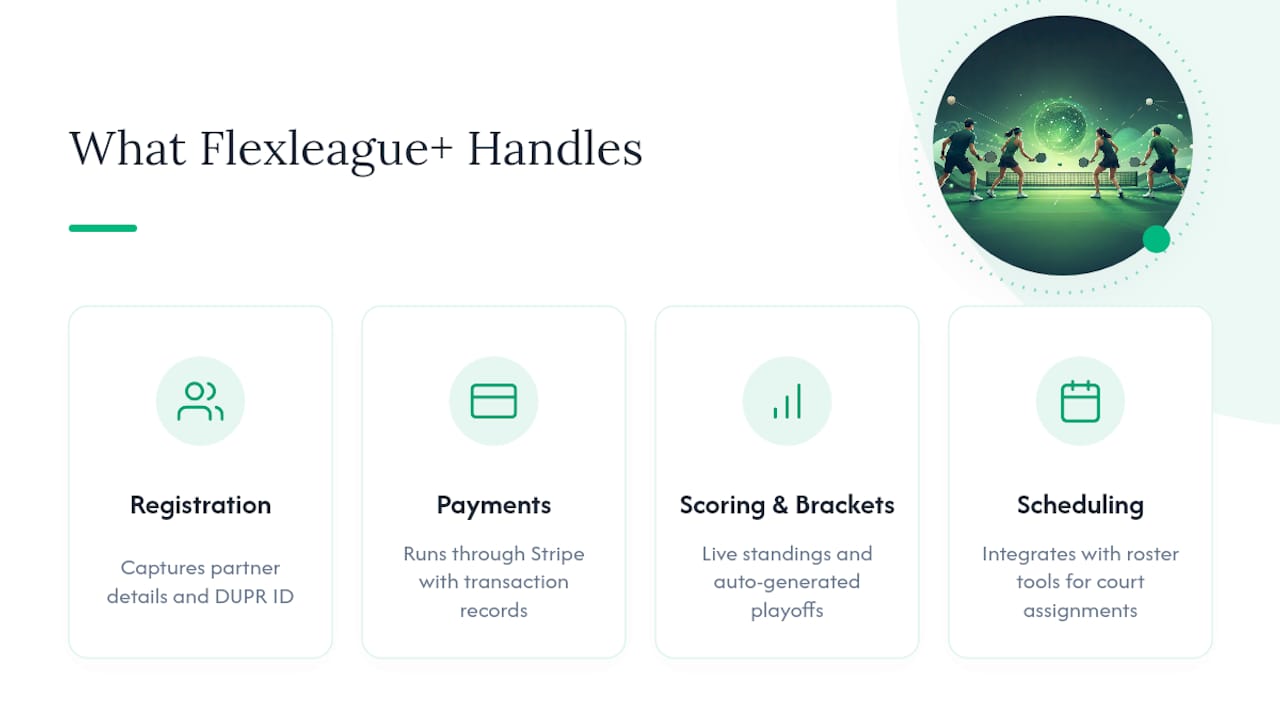
Registration captures partner details and DUPR ID automatically, so you’re not manually cross-checking ratings before assigning divisions. Payments run through Stripe, giving players a secure checkout and giving you a clean transaction record without touching a personal payment app. Score reporting and standings update live, and playoff brackets generate directly from your final rankings.
For scheduling day-to-day court assignments, a roster tool like Roster Sports can complement the league structure if you’re coordinating shared facility time across multiple sports.
Set up your first mixed doubles division on the Flexleague+ league software platform and see how much of the season you can put on autopilot before your first match night.