Organizers: Men's Doubles Format Rules to Prevent Bracket Collapse
Organizers: Men’s Doubles Format Rules to Prevent Bracket Collapse
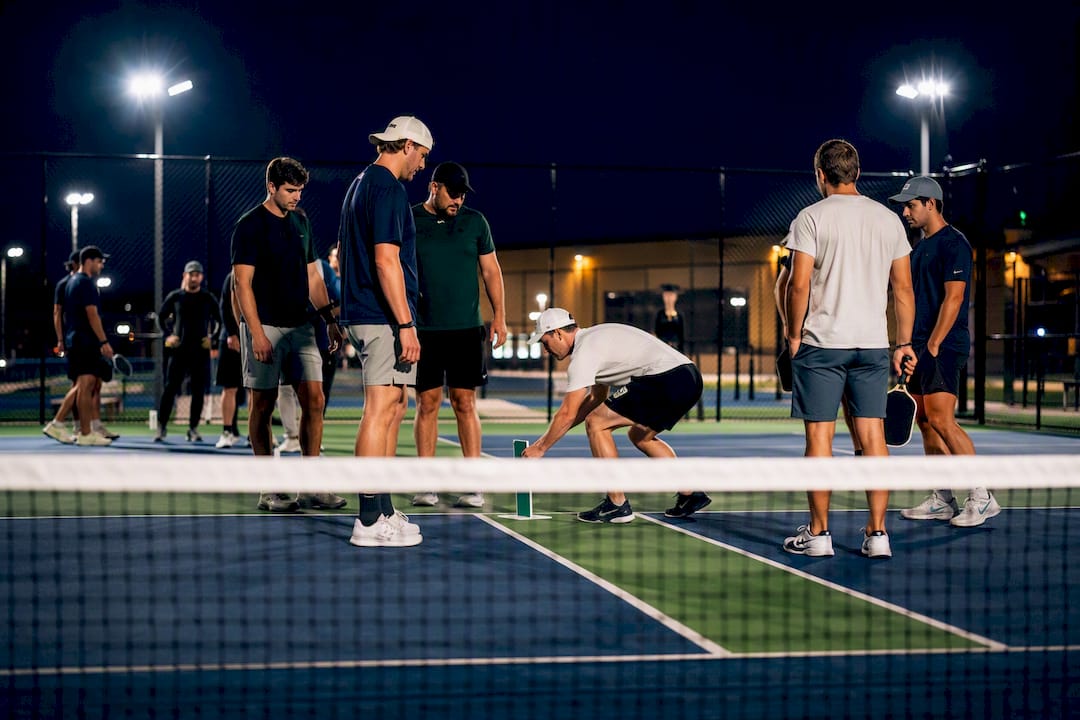
Men’s doubles format in pickleball means two-player teams competing under Official USA Pickleball rules, with doubles-specific serving and rotation, the three-number score call, and games typically played to 11, win by 2. Organizers building a league or tournament around this format need to lock in those baseline mechanics before they touch brackets or scheduling.
TL;DR:
- Accurate partner confirmation before registration is essential to prevent last-minute bracket disruptions and ensure smooth tournament flow.
- Using online platforms with built-in rating imports and automatic seeding simplifies scheduling and minimizes errors during setup.
- Detailed court assignment and scorekeeping protocols, including posting rotations and reading the three-number score call aloud, keep matches organized and transparent.
- Time-capped pool matches and smaller divisions help manage scheduling pressures, especially when court availability or daylight hours are limited.
- Clarifying the scoring system and choosing between side-out and rally scoring depending on event goals can significantly impact match length and competitiveness.
Table of Contents
- What Are the Core Rules and Scoring for Men’s Doubles?
- Which Tournament Format Fits Your Men’s Doubles Event?
- How Do You Plan the Schedule and Bracket Math?
- What Registration and Partner-Confirmation Process Works Best?
- How Do You Keep Match Day Running Smoothly?
- Why Clear Format Rules Matter More Than the Format Itself
- How FlexLeague+ Handles the Organizer Side of Men’s Doubles
- Sources
- FAQ
What Are the Core Rules and Scoring for Men’s Doubles?
Every men’s doubles match runs on the three-number score call: server’s score, receiver’s score, then the server number (1 or 2). A call of “4-2-1” means the serving team has 4, the receiving team has 2, and the first server on that side is serving. It sounds fussy until you’ve run a tournament without it. Get this wrong on a busy Saturday and you’ll have two teams arguing about whose serve it actually was.
The serve rotation is where most rules confusion happens. At the very start of each game, only one player serves before the first side-out. After that, both players on a team get a chance to serve each time their team wins the serve, until they commit a fault and side-out to the opponents. Positioning matters just as much as sequence: the player in the right/even court serves first on each service turn, and teams rotate court sides only after scoring, not after every serve.
- Double bounce rule: the ball must bounce once on each side before volleys are allowed, which forces both teams to let the return of serve bounce.
- Kitchen (non-volley zone): players can’t volley the ball while standing inside the 7-foot zone from the net, on either side.
- Standard game target: games to 11, win by 2, following the USAP Official Rulebook.
- Tournament finals: often extended to 15 or 21 to reward depth over a lucky streak.
Most leagues run traditional side-out scoring, where only the serving team can score. Some organizers switch to rally scoring for time-capped social events, since every rally awards a point regardless of who served. That single change speeds up match length significantly and simplifies the score call to two numbers instead of three, though it changes strategy enough that competitive players often prefer to keep it out of championship brackets. For the official mechanics behind all of this, PickleballUS breaks down the three-number system with call examples worth printing for your scorekeepers.
Which Tournament Format Fits Your Men’s Doubles Event?
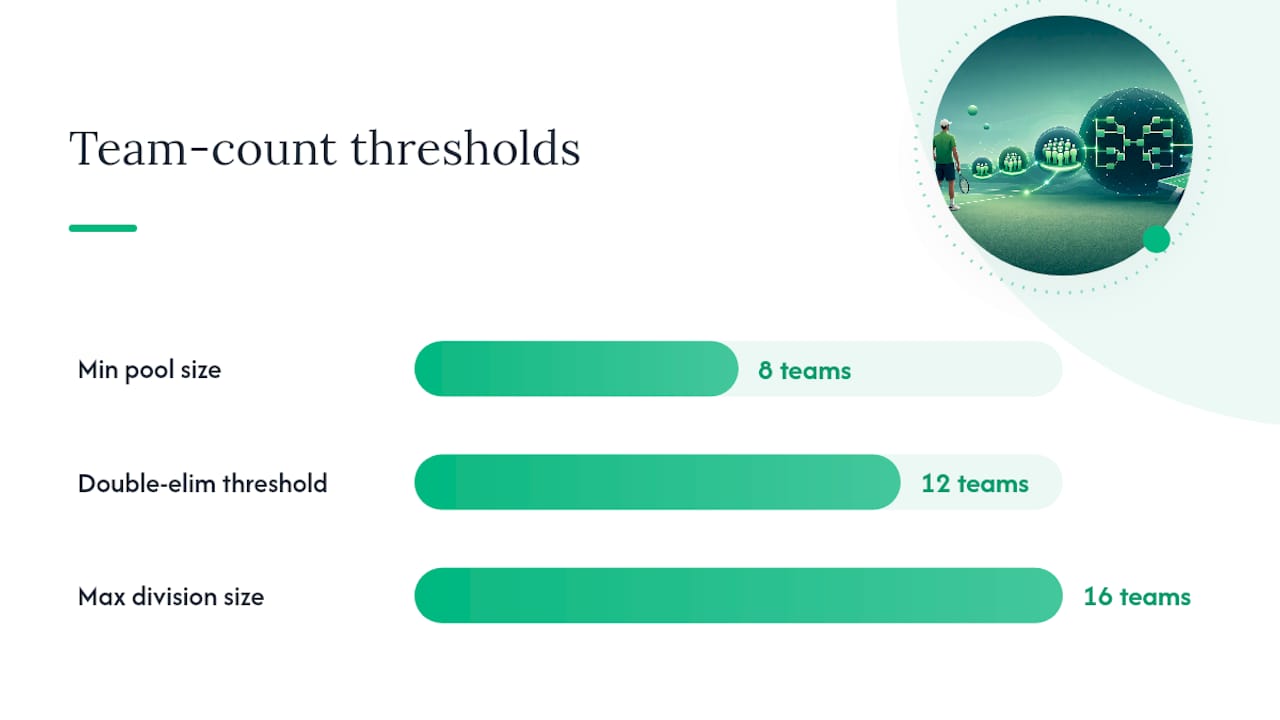
Format choice depends almost entirely on two numbers: how many teams you have, and how much time you’ve booked. Get the format wrong and you either run out of courts or run out of daylight.
Round-robin formats work best for smaller groups where everyone wants real playing time.
- Fixed-pair round robin: partners stay together all day and play every other team once. Simple to schedule, easy to seed, and the standard for league play.
- Rotating-partner round robin: players get a new partner each round. It’s more social, reveals individual skill separate from partner chemistry, but scheduling gets considerably more complex since you’re tracking partner combinations, not just opponents.
Bracket formats suit larger fields chasing a clear champion.
- Single-elimination: fastest format, best when courts or time are tight, worst for teams who traveled far to play one match and go home.
- Double-elimination: gives teams a second chance through a losers bracket, the go-to for a serious men’s doubles tournament with 12 or more teams.
- Pools plus playoffs: teams play round-robin within a pool, then the top finishers cross into a single or double-elimination playoff bracket. This is the format most facility operators land on because it guarantees a minimum number of matches per team while still producing a clean bracket at the end.
Match targets should scale with the stakes: pool play often runs single games to 11 or time-capped matches to keep things moving, while semifinals and finals move too best-of-three to 11, or single games to 15 or 21. Divide by skill level (using DUPR or an organizer rating) and by age bracket where your player base supports it, and try to keep divisions between 8 and 16 teams. Smaller than that, and a pool feels thin; larger, and you need multiple pools anyway.
How Do You Plan the Schedule and Bracket Math?
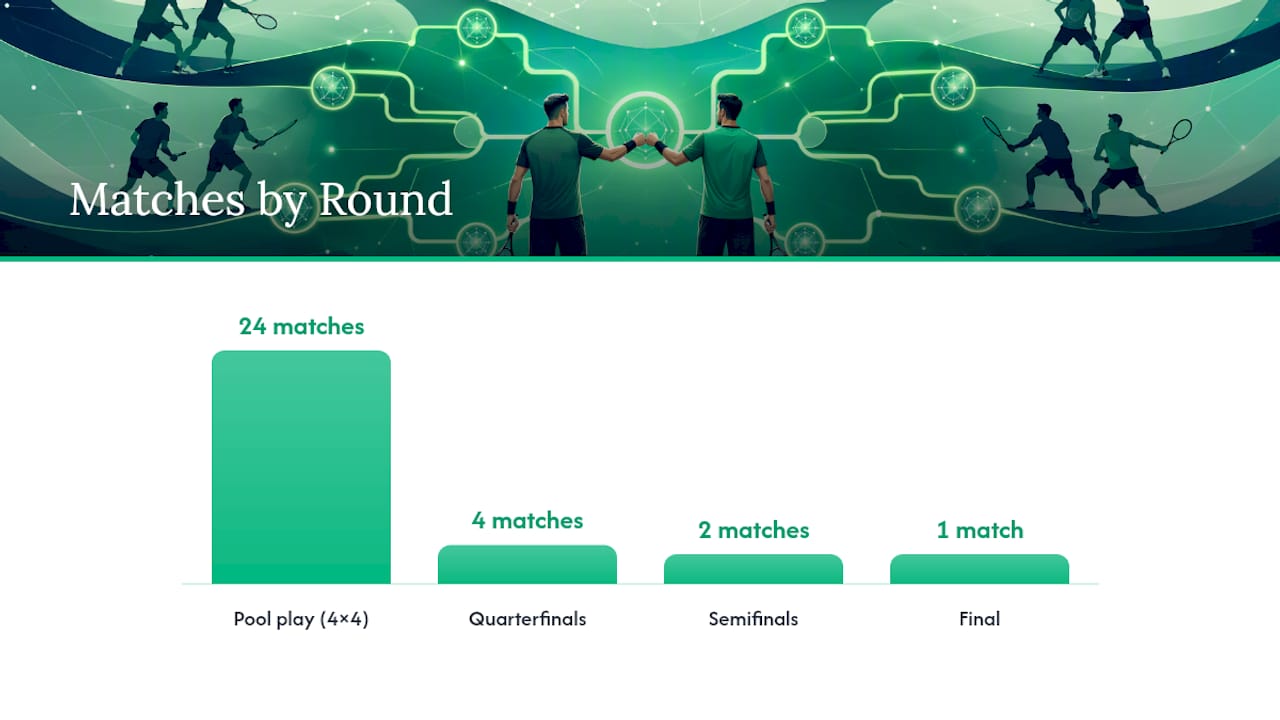
The double-elimination rule of thumb says total matches equal roughly twice the number of teams minus two. That number is what you use to reverse-engineer your court count and end time, not the other way around.
Average match length depends on format. A best-of-three to 11 typically runs 45 to 60 minutes with warmup and changeovers. A single game to 11 usually wraps in 20 to 25 minutes. Time-capped pool matches, often set at 15 minutes per game, are the easiest to schedule tightly because you know exactly when a court frees up.
| Round | Matches | Courts Needed (4 available) | Estimated Rounds |
|---|---|---|---|
| Pool play (4 pools of 4) | 24 total | 4 | 6 |
| Quarterfinals | 4 | 4 | 1 |
| Semifinals | 2 | 2 | 1 |
| Final | 1 | 1 | 1 |
- Build in a 15% to 20% time buffer beyond your calculated total. Matches run long. Players show up late. A tight schedule with zero slack is a schedule that collapses by round three.
- Smaller, evenly sized pools reduce byes and simplify seeding into playoffs far more than one giant pool.
- Post a court assignment grid at check-in so players aren’t hunting down organizers between rounds.
What Registration and Partner-Confirmation Process Works Best?
Incomplete teams cause more scheduling chaos than any bracket format decision you’ll make. A player who registers solo, assuming a partner will “figure it out,” is the single most common source of last-minute bracket rebuilds.
- Require both partners to confirm registration independently, whether by email, text, or in-app confirmation, before a team counts as registered.
- Collect a skill rating at signup, whether that’s a DUPR rating or an organizer-assigned rating, and use it to seed pools and avoid lopsided first-round blowouts.
- Set a hard cutoff for substitutions, typically 48 to 72 hours before the event, after which only pre-approved alternates can step in.
- Process payment at the point of confirmation, not before both partners are locked in, so you’re not refunding half-formed teams.
Pro Tip: Build your alternate list before registration closes, not after a withdrawal happens. A ranked waitlist of two or three backup teams turns a Friday-night scramble into a five-minute swap.
Platforms with paired-confirmation logic and built-in DUPR rating import handle most of this automatically, which matters once you’re managing more than a handful of teams by spreadsheet.
How Do You Keep Match Day Running Smoothly?
Court assignment should follow a fixed rotation posted where players can see it, not verbal calls shouted across the facility. That alone cuts down on the “wait, is it our court?” confusion that eats ten minutes per round.
- Have scorekeepers repeat the full three-number call before each serve, out loud, so both teams hear and confirm it.
- Assign at least one volunteer per two or three courts to handle disputes before they escalate to the tournament desk.
- If a team withdraws mid-event, pair the remaining player with a waitlisted alternate, merge undersized pools, or award a bye rather than forcing a forfeit.
Pro Tip: Keep a laminated score-call script at every court. New volunteers make fewer mistakes when they can read the format instead of guessing at it under pressure.
Why Clear Format Rules Matter More Than the Format Itself
Organizers spend a lot of energy debating single versus double elimination when the real risk sits somewhere less exciting: incomplete teams. A bracket built on unconfirmed partners falls apart no matter how clean the format looks on paper.
Time-capped pools work well for social leagues where turnout and fun matter more than a clean champion. Full best-of-three matches earn their place in championship rounds, where players expect the format to reward consistency, not a lucky game. The organizers who run the smoothest events are the ones who confirm every partner before the bracket gets built, and who lean on software to handle that confirmation instead of a group text thread that someone inevitably misses.
— Robert
How FlexLeague+ Handles the Organizer Side of Men’s Doubles
Everything covered above, from paired confirmations to seeding math to match-day scorekeeping, is exactly what FlexLeague+ is built to run. It’s the alternative to managing men’s doubles through spreadsheets and group chats: partners confirm registration together inside the app, ratings pull in through DUPR integration for accurate seeding, and brackets generate automatically once pools close.
Payments can be processed at the point of registration to simplify fee collection and avoid chasing down partner contributions after the bracket is set. Facility operators running weekly leagues can automate the scheduling grid instead of rebuilding it every session, and players get live standings without asking an organizer for updates. If you’re planning a men’s doubles league or tournament for the next season, set up your league on FlexLeague+ and see how much of the registration and bracket work runs itself.
Sources
- USAP Official Rulebook v2025 (Official USA Pickleball Rulebook)
- How to Keep Score in Doubles Pickleball: The 3-Number System (PickleballUS)
- Tournaments guide (organizer planning guidance)
FAQ
What is the standard scoring format for men’s doubles?
Games are typically played to 11 points, win by 2, using the three-number score call: server’s score, receiver’s score, and server number.
Do both players serve in doubles before a side-out?
Yes, except at the very start of each game, when only one player serves before the first side-out. After that, both partners serve in sequence until their team faults.
How many matches should I plan for a 16-team double-elimination bracket?
Based on the rule of thumb that total matches equal about twice the number of teams minus two.
When should I use rally scoring instead of side-out scoring?
Rally scoring works well for time-capped social events or pool play where you need faster, more predictable match lengths, since every rally scores a point.
What’s the best way to prevent incomplete teams from disrupting a bracket?
Require independent confirmation from both partners at registration, ideally through a platform like FlexLeague+ that enforces paired sign-up before payment processes.