2026 World Cup Group Stage Standings: Live and Explained
2026 World Cup Group Stage Standings: Live and Explained

The fastest way to check live group stage standings is FIFA’s official standings page, which updates in real time during matches. ESPN and Fox Sports carry the same core data alongside analysis and bracket views. Every group table ranks teams by Points (PTS) first, then Goal Differential (GD), with columns for Matches Played (MP), Wins (W), Draws (D), Losses (L), Goals For (GF), and Goals Against (GA).
Table of Contents
- Where to find live group stage standings right now
- How to read a World Cup group table
- How tie-breakers work when teams finish level on points
- How group results feed the knockout bracket
- How to interpret a live table that keeps changing
- Key Takeaways
- Why goal differential matters more than most fans realize
Where to find live group stage standings right now
Three sources cover the 2026 World Cup standings authoritatively, and each serves a slightly different purpose.
- FIFA.com is the official record. Standings update live during matches and carry the knockout bracket. When you need the verified final result after full-time, this is the one to trust.
- ESPN pairs the group table with live scores, match analysis, and a bracket visualization. The columns (GP, W, D, L, GF, GA, GD, PTS) match FIFA’s layout, but the surrounding context helps you understand what a result actually means for qualification.
- Fox Sports broadcasts matches in the U.S. and publishes standings and bracket views alongside its coverage, making it useful if you are already watching on that platform.
- NBC Sports and CBS Sports also publish full standings for all 12 groups, with CBS Sports using a clean Pos/Team/GP/W/D/L/GF/GA/GD/PTS layout that is easy to scan at a glance.
Live tables refresh instantly as goals go in, but they are provisional until the final whistle. A goal scored in the 89th minute can flip two teams’ positions before the referee even blows for time.
Pro Tip: On matchday, keep FIFA open in one tab for official confirmation and ESPN or CBS open in another for the bracket view. When multiple groups play simultaneously, the bracket tab shows you which third-place slot a live result would fill, saving you from doing the math yourself.
How to read a World Cup group table
Every group table uses the same column structure across FIFA, ESPN, and CBS. Here is what each abbreviation means:
| Column | Full Name | What It Tells You |
|---|---|---|
| MP / GP | Matches Played | How many games a team has completed |
| W | Wins | Three points each |
| D | Draws | One point each |
| L | Losses | Zero points |
| GF | Goals For | Total goals scored |
| GA | Goals Against | Total goals conceded |
| GD | Goal Differential | GF minus GA; positive is good |
| PTS | Points | Primary ranking metric |
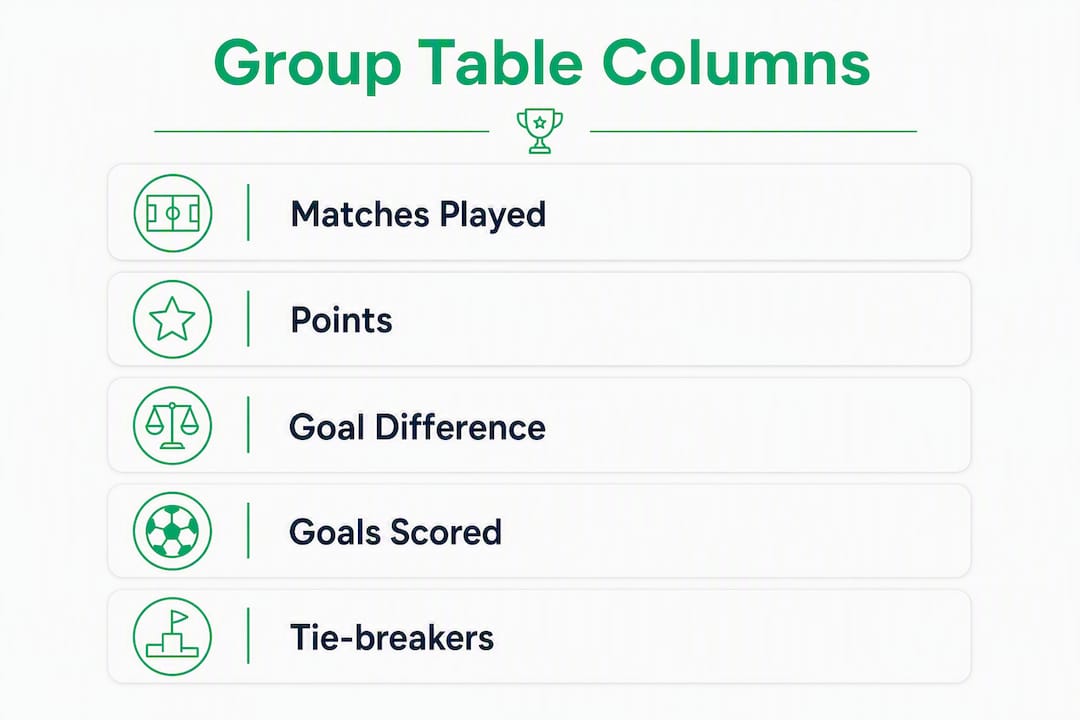
A sample mid-tournament snapshot might look like this:
| Pos | Team | MP | W | D | L | GF | GA | GD | PTS |
|---|---|---|---|---|---|---|---|---|---|
| 1 | Team A | 2 | 2 | 0 | 0 | 5 | 1 | +4 | 6 |
| 2 | Team B | 2 | 1 | 0 | 1 | 3 | 3 | 0 | 3 |
| 3 | Team C | 2 | 1 | 0 | 1 | 2 | 3 | -1 | 3 |
| 4 | Team D | 2 | 0 | 0 | 2 | 1 | 4 | -3 | 0 |
Quick reading tips:
- A team with six points from two games is effectively safe. A team with zero points from two games needs a win and help.
- When two teams share the same points total, scan GD immediately. Points are primary, but goal differential is the most decisive immediate tie-breaker and often determines third-place advancement.
- Outlets like ESPN label finalized positions as “GROUP WINNERS,” “RUNNERS-UP,” “ADVANCED,” or “ELIMINATED” once results are confirmed, so you can read qualification status at a glance.
How tie-breakers work when teams finish level on points
FIFA applies tie-breakers in a specific order. Knowing the sequence prevents confusion on a chaotic final matchday.
- Points — always the primary separator.
- Head-to-head points between the tied teams.
- Head-to-head goal differential in matches between those teams.
- Head-to-head goals scored in those same matches.
- Overall goal differential across all group games.
- Overall goals scored across all group games.
- Fair play points (yellow and red card deductions).
- Drawing of lots — extremely rare, used only when everything else is equal.
The head-to-head rule applies cleanly when exactly two teams are tied. When three or more teams share the same points, FIFA first compares their head-to-head record among themselves. If that mini-table is still level, the process moves to overall GD. That is why a team can sometimes leapfrog a rival despite losing their direct meeting: the overall numbers across all three games override the head-to-head once a multi-team tie is involved.
Pro Tip: When two groups are playing their final matches simultaneously, the live table you see is “virtual” — it reflects current scores, not confirmed results. A goal in the other game can instantly change which tie-breaker applies. Wait for both matches to finish before treating any position as settled.

How group results feed the knockout bracket
The 2026 World Cup uses an expanded 48-team format across 12 groups. Advancement works like this:
- The top two teams in each of the 12 groups qualify automatically. That is 24 teams.
- The eight best third-place teams across all 12 groups also advance, bringing the total to 32.
- Those 32 teams enter a Round of 32, then proceed through the Round of 16, Quarter-finals, Semi-finals, and the Final.
Third-place teams are ranked by the same criteria used within groups: points first, then GD, then goals scored. A third-place team with four points and a strong GD can finish ahead of a third-place team with four points and a flat GD from a different group.
Pro Tip: NBC Sports and CBS Sports both maintain a live third-place ranking table during the group stage. Bookmark it separately from the individual group tables. On final matchday, that table is where the real drama plays out.
How to interpret a live table that keeps changing
Live standings are provisional by design. FIFA updates them instantly as goals are scored, which means the table you see at the 70th minute may look nothing like the one at full-time.
- A goal that changes GD by one can flip two teams’ positions when they are level on points.
- If a third-place team in one group scores late, it can push a third-place team from a finished group off the bubble entirely.
- Tie-breaker checks (especially head-to-head comparisons) cannot be fully resolved until all relevant matches are complete.
Official confirmation arrives at full-time, after FIFA applies all tie-breakers. For final verification, go directly to FIFA.com. For real-time scenario tracking during the match, broadcaster standings pages update quickly and often display color-coded “currently qualifying” indicators that show which positions a live result would produce.
Pro Tip: If you are watching a match where qualification is on the line, open a second screen with the other simultaneous group game. A goal there can make your team’s result irrelevant, or suddenly critical, within seconds.

Key Takeaways
The most important thing to know about group stage standings is that points decide rank first, goal differential decides ties, and live tables are provisional until full-time.
| Point | Details |
|---|---|
| Primary source for official standings | Use FIFA.com for verified, final group results and the knockout bracket. |
| Broadcasters add context | ESPN, Fox Sports, and CBS Sports pair standings with analysis, live scores, and bracket views. |
| Points then goal differential | PTS ranks teams first; GD is the most immediate tie-breaker fans should watch. |
| Third-place ranking is separate | Eight best third-place teams advance; track that table independently on final matchday. |
| Live tables are provisional | Wait for full-time confirmation before treating any position as official. |
Why goal differential matters more than most fans realize
Most fans watch the scoreline. The sharper move on a decisive final matchday is watching the GD column.
A team chasing qualification often needs more than a win. It needs a win by a specific margin, because the third-place ranking across 12 groups compares GD before it compares goals scored. Playing safe for a 1-0 when a +2 GD is required is not cautious, it is a path to elimination. The teams that understand this press for a second goal even when one feels comfortable.
The same logic applies to how you watch. If your team is third with four points and another group’s third-place team also has four points but a better GD, your team needs goals, not just a result. Splitting attention between your match and that other group is not distraction. It is the only way to know whether the current score is actually enough.
Platforms built around live standings, like Flexleagueplus for pickleball leagues, are designed around exactly this problem: showing organizers and players a live table that reflects current results without requiring manual math. The principle is the same whether the sport is soccer or pickleball. A standings table is only useful if it updates fast and shows you the number that actually decides rank.