Managers: Record Pickleball League Forfeits the USAP/DUPR Way
Managers: Record Pickleball League Forfeits the USAP/DUPR Way

A forfeit is a rule-based loss recorded when a player or team fails to show up, fields ineligible players, or is otherwise disqualified from a scheduled match, and it counts as a win for the opponent, typically scored 11-0. That result can affect standings, tie-breakers, and playoff eligibility, though most rulebooks exclude forfeited matches from official player ratings.
TL;DR:
- Most forfeits are scored as 11-0 in two-out-of-three formats, but actual scores are kept during retirements for injuries, and no points are awarded for withdrawals before the match.
- Repeated forfeits can lead to playoff disqualification, although they do not impact the official standings, but they do influence player and team ratings.
- Allowing flexible scheduling, clear roster minimums, and early reminders significantly reduces no-shows, while strict penalty policies have less impact on forfeits.
- League management should prioritize logistics like backup players and communication over penalties to minimize forfeits effectively.
- Automated league software can streamline forfeit reporting, score entry, and ratings updates, reducing administrative friction and dispute risk.
Table of Contents
- Definitions: Forfeit vs Withdrawal vs Retirement
- How Forfeits and Retirements Are Scored
- How Forfeits Affect Standings, Tie-Breakers, and Ratings
- Typical League Policies: Grace Periods, Fees, and Substitution Rules
- A Manager’s Checklist for Recording and Appealing a Forfeit
- How to Prevent Forfeits Before They Happen
- Why Better Administration Cuts Forfeits, Not Just Records Them
- Letting Software Handle the Forfeit Paperwork
- Sources
- FAQ
Definitions: Forfeit vs Withdrawal vs Retirement
These three outcomes look similar on a scoresheet but mean different things to a league manager, and mixing them up creates disputes later.
A withdrawal happens before a match starts: a player or team notifies the league they cannot play and pulls out, often with enough notice to find a replacement or adjust the bracket. A forfeit happens when a team fails to show, fields an ineligible player, or is disqualified by a referee for conduct or lineup violations, and the match is awarded to the opponent without any points played. A retirement happens mid-match, most often due to injury, illness, or a medical timeout that runs out, and the score at the point of retirement matters for how the result gets recorded.
- Withdrawal: a team or player notifies the league before the match begins, and the slot is often filled by a substitute.
- Forfeit: a team fails to appear, misses the grace period, or breaks eligibility rules, and the opponent is awarded the win.
- Retirement: a team stops play after the match has started, usually for a medical reason, and the existing score carries into the final result.
A quick scenario: a doubles team shows up nine minutes into a 10-minute grace period but with only one eligible player, that’s a forfeit under most rulebooks, not a withdrawal, because the match was already scheduled to start. A player who twists an ankle in the second game and can’t continue is a retirement, not a forfeit, and the scorekeeper needs to know the difference before typing anything into the system.
How Forfeits and Retirements Are Scored
Scoring conventions vary slightly by league, but the pattern across rulebooks is consistent enough to treat as a default.
The USAP Official Rulebook lists specific scoring and handling rules for withdrawals, retirements, and forfeits, and the USAP rulebook change document sets explicit scoring conventions, including rule-based forfeits reported as 11-0 in two-out-of-three formats. The Premier Pickleball League rules follow the same pattern: a forfeited line gets entered as 11-0, and managers are told not to enter player statistics for a line that never actually played.
Retirements are treated differently. When a match stops mid-play because of injury, the actual score at that point stands, and the remaining games or points are typically awarded to the opponent to preserve a standard winning margin, rather than wiping the board to 11-0. Retirements tied to physical injury are common enough in racquet sports that leagues benefit from clear medical timeout rules, a topic covered in detail by orthopedic specialists writing about common pickleball injuries.
Withdrawals before a match starts are usually logged as 0-0 placeholders rather than a scored loss, since no play occurred and the slot may still be filled.
| Outcome | When it happens | Typical score entry |
|---|---|---|
| Rule-based forfeit | No-show, ineligible player, disqualification | 11-0 per game (two-out-of-three format) |
| Retirement | Mid-match injury or medical timeout expiry | Actual score kept, remaining points awarded to opponent |
| Withdrawal | Team or player exits before match starts | 0-0 placeholder, no result scored |
How Forfeits Affect Standings, Tie-Breakers, and Ratings
This is where forfeits stop being a scoring technicality and start shaping who makes the playoffs.
Under the USAP rule changes referenced above, when a player or team withdraws, retires, or is forfeited from a round robin event, their match results do not count toward standings but do count toward the player or team rating. That distinction matters for anyone tracking DUPR, since a forfeit still shows up in a player’s rating history even though it never touches the league table.
- Standings math: forfeited matches are typically removed from win-loss calculations for tie-break purposes, so a forfeit against a strong opponent doesn’t distort point differential the way an actual loss would.
- Tie-breakers: leagues that use point differential or head-to-head results for seeding usually exclude forfeited games from those calculations, though the win itself still counts for the opponent.
- Playoff eligibility: repeated forfeits, often two or three in a season depending on the league’s own policy, can trigger disqualification from playoff contention regardless of overall record.
- Rating impact: DUPR and similar systems generally still log the result for rating purposes even when the league excludes it from standings, which is why consistent, accurate score entry matters even for a walkover.
Managers running multi-pool formats should pay particular attention here, since a forfeit in one pool can shift seeding for teams that never played the forfeiting side, a scenario covered in more depth in a guide to fixing uneven playoff pools.
Typical League Policies: Grace Periods, Fees, and Substitution Rules
Most leagues build their forfeit policy around four decisions, and the choices below reflect what shows up repeatedly across municipal and private league rulebooks.
- Grace period: the City of Dublin pickleball league rules use a 10-minute grace period before a no-show becomes an official forfeit, while the Premier Pickleball League allows 15 minutes for lineup submission, so leagues generally allow a grace period typically between ten and twenty minutes.
- Fees and penalties: the BSSC forfeit penalty policy uses tiered fees based on how much notice a team gives before forfeiting, with steeper charges for same-day no-shows than for advance notice.
- Substitution and pickup rules: the Dublin rules and similar municipal rulebooks allow pickup players, rostered or not, during the regular season to avoid a forfeit, but most leagues, including BSSC’s policy, prohibit pickups once playoffs begin.
- Notification and proof: leagues generally require written or app-based notice ahead of a match, and appeals typically need some form of documentation, whether a message thread, a timestamp, or a witness statement from an opposing captain.
Minimum roster sizes also factor in here. The Dublin rules require a minimum number of eligible players on a roster specifically to reduce the odds of a short-handed no-show turning into a forfeit later in the season.
A Manager’s Checklist for Recording and Appealing a Forfeit
When a forfeit happens at the court, what a manager does in the next ten minutes determines whether it becomes a clean entry or a season-long dispute.
- At the court: note the exact time, get the opposing captain or a neutral witness to confirm the no-show, and screenshot any late text messages or app notifications about the absence.
- Scoring: enter the match as the standard forfeit score for your league’s format, usually 11-0 per game, and leave individual player statistics blank for the forfeited side.
- Notification: report the result to the league office or through the league’s software the same day, along with the documentation gathered at the court.
- Retention: keep a copy of all messages and timestamps for at least the length of the appeal window stated in your league rules.
- Appeals: spell out a fixed window, often 24 to 48 hours, for a team to contest a forfeit, and require them to submit evidence rather than just a verbal objection.
Pro Tip: Screenshot the exact timestamp of any late-arrival text before you screenshot anything else. Time-stamped proof is the single piece of evidence that ends most forfeit disputes fast.
How to Prevent Forfeits Before They Happen
Most forfeits trace back to a handful of preventable causes: an unclear roster, a missed reminder, or no easy way to find a substitute on short notice.
- Open rosters with minimums: set a required minimum number of players per team and allow pickup players during the regular season, following the model used in the Dublin rules, so one absence doesn’t sink a whole match.
- Scheduling flexibility: formats that give players a date window instead of a fixed time slot, sometimes called play-by-date leagues, cut down on the scheduling conflicts that cause last-minute no-shows.
- Automated reminders: a reminder sent a day or two before a match, and again a few hours out, catches the conflicts that would otherwise surface only when a team fails to appear.
- Fee structures that reward notice: a tiered fee, cheaper for early cancellation and steeper for a same-day no-show, gives players an incentive to communicate early rather than just skip.
Pro Tip: Build your pickup-player list before the season starts, not after your first forfeit. A ready roster of substitutes turns a potential no-show into a five-minute fix.
Why Better Administration Cuts Forfeits, Not Just Records Them

Most recurring forfeits are not about flaky players. They are about logistics: a roster with no backup, a reminder that never went out, or a substitution rule nobody explained clearly at the start of the season.
I’ve come to think managers spend too much time writing penalty policies and not enough time removing the friction that causes the no-show in the first place. A 10-minute grace period and a fee grid are useful for handling forfeits after they happen, but the leagues with the fewest forfeits are usually the ones with the clearest pickup rules and the most consistent reminders, not the strictest penalties. Treat forfeits as a scheduling and communication problem first, and a discipline problem only when the pattern repeats.
— Robert
Letting Software Handle the Forfeit Paperwork
Running a league by spreadsheet means every forfeit becomes a manual entry, a manual notification, and a manual argument about the score. FlexLeague+ automates the parts that cause most of that friction: roster management and pickup lists, automated scheduling and reminders, and score entry tied directly to the match format your league runs, whether that’s singles, doubles, or FLP teams.
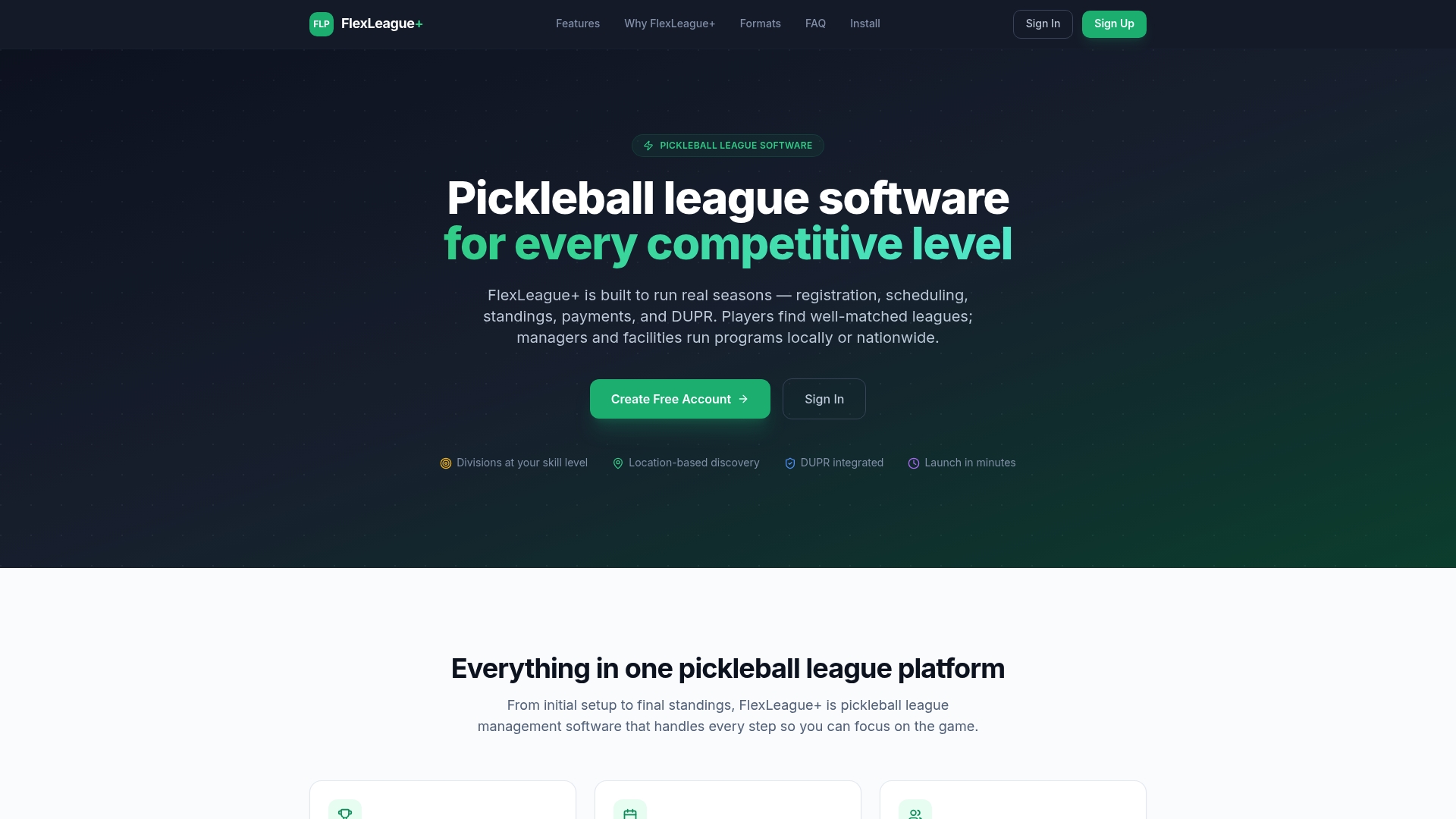
The platform is DUPR approved, so results feed directly into player ratings without a separate reporting step, and payment collection runs through Stripe with no monthly subscription required. A single division costs a $25 one-off platform fee, and you can see the full feature set on the pickleball league software page before deciding whether it fits your season.
Sources
- USAP Official Rulebook
- USAP rulebook change document (excerpt)
- The Premier Pickleball League — Rules
- City of Dublin pickleball league rules and regulations
- Forfeit penalty policy (BSSC)
FAQ
What counts as a forfeit in a pickleball league?
A forfeit is when a player or team fails to appear, fields an ineligible player, or is disqualified before or during a scheduled match, resulting in an automatic loss. Most leagues score a rule-based forfeit as 11-0 per game, following conventions used in the USAP Official Rulebook.
Does a forfeit affect my DUPR rating?
Yes, forfeited results are generally still logged for rating purposes even when a league excludes them from standings for tie-break calculations. This distinction comes directly from USAP’s rule change document, which separates standings treatment from rating treatment.
Is pickleball popularity expected to decline in 2026?
There is no credible indication that pickleball participation is declining. The sport has grown steadily in recent years, and nothing in current league or governing body documentation points to a reversal.
What is the 10 second rule in pickleball?
The 10 second rule refers to serve timing: a server generally has up to 10 seconds after the score is called to put the ball in play. It is a gameplay rule rather than a forfeit or standings rule, and it is separate from the grace periods leagues set for match no-shows.
How do I know if I’m a 3.0 pickleball player?
Self-rated skill levels are typically based on a player’s consistency, shot variety, and match experience, and definitions vary slightly by rating system. A verified rating through a platform like DUPR gives a more precise answer than a self-assessed skill level.