$25 Per Division: Ops Playbook for Volunteer Run Pickleball Leagues
$25 Per Division: Ops Playbook for Volunteer Run Pickleball Leagues

The fastest way to expand a pickleball league is to work four levers at once: add court time through conversion or smarter scheduling, standardize skill ratings so matches stay fair, automate registration and payments, and run recruitment events that turn newcomers into season regulars. Done together, these steps raise match capacity, keep competition balanced, stabilize revenue, and improve retention between seasons.
TL;DR:
- Regularly tracking session signups, court utilization, match cancelations, and player retention helps catch early signs of declining engagement.
- Converting existing tennis courts, borrowing indoor gym space, or using portable nets are cost-effective ways to expand playable court capacity quickly.
- Implementing skill ratings with DUPR and using official rules ensures fair matchups and consistent league formats, suitable for multiple skill levels.
- Automating registration, scheduling, and payments reduces administrative burden and allows for scalable league management through dedicated platforms like FlexLeague+.
- Community outreach, noise mitigation, and early neighbor engagement prevent municipal bans, ensuring sustainable access as the league grows.
Table of Contents
- What success looks like and which quick metrics to watch
- Practical options to add playable court time or convert existing space
- Which formats and rule sets to use for fair, repeatable league play
- Workflow for signups, pricing, and scalable scheduling
- Daily operations: equipment, staffing, and maintenance
- Player recruitment, retention loops, events, and sponsorship opportunities
- Practical strategies for noise mitigation, neighbor outreach, and working with parks departments
- FlexLeague+ implementation: how an organizer moves from spreadsheets to a scalable platform
- Building a leadership structure that can handle growth
- Planning the money: funding and budgeting for a growing league
- Legal considerations and insurance every organizer should cover
- Choosing technology that actually reduces admin work
- Author perspective: balancing growth with community stewardship
- How FlexLeague+ helps scale your league
- Sources
- FAQ
What success looks like and which quick metrics to watch
Growth without measurement is just activity. Organizers who track a handful of numbers each session catch problems before they turn into empty courts or player complaints.
- Signups per session: watch week-over-week trend, not just totals, to catch early drop-off.
- Court utilization: the percentage of scheduled court time actually filled with matches.
- Match fill rate: how many scheduled matches happen versus how many get canceled or no-showed.
- Retention between sessions: the share of players who register again for the next session or season.
Court conversion costs vary widely depending on whether the work is temporary or permanent, and league platform fees add a predictable per-division cost rather than a monthly subscription, for example Flex League Plus charges a $25 one-off fee per division. The first three priorities for most volunteer-run leagues are simple: secure reliable court access, remove friction from signup and payment, and put a rating system in place before the player pool gets large enough that mismatches become common.
Practical options to add playable court time or convert existing space
Court access is usually the real bottleneck, not player demand. Three paths cover most situations organizers face.
- Convert existing tennis courts: a single tennis court typically fits four temporary pickleball courts using portable nets and tape or chalk lines, which is the most common low-cost conversion layout leagues use to get started quickly.
- Borrow or rent indoor gym time: school gyms, community centers, and recreation departments often have off-peak hours available, which works well for winter play or rain contingency.
- Use portable nets and temporary lines: this keeps the investment low and the setup reversible, useful when a facility or neighborhood is still evaluating whether to allow permanent courts.
Temporary conversions (tape, portable nets, chalk lines) cost far less than permanent resurfacing and dedicated fencing, but they require setup and teardown time each session. Permanent conversions cost more upfront and typically involve surface work, striping, and sometimes new fencing or lighting, but they remove the weekly labor of building and breaking down courts.
Before committing to any site, walk through a short checklist: adequate lighting for evening play, a surface free of major cracks or drainage issues, enough buffer distance from residential property lines to limit noise complaints, and confirmation of what permits or facility-use agreements the location requires. Skipping this step is the single most common reason new league sites run into trouble within the first season.

Which formats and rule sets to use for fair, repeatable league play
Format choice determines whether a league feels fair and whether it can scale past a single evening. Round-robin play works well for casual sessions of 16 to 24 players, since everyone gets multiple matches without the pressure of elimination. Pools and divisions suit larger groups, letting organizers separate skill levels before cross-division playoffs. Team formats, similar to structures used in Major League Pickleball, work best for established leagues with 32 or more committed players who want season-long standings rather than single-night results. Playoffs or a season finale give any format a natural closing event that boosts turnout.
- Round-robin: best for casual or beginner-friendly sessions with frequent player turnover.
- Pools and divisions: best when skill spread is wide and match fairness matters more than simplicity.
- Team leagues: best for committed players seeking a season-long competitive structure.
- Playoffs: best as a capstone event to drive attendance and mark the season’s end.
Organizers should build their formats, scoring, and scheduling rules around the official rulebook, which covers event categories, round-robin and elimination formats, tie-breaking, and scheduling guidance for consistent play. Sanctioned formats matter more for competitive or ranked leagues; casual community leagues can adopt the same rules for consistency without pursuing formal sanctioning.
Skill ratings solve the biggest complaint new leagues face: mismatched games. DUPR integration lets organizers assign divisions based on verified rating data rather than guesswork, and onboarding is simple: have players link or create a DUPR profile at registration, seed initial divisions from that rating, and adjust as match results come in.
Session sizes of 16 to 32 players give most volunteer-run leagues enough depth for two or three balanced divisions without overwhelming a single set of courts.
Workflow for signups, pricing, and scalable scheduling
Registration and scheduling are where most volunteer leagues lose time, and where automation pays off fastest.
- Choose a pricing shape: a flat session fee simplifies budgeting, while per-match fees suit drop-in formats with variable attendance.
- Set a waitlist policy: cap each division at a fixed size and automatically promote waitlisted players when a spot opens.
- Define a refund window: a clear cutoff, such as 48 hours before a session, avoids disputes over late cancellations.
- Build the schedule around court blocks: group matches into fixed time blocks per court rather than open-ended play to keep utilization predictable.
- Automate round-robin generation: software that builds the rotation removes hours of manual bracket work each week.
Pro Tip: Reserve a small share of court blocks for walk-ups or overflow so a late signup surge doesn’t force you to turn players away.
Payments and waivers deserve the same attention as scheduling. Collecting registration fees through a payment processor like Stripe at signup, rather than cash on the day, cuts no-shows and speeds up check-in. Pairing that with a digital liability waiver at registration, plus automated confirmation and reminder messages, keeps communication consistent without extra volunteer hours.
Daily operations: equipment, staffing, and maintenance
Reliable equipment and a light staffing structure keep match nights running without surprises.
- Core equipment: nets, court-marking tape or paint, and a supply of approved paddles and balls on hand for players who forget theirs.
- Quiet paddle options: keeping a few quieter paddle models available helps if a facility or neighbors have raised noise concerns.
- Staffing roles: a check-in volunteer, a court monitor to handle disputes, and a score reporter to keep standings current cover most match-night needs.
- Simple SOPs: a one-page setup and teardown checklist prevents missed steps when volunteers rotate week to week.
- Maintenance routine: inspect surfaces for cracks or debris before each session, refresh worn lines monthly, and check net height and tension regularly.
Seasonal needs to shift the checklist too: winter play calls for indoor backup plans, while summer sessions need shade or hydration stations if courts run in direct sun for multiple hours.
Player recruitment, retention loops, events, and sponsorship opportunities
Growth and retention are two different problems, and both need to deliberate tactics rather than hoping word of mouth carries a league forward.
On the acquisition side, free demo nights let curious newcomers try the sport with loaner paddles before committing to a paid session. Partnering with local recreation centers, gyms, or senior centers puts league information in front of people already active in the community. Referral incentives, such as a discounted second session for players who bring a friend, turn existing members into recruiters. Local social media groups and neighborhood apps tend to outperform broad paid ads for a community-based sport.
Retention depends on giving players a reason to keep showing up beyond the game itself. Clear skill divisions prevent frustration from mismatched play. Occasional clinics for beginners build confidence and reduce early drop-off. Social events, like a post-session gathering or a mid-season mixer, build the relationships that keep people committed to a league rather than just a sport. A season finale or small tournament gives every session a target to build toward.
- Demo nights: lower the barrier for first-time players with loaner equipment.
- Referral incentives: reward existing players for bringing new signups.
- Skill clinics: reduce beginner drop-off and build confidence early.
- Season finales: give the league a clear, exciting closing event each cycle.
Pro Tip: Ask a local paddle shop or sports bar to sponsor a season finale in exchange for signage and a mention in registration emails: it costs the sponsor little and gives the league a modest funding boost.
Sponsorships don’t need to be large to matter. A local business covering the cost of balls, nets, or a finale trophy in exchange for a banner and a shoutout in league communications is a realistic starting point for most volunteer-run leagues, and it can grow into a recurring partnership once the league proves it draws a consistent crowd.
Practical strategies for noise mitigation, neighbor outreach, and working with parks departments
Noise complaints are the most common threat to a growing league’s court access, and they are largely preventable with early outreach. Quiet paddles, staggered start times, and modest fencing all reduce the sound that travels to nearby homes. Some municipalities have gone further: Laguna Beach required quieter paddles and reduced hours at certain parks as a compromise rather than a shutdown, according to coverage of municipal responses to pickleball noise.
Not every city has taken the compromise route. Carmel-by-the-Sea permanently banned pickleball at public facilities, and Boise settled a lawsuit by agreeing to reconvert some courts back to tennis after persistent complaints, according to reporting on the Carmel ban and related noise issues.
- Notify neighbors early: a simple letter or flyer before play begins builds goodwill and surfaces concerns before they escalate.
- Propose a trial period: offer a limited schedule window that can be adjusted based on feedback rather than asking for permanent hours upfront.
- Attend open hearings: showing up to a parks department meeting with a mitigation plan in hand signals good faith.
- Document every mitigation step: keep records of quiet paddle policies, hour restrictions, and outreach efforts in case questions arise later.
When a site is contentious, a formal use agreement with the parks department, spelling out hours and noise mitigation commitments, is worth pursuing before investing in permanent conversion.
FlexLeague+ implementation: how an organizer moves from spreadsheets to a scalable platform
Spreadsheets work for a single session with 16 players. They break down once a league runs multiple divisions, collects payments, and tracks standings across a full season. Moving to dedicated software solves the specific pain points this guide has covered.
- Registration and payments: players sign up and pay online, with fees processed through Stripe, removing cash handling and manual tracking.
- Automated scheduling: round-robin and division schedules build automatically instead of by hand each week.
- DUPR integration: division assignments and match balance draw on verified skill ratings rather than organizer guesswork.
- Score reporting and standings: players report scores directly, and standings update without a volunteer compiling results after each session.
- Playoff brackets: end-of-season formats generate from existing standings data rather than a separate spreadsheet.
A practical migration path looks like this: set up the season and divisions in the platform, import the existing player roster, run a test registration to confirm payment processing works end to end, then open registration to the full player list. Organizers who have used this workflow for a season typically find the switch saves the most time during the exact moments spreadsheets tend to fail: the week registration opens and the week playoffs are seeded.
Building a leadership structure that can handle growth
A league that outgrows one volunteer’s spare time needs defined roles before it outgrows its own management. A small organizing committee, even three or four people, splits the work in ways that prevent burnout and keep decisions from bottlenecking on one person.
Typical roles include a registration lead who manages signups and payments, a scheduling lead who builds and adjusts the match calendar, a communications lead who handles player messaging and social media, and a facilities liaison who manages the relationship with the parks department or facility owner. Larger leagues sometimes add a sponsorship coordinator once revenue diversification becomes worth pursuing.

Clear responsibilities matter more than titles. When everyone knows who handles waitlist questions, who approves refund requests, and who speaks for the league in facility negotiations, disputes get resolved faster and volunteers are less likely to step on each other’s work. Rotating committee roles each season, or at least documenting how each role works, also protects the league from collapsing if one key volunteer steps away.
Committees work best when they meet briefly but regularly, reviewing the KPIs from the season, such as signup trends and utilization, rather than only meeting when a problem arises.
Planning the money: funding and budgeting for a growing league
A league’s budget needs to cover court fees or facility rental, equipment purchases and replacement, and any software or payment processing costs, balanced against registration revenue. Most volunteer-run leagues fund themselves primarily through session or seasonal registration fees, with sponsorships and fundraising events serving as a secondary layer rather than the core budget.
Setting fees requires knowing the real cost per session: facility time, equipment wear, and any platform fees per division all factor in. Building a small reserve, even a modest buffer built up over a season or two, protects the league against an unexpected facility cost or a low-turnout session that would otherwise force a mid-season fee increase.
Expense tracking doesn’t need to be complicated, but it does need to be consistent. A simple ledger of court costs, equipment purchases, and platform fees, reviewed monthly, catches overspending before it becomes a budget crisis. Sponsorships, even small ones covering balls or a finale trophy, reduce pressure on registration fees and give local businesses a visible reason to support the league.
Organizers should also decide early whether the league needs to be revenue-neutral, break even, or generate a modest surplus to fund growth, since that decision shapes every fee and sponsorship conversation that follows.
Legal considerations and insurance every organizer should cover
Liability waivers are the first line of protection for any organized sport, and pickleball leagues are no exception. Every player, whether a first-time drop-in or a season-long regular, should sign a waiver before playing, and digital waivers collected at registration are easier to track than paper forms.
Facility permits or use agreements should spell out hours, noise expectations, and any insurance requirements the facility owner sets, particularly for public parks where a parks department may require proof of coverage before granting access. General liability insurance, sometimes available through a facility’s own policy and sometimes requiring a separate policy for the league itself, protects organizers if a player is injured during a match.
None of this is a substitute for legal advice specific to a league’s location and setup. Organizers should confirm their waiver language and insurance needs with a local attorney or their facility’s risk management contact rather than relying on a generic template, especially once a league grows large enough that an injury or dispute carries real financial exposure.
Choosing technology that actually reduces admin work
The right technology stack removes the two biggest time sinks in league management: manual scheduling and scattered communication. League management software that handles registration, scheduling, and standings in one place replaces the spreadsheet-and-group-chat combination most leagues start with.
Communication platforms matter just as much as scheduling tools. A dedicated league app or a simple, consistent channel for match reminders, weather delays, and schedule changes prevents the confusion that comes from splitting announcements across email, text, and social media. Whatever platform a league chooses, consistency matters more than which specific tool wins out: players need to know where to check for updates every single week.
For leagues weighing options, Flex League Plus is one example built specifically around competitive league operations rather than casual open-play tracking, and other league-building tools like MoveTogether’s league features offer a similar focus on recurring competitive programming. The right fit depends on whether a league needs deep DUPR integration and payment processing or simpler weekly scheduling.
Author perspective: balancing growth with community stewardship
Fast growth and long-term court access sometimes pull in opposite directions. A league that adds courts and players quickly without addressing noise or neighbor concerns risks the exact backlash that has closed courts in other cities. The organizers who last are the ones who treat neighbors and parks departments as partners, not obstacles, and who measure their own KPIs, utilization, fill rate, retention, every season rather than assuming last year’s format still fits this year’s player pool. Growth that outpaces community buy-in tends to get reversed.
— Robert
How FlexLeague+ helps scale your league
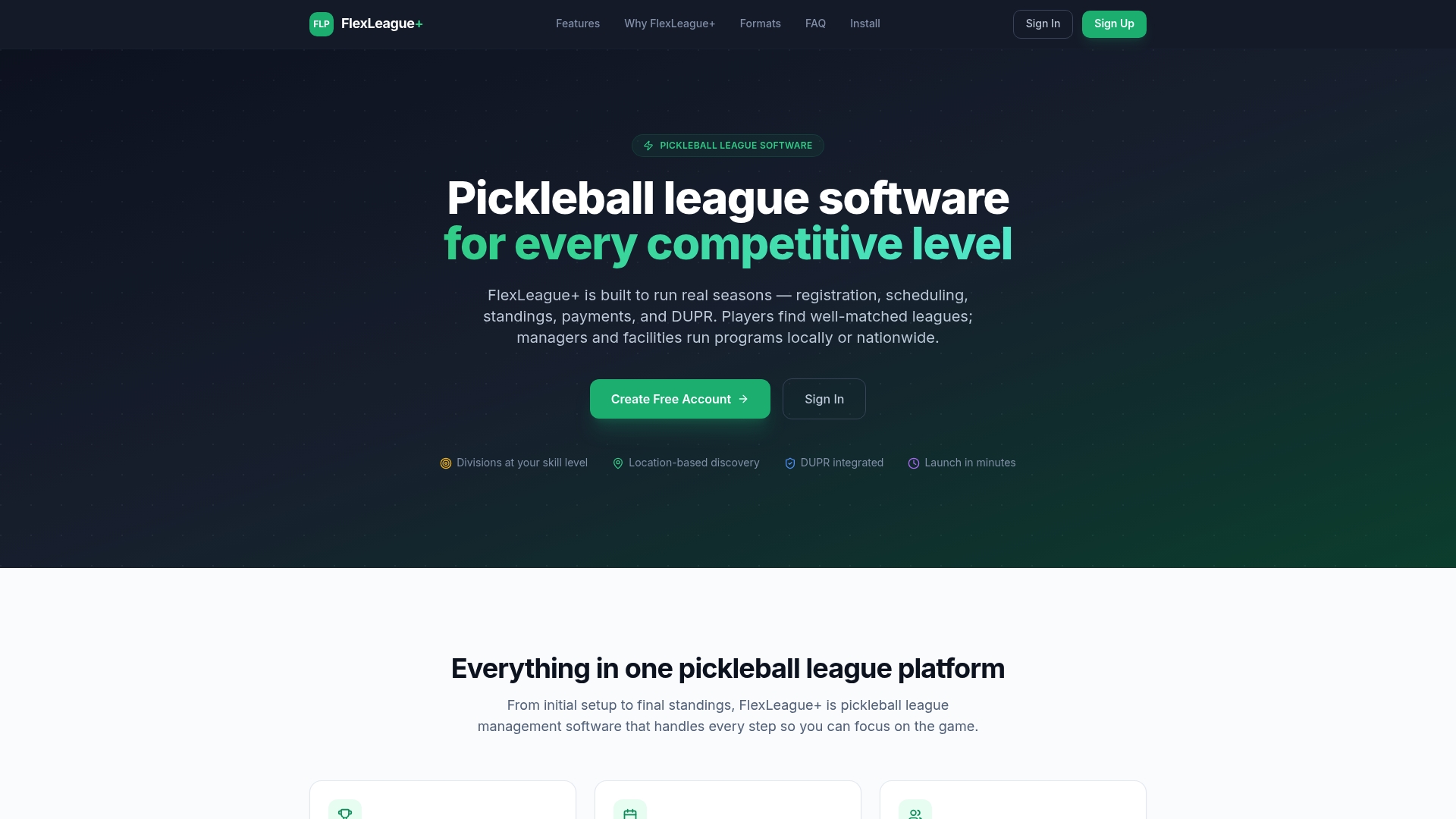
Every operational pain this guide covers, mismatched registration spreadsheets, manual scheduling, cash payments, unverified skill levels, has a direct fix in dedicated league software. Flex League Plus handles registration and Stripe-based payments, builds schedules automatically across multiple divisions, integrates with DUPR for fair matchups, and tracks standings and playoff brackets without a volunteer compiling results by hand.
Getting started takes less time than running one manual season:
- Set up a test season with your actual divisions to see how the scheduling tools handle your player count.
- Import your existing roster to check how quickly players transition from a spreadsheet to the platform.
- Run a mock schedule across your available courts to confirm utilization before committing fully.
- Collect a test payment through Stripe to confirm the registration flow works for your specific fee structure.
Pricing runs $25 one-off per division, with full pricing details available here, and no player or manager subscription required.
Sources
The official rulebook governs formats and scoring for consistent play. SFIA’s participation report tracks national growth trends shaping league demand. Playpickleball summarizes serving and timing rules. Coverage of the Carmel ban documents real municipal noise outcomes organizers should plan around.
FAQ
Is pickleball growing or dying?
Pickleball is growing sharply, not declining. Participation rose from about 4.2 million players in 2020 to roughly 24.3 million in 2025, making it one of the fastest-growing sports over that period.
What sport is replacing pickleball?
No sport is currently displacing pickleball based on available participation data. The available growth figures show pickleball expanding rapidly rather than losing ground to another sport.
What is the 10 second rule in pickleball?
The 10 second rule requires the server to begin their serve within 10 seconds of the score being called. Failing to serve within that window results in a fault against the server.
What city is outlawing pickleball?
Carmel-by-the-Sea, California, permanently banned pickleball at its public facilities due to noise complaints, according to reporting on the ban. Boise separately settled a lawsuit and agreed to reconvert some pickleball courts back to tennis courts following similar complaints.