Early Bird Pricing for Event Organizers: Boost Revenue
Early Bird Pricing for Event Organizers: Boost Revenue

Early bird pricing is a limited-time or quantity-capped discount tier that trades a controlled slice of margin for earlier cash flow, stronger commitment, and social proof that sells remaining inventory at full price. The most effective configuration: set the discount in a moderate range off your true standard price, cap the tier at a reasonable share of sellable inventory, and pair a quantity limit with a firm backstop date so the tier closes on whichever comes first. Three quick actions before you launch: (1) cap the tier by quantity or by quantity plus date, never leave it open-ended; (2) display the savings clearly next to the standard price at checkout; (3) announce the cutoff date publicly and treat it as a marketing milestone, not a footnote.
Industry benchmarks put the working discount range at 15–30%, with most organizers landing between 20–25% to balance early-sale attraction and margin protection. Size your early-bird pool at 20% of capacity. That combination creates genuine scarcity, funds your deposits, and gives you a sellout moment to promote.
Table of Contents
- Why early bird pricing works for organizers
- How to choose your discount depth and early-bird duration
- How to structure tiers that protect margin and create urgency
- Marketing tactics that actually move early registrations
- Launch checklist: what to configure before you open registration
- KPIs to track and pitfalls to avoid
- Worked example: a pickleball league price ladder
- Key Takeaways
- The deadline is the product
- Flexleagueplus makes tiered registration simple for pickleball leagues
- Useful sources
Why early bird pricing works for organizers
Three things happen when you run a well-structured early-bird offer: you collect cash before your deposit deadlines, you generate social proof that nudges fence-sitters, and you get an early commitment signal that tells you whether to adjust pricing or tier sizes before the main sales window opens. Those aren’t soft benefits. They’re operational levers.

The behavioral mechanics behind it are straightforward. Scarcity (a visible quantity cap) triggers loss aversion. A firm deadline creates calendar urgency. Showing the savings next to the standard price anchors the buyer’s perception of value. All three work together, but only if the tier is genuinely capped and the deadline is genuinely enforced.
Here’s what each benefit delivers in practice:
- Cash flow: Early-bird revenue funds venue deposits, insurance, and other fixed costs before you’ve spent a dollar on late-stage marketing. Collecting 20–25% of your revenue target in the first few weeks removes the financial pressure that causes organizers to discount too aggressively later.
- Social proof: A sold-out early-bird tier is a marketing asset. “Early bird sold out in 48 hours” on your next promotional email converts better than almost any discount offer.
- Demand signal: If your early-bird tier moves slowly, that’s data. You can adjust your marketing message, test a deeper discount in a second tier, or revisit your pricing before the main window opens. Waiting until two weeks before the event to discover weak demand is far more expensive.
Pro Tip: Schedule at least one re-engagement email tied specifically to the early-bird deadline. “Last 24 hours to save $X” converts fence-sitters who ignored the launch announcement. Treat the cutoff as a repeatable marketing beat, not a one-time notice.
How to choose your discount depth and early-bird duration
Start with the question that actually matters: how much early cash do you need, and how price-sensitive is your audience? Those two variables determine your discount depth more reliably than any rule of thumb. The 15–30% benchmark range is a guardrail, not a formula.
Decision rules by depth:
- 15% off: Use when your audience is loyal and would likely register anyway, or when your margins are thin. Works well for recurring leagues where past participants already trust the product.
- 20–25% off: The default band for most events. Attractive enough to move early buyers, shallow enough to protect margin on the bulk of your inventory.
- 25–30% off: Reserve for high-risk launches with large upfront deposits, new events with no attendance history, or situations where you need to seed social proof fast. Don’t go here out of generosity; go here out of necessity.
Timing varies significantly by event type. A one-day workshop needs a shorter early-bird window than a multi-week league season.
| Event type | Suggested early-bird length | Rationale |
|---|---|---|
| Festival or large conference | 6 weeks | Long planning horizon; buyers need time to book travel |
| Tournament or league season | 3–5 weeks | Moderate lead time; urgency builds naturally near registration close |
| Workshop or class series | 2–3 weeks | Short cycle; buyers decide quickly |
| Club night or weekly league | 1–2 weeks | Near-term commitment; longer window dilutes urgency |
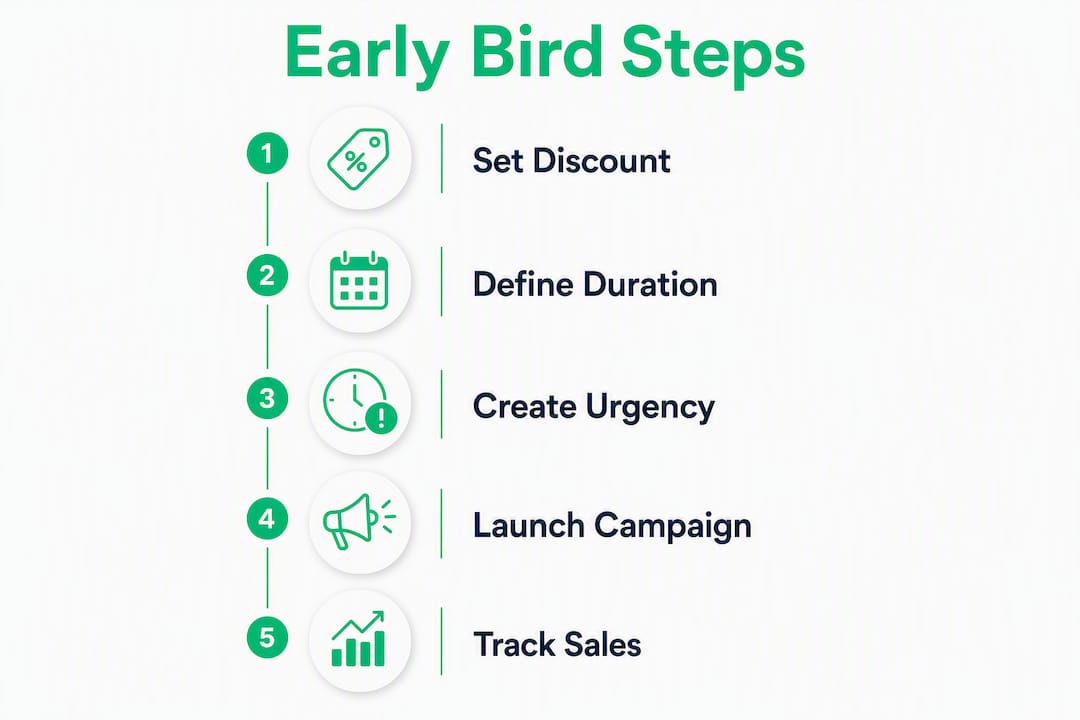
On mechanics: a date-only cutoff is the weakest structure because it creates no inventory scarcity. A quantity-only cap is stronger but can close too fast if you underestimate demand. The strongest approach combines a quantity cap with a backstop date: the tier closes when the cap is hit or on the date, whichever comes first. That hybrid gives you predictability and genuine urgency.
Pro Tip: Size your early-bird pool as a percentage of sellable inventory (20%) rather than an open-ended “first come, first served” pool. A capped pool creates an authentic sellout moment that drives conversions into the next tier.
How to structure tiers that protect margin and create urgency
Two to four tiers work for nearly every event. Three is the clean default: a discounted early tier, standard price, and a final or door price. More than four tiers confuse buyers and dilute urgency at each step.

Layered tiers help capture different buyer segments without locking into a single discount that either leaves money on the table or underdelivers on cash flow. Here are three templates you can adapt:
Template A: Three-tier (most events)
| Tier | Discount | Inventory share | Closes |
|---|---|---|---|
| Early bird | 20% off | 20% of capacity | Quantity cap + 4-week backstop |
| Standard | Full price | 60% of capacity | 2 weeks before event |
| Final/door | 15–25% | 20% of capacity | Event day |
Template B: Four-tier (high-demand events or large conferences)
| Tier | Discount | Inventory share | Closes |
|---|---|---|---|
| Super early | 30% off | 15–25% of total capacity | First 50 spots or 6 weeks out |
| Early bird | 20% off | 20% of capacity | Quantity cap + 4-week backstop |
| Standard | Full price | 50% of capacity | 2 weeks before event |
| Final/door | 15–25% | 20% of capacity | Event day |
Template C: Two-tier (simple events, weekly leagues)
| Tier | Discount | Inventory share | Closes |
|---|---|---|---|
| Early bird | 15% off | 25% of capacity | 2-week backstop |
| Standard | Full price | 75% of capacity | Event day |
The rollout timeline matters as much as the structure. Announce the early-bird launch as a campaign, not a quiet update. Then run: announcement → early-bird open → midpoint reminder → 72-hour warning → final 24-hour push → tier closes → standard price announcement. Each cutoff is a marketing beat.
A few rules that separate organizers who run this well from those who don’t:
- Enforce every cutoff without exception. Extensions teach buyers that deadlines are negotiable.
- Never inflate your standard price to manufacture a larger-looking discount. Buyers notice, and it destroys trust.
- Don’t add a fifth or sixth tier. Each additional tier reduces the urgency of every other one.
- Announce the next price when a tier closes. “Early bird just sold out — standard pricing now live” is a conversion email.
Marketing tactics that actually move early registrations
Treat the early-bird launch as a campaign milestone, not a price update. That means planning your announcement, reminder, and final-push messages before you open registration, not after.
Email sequence
Email is still the highest-converting channel for event registrations. Here’s a working sequence:
- Launch day: Subject line: “Early bird is open — save $X before [date].” Body: lead with the savings, show the standard price next to the early-bird price, include one clear CTA.
- One week before cutoff: Subject line: “One week left at the early-bird rate.” Segment past attendees separately; they convert at a higher rate and deserve a more personal message.
- 72 hours out: Subject line: “72 hours to lock in your spot at $X.” Include remaining quantity if you’re using a cap.
- Final 24 hours: Subject line: “Last chance — early bird closes tomorrow.” Short, direct, no fluff.
Segment your list: past attendees, waitlist signups, and VIPs each respond to slightly different angles. Past attendees want the loyalty acknowledgment. Waitlist contacts want urgency. VIPs want exclusivity.
Channel checklist
- Organic social posts with countdown graphics tied to the deadline
- Paid social with lookalike audiences built from past registrants
- Retargeting ads for anyone who visited the registration page but didn’t complete checkout
- Community partnerships (local clubs, Facebook groups, Discord servers) for league-specific events
- SMS reminders for the final 24 hours if you have opt-in consent
A/B test ideas worth running
- Discount framing: “$15 off” vs. “25% off” (dollar amounts often outperform percentages for lower-priced events)
- Scarcity messaging: visible remaining quantity vs. hidden cap
- CTA phrasing: “Save $15” vs. “Reserve your spot”
Pro Tip: When using a quantity cap, display a real-time remaining-count on the registration page. “Only 12 spots left at this price” outperforms any manufactured countdown timer because it’s verifiably true. Real scarcity converts; fake urgency erodes trust.
Launch checklist: what to configure before you open registration
A clean launch comes down to getting the pricing logic, platform configuration, and customer support scripting right before you go live. Here’s the sequence:
- Finalize your standard price first. Calculate your early-bird price as a percentage off that true standard price. Never work backward from a desired discount to set a fake anchor.
- Set inventory caps and dates. Decide on quantity cap, backstop date, or both. Document these in writing before you touch the platform.
- Configure your payment processor. If you’re using Stripe (directly or through a registration platform), confirm that processing fees are factored into your pricing. A $50 early-bird price that nets $47.55 after fees is a different margin calculation than you might expect.
- Create your refund and transfer policy. Write it before launch. Common options: full refund within 48 hours of purchase, transfer to another player allowed up to 7 days before the event, no refunds after that. Publish it on the registration page.
- Prepare a customer support FAQ. Script answers to: “Can I transfer my registration?”, “What happens if the event is canceled?”, “Can I register a group at the early-bird rate?” Auto-responses for these questions save hours of inbox management.
- Schedule your email reminders. Set up the full sequence (launch, midpoint, 72-hour, final 24-hour) before you open registration. Don’t rely on remembering to send them manually.
- Run a QA test before going live. Complete a full purchase flow yourself: add to cart, apply any promo codes, complete checkout, confirm the confirmation email fires, and verify that the inventory counter decrements correctly. Test on mobile.
For automated price-rule mechanics, most modern registration platforms let you configure rules that trigger price changes based on date, quantity sold, or both. Verify that your platform supports hybrid triggers (quantity cap + date) before you commit to that structure.
- Confirm the checkout page shows both the early-bird price and the standard price side by side
- Verify that the tier closes automatically when the cap is hit, without manual intervention
- Check that sold-out messaging displays correctly and redirects buyers to the next tier
- Test the mobile checkout experience end to end
KPIs to track and pitfalls to avoid
The metrics that tell you whether your early-bird strategy is working:
- Early-bird conversion rate: What percentage of people who visited the registration page purchased at the early-bird price? A low rate points to a messaging or discount-depth problem, not a timing problem.
- Percentage of inventory sold in early tiers: Are you hitting the 20% target before the tier closes? Consistently undershooting suggests the discount isn’t deep enough or the launch isn’t reaching the right audience.
- Cash collected before key deposit dates: This is the operational metric that matters most. Did early-bird revenue cover your venue deposit, insurance, and other fixed costs before they were due?
- Average revenue per buyer across all tiers: If early-bird buyers are dragging this number down significantly, your discount may be too deep or your tier too large.
- Revenue cannibalization rate: What share of early-bird buyers would have paid full price anyway? You can estimate this by surveying a sample of buyers or by comparing early-bird uptake against your historical registration pace.
The most common pitfalls, and how to handle them:
- Extending deadlines: Never extend an early-bird deadline. Extensions teach buyers that your cutoffs are negotiable, which destroys urgency in every future campaign. If sales are slow, fix your marketing or adjust your discount depth in the next tier. Don’t move the goalposts.
- Over-discounting: A discount deeper than 30% rarely produces proportionally more early buyers, and it permanently reduces the revenue ceiling for that event. Size discounts relative to what you actually need, not what feels generous.
- Inflating the anchor price: Calculating discounts from a true standard price is non-negotiable. Inflating the standard price to manufacture a larger-looking discount damages trust and lowers conversion over time.
- Training buyers to wait: If you run early-bird on every event and always extend the deadline, your audience learns to ignore the urgency. Enforce cutoffs consistently to preserve the mechanism’s credibility.
When to skip early-bird entirely: if you consistently sell out at face value, or if your audience is extremely price-inelastic (corporate events where the company pays, for example), the discount costs you margin without adding meaningful early commitment. Use it where it solves a real cash-flow or demand-seeding problem.
Worked example: a pickleball league price ladder
A concrete example makes the math tangible. Take a 300-player pickleball league with a standard registration fee of $60 per player.
Eventist’s worked sample structure for a 300-ticket event provides a useful baseline: Tier 1 at $45 (25% off) for 75 spots, Tier 2 at $52 (~13% off) for 150 spots, and Tier 3 at full price ($60) for 75 spots. Full sellout revenue under that structure is lower than a flat-price sellout, but the early cash and momentum it generates justify the trade.
Here’s how that maps to a pickleball-league scenario:
| Tier | Price | Discount | Spots | Revenue |
|---|---|---|---|---|
| Early bird | $45 | 25% off | 75 | $3,375 |
| Standard | $52 | 13% off | 150 | — |
| Full price | $60 | — | 75 | — |
| Total | 300 | $15,675 |
Flat-price baseline (all 300 at $60): $18,000. The early-bird structure costs $2,325 in gross revenue on a full sellout. In exchange, you collect $3,375 in the first few weeks, which covers a typical venue deposit and insurance before you’ve spent heavily on marketing.
Simple calculator formula:
- Set your full-price revenue target (e.g., 300 players × $60 = $18,000).
- Choose your early-bird inventory share (e.g., 25% = 75 spots).
- Set your discount percentage (e.g., 25% off = $45 per spot).
- Compute early revenue secured: 75 × $45 = $3,375.
- Calculate margin impact: $18,000 baseline minus $15,675 tiered total = $2,325 cost for early cash and momentum.
- Evaluate against your deposit deadline. If your venue deposit is $2,500 due in week three, the early-bird tier covers it with a small buffer.
Flexleagueplus configuration tip: Map each tier to a separate registration product in the platform. Set the early-bird product with a quantity cap (75 spots) and a backstop date. Display both the early-bird price and the standard price on the checkout screen so buyers see the savings in real time. Stripe handles payment collection automatically, so early cash lands in your account as registrations come in. For league organizers running singles, doubles, or team formats, the same tier structure applies regardless of format.
If you’re uncertain about discount depth, run a small pilot: open the early-bird tier to your email list only before announcing publicly. The uptake rate from your most engaged audience is a reliable signal of how the broader market will respond.
Key Takeaways
A well-executed early bird pricing strategy funds deposits, seeds demand, and creates genuine urgency when the tier is capped, enforced, and treated as a marketing campaign rather than a passive discount.
| Point | Details |
|---|---|
| Default configuration | Test 20% off, 20% of inventory, with a quantity cap plus a 4-week backstop date. |
| Never extend deadlines | Extensions train buyers to wait; fix marketing or discount depth instead of moving the cutoff. |
| Discount from true price | Always calculate the discount from your real standard price to protect trust and conversion rates. |
| Track the right KPIs | Measure early-bird conversion rate, cash collected before deposit dates, and average revenue per buyer. |
| Flexleagueplus | Supports tiered registration, Stripe payment collection, and quantity caps for pickleball league early-bird campaigns. |
The deadline is the product
Most organizers treat the early-bird cutoff as an administrative detail. It isn’t. The deadline is the product. It’s the mechanism that converts a passive browser into a committed buyer, and every decision you make around early-bird pricing should reinforce that deadline’s credibility.
The single biggest mistake I see organizers make is extending the deadline when early sales are slow. It feels like a reasonable response to a demand problem. It isn’t. What it actually does is teach your audience that your deadlines are suggestions, which means every future campaign starts with a credibility deficit. Buyers who know you’ll extend will wait. Every time.
The more interesting lesson is what happens when you enforce the cutoff and the tier sells out. That sellout moment is worth more than the revenue it represents. “Early bird just sold out” is one of the most effective marketing messages you can send, because it’s verifiably true and it creates real urgency for the standard tier. Organizers who understand this stop thinking about early-bird as a discount mechanism and start thinking about it as a demand-generation tool. The discount is just the entry fee for that tool.
There’s also a community dimension that templates miss. In recreational leagues especially, players talk. A capped early-bird that sells out quickly signals that the league is worth joining, which makes the standard-price registration feel like a fair deal rather than a consolation prize. That perception shift is hard to manufacture any other way.
The math on over-discounting is straightforward: a discount deeper than 30% rarely produces proportionally more early buyers, and it permanently reduces the revenue ceiling for that event. The math on deadline extensions is less obvious but more damaging: you lose not just the revenue from buyers who waited, but the urgency mechanism itself for every event that follows.
Flexleagueplus makes tiered registration simple for pickleball leagues
Running a capped early-bird tier across a 300-player pickleball league involves more moving parts than most organizers expect: quantity limits, comparative pricing at checkout, Stripe payment collection, and automated tier transitions when a cap is hit. Doing that manually across a spreadsheet and a payment link is how deposits get missed and buyers get confused.
Flexleagueplus handles all of it in one place. The platform supports tiered registration products with quantity caps, so your early-bird tier closes automatically when it sells out. Stripe integration means early cash lands in your account as registrations come in, before your venue deposit is due. DUPR integration keeps player ratings current across singles, doubles, and team formats without manual data entry. And the checkout screen can display both the early-bird price and the standard price side by side, so buyers see the savings without you having to explain it.
For league organizers who want to run a clean early-bird campaign without stitching together three separate tools, Flexleagueplus pickleball league software is built for exactly this workflow. Start your first tiered league at flexleagueplus.com.
Useful sources
- Early Bird Pricing Guide: Strategy & Best Practices — Engineerica: Practitioner overview covering cash-flow mechanics, social proof, and demand-forecasting benefits of early-bird structures.
- Early-bird pricing strategy — TickPick organizer blog: Industry benchmarks (15–30% discount range), tier structure guidance, and the case for enforcing deadlines without extension.
- Create an early bird price rule — ROLLER Help: Platform documentation showing how automated price rules based on date and quantity are configured in registration software.