DUPR Rating Explained: Your 2026 Pickleball Guide
DUPR Rating Explained: Your 2026 Pickleball Guide

The DUPR (Dynamic Universal Pickleball Rating) is the global standard for measuring pickleball skill, running on a scale from 2.000 to 8.000 and updating automatically after every verified match. Unlike older self-assessed systems, DUPR uses a modified Elo algorithm that weighs your actual score against what the system expected, given your opponents’ ratings. The result is a number that reflects how you’re playing right now, not how you played two seasons ago.
Here’s what the system covers at a glance:
- Scale: 2.000 (beginner) to 8.000 (professional)
- Separate ratings for singles and doubles
- Updates automatically after each verified match
- Tracks over 10 million matches across 183 countries
- Used by the PPA Tour, Major League Pickleball, and most regional tournaments for seeding and bracketing
How does DUPR calculate your rating?
DUPR’s algorithm considers four factors every time a result is logged, and understanding them changes how you read your number.
- Performance vs. expectation: Every match has a predicted score based on both teams’ current ratings. Score more than expected and your rating rises; score less and it drops. A close loss to a stronger opponent can actually push your rating up.
- Match type weighting: Tournament, league, and club matches count twice as much as self-reported recreational games. Self-reported rec matches only count once both sides confirm the score in the app.
- Match recency: Recent matches carry more weight than older ones. A result from last week moves your rating more than one from eight months ago.
- Match volume: The more verified matches you have, the more stable your rating becomes. Each result refines the algorithm’s picture of your true level.
For doubles, DUPR calculates a team rating as the average of both partners’ individual ratings, then compares the team’s actual score to the predicted score. Each player’s individual adjustment still depends on their own match history and recency.
What does your DUPR number actually mean?
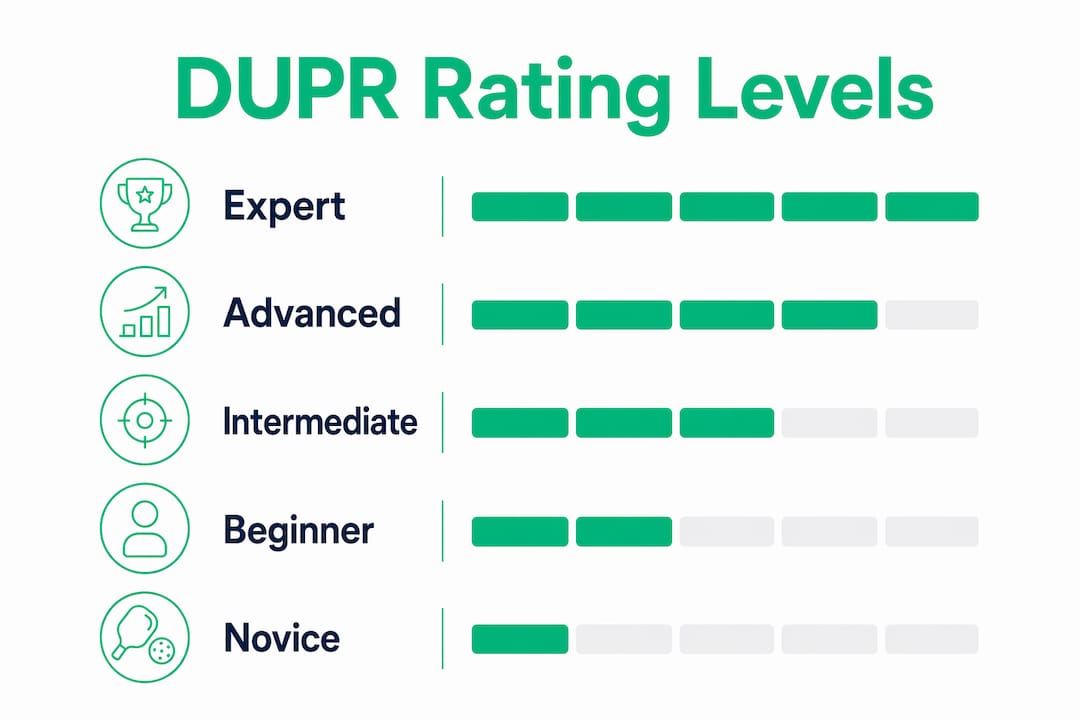
The scale is straightforward once you know the landmarks.

| Rating Range | Skill Level | Typical Context |
|---|---|---|
| Beginner | Just learning rules and basic shots | |
| Recreational | Casual club play, open rec sessions | |
| Strong club player | Regular league and ladder competition | |
| Top amateur | Competitive open tournaments | |
| Professional | PPA Tour, MLP, elite events |
Your profile shows two numbers: the rating itself and a Reliability Score from 1–100%. A high reliability score means the algorithm has enough recent, varied match data to trust your rating for tournament seeding. A low score, marked “provisional,” means the system is still learning your level and your rating can swing noticeably after a single match.
Pro Tip: Don’t obsess over your rating after one session. Look at your trend over 30 days. A high-reliability rating barely moves after a single match, so a bad Tuesday night tells you almost nothing.
Most recreational players land between 2.5 and 3.5. Strong club regulars sit in the 3.5–4.5 range. If you’re consistently competing at open amateur tournaments and winning, you’re likely approaching 5.0.
How to get your DUPR rating and push it higher
Getting rated is simple. Improving takes a bit more thought.
- Create a DUPR account at dupr.com and download the app.
- Play in a DUPR-verified event or log a rec match with all players’ DUPR IDs and a confirmed final score.
- Complete initialization. New players enter a 7-day initialization phase where your results only affect your own rating. You need 3 “points” worth of matches to exit initialization; if the timer lapses first, you receive a best-guess rating.
- Log matches consistently. Your reliability score rises with volume and recency. Aim for verified matches against a variety of opponents, not just your regular group.
- Play up when you can. Competitive losses to higher-rated opponents move your rating up more than easy wins over weaker players. The algorithm rewards you for performing close to or above expectation against stronger competition.
- Use tournament results. Sanctioned events carry double the weight of rec games, so a weekend tournament does more for your rating than a month of casual play.
- Track your trend, not the daily number. One match barely moves a stable rating. Focus on whether your number is trending up over weeks, not sessions.
How does DUPR compare to other pickleball rating systems?
The main alternative players encounter is the USA Pickleball (USAP) tournament rating, a four-digit number (like 3.500 or 4.250) earned exclusively through USAP-sanctioned tournament results.

The differences are significant. USAP ratings move slowly, exclude rec and league play entirely, and don’t decay if you stop competing. DUPR is dynamic, includes every type of confirmed match, and your reliability score drops with inactivity even if the rating number holds. The two systems often disagree by 0.2–0.5 for the same player. Tournament-only players tend to carry a higher USAP rating than DUPR; players who log lots of league and rec results often show a higher DUPR than USAP.
DUPR is now the default bracket tool at PPA Tour amateur events and most regional tournaments. For practical purposes, if you’re entering any competitive event in 2026, your DUPR is the number that matters most for seeding and division placement.
How DUPR keeps ratings accurate over time
Rating credibility depends on more than just winning. DUPR builds stability through several overlapping mechanisms.
- Reliability Score inputs: Match quantity, recency, and opponent diversity all feed the reliability calculation. A player who logs matches against the same three friends scores lower on diversity than one who plays across different venues and events.
- Provisional volatility by design: During initialization, a single match can move a new player’s rating by 0.2 or more. That’s intentional. The system has little data and needs to find the right level fast.
- Stabilization with history: Once a player has a meaningful match history, the algorithm resists overreacting. A 4.0 player with high reliability might see a change of 0.005–0.02 per match.
- Margin-based weighting: DUPR rewards competitive performance, not just wins. A 4.0 player who loses three matches to 4.3-rated opponents can still see their rating climb, because a competitive loss against a stronger player meets or beats the expected outcome.
- Recency decay: Older results gradually count for less. Players who stop logging matches see their reliability drop over time, which signals to tournament directors that the rating may not reflect current skill.
Tournament directors rely on high reliability scores for bracket placement. A provisional or low-reliability rating gets treated cautiously, regardless of the number itself.
Run your own league with DUPR built in
If you organize pickleball leagues, Flexleagueplus is a DUPR-approved pickleball league software that connects score reporting directly to DUPR. Managers can run singles, men’s doubles, women’s doubles, mixed doubles, and FLP team formats, with automated scheduling, live standings, playoff brackets, and Stripe-powered payment collection built in. Players report scores through the app, results flow to DUPR, and division placement stays honest.

Start running your league with Flexleagueplus and keep every bracket fair from day one.
Key Takeaways
DUPR’s modified Elo algorithm, combined with match type weighting and a live Reliability Score, makes it the most accurate and widely trusted pickleball rating system available in 2026.
| Point | Details |
|---|---|
| Scale runs 2.000–8.000 | Beginners start near 2.000; professionals rate at 8.000. |
| Four calculation factors | Performance vs. expectation, match type, recency, and volume all shape every rating change. |
| Reliability Score matters | Tournament directors use it to verify a rating reflects current skill, not stale data. |
| Provisional ratings swing hard | New players can move 0.2+ per match until enough history stabilizes the algorithm. |
| Competitive losses can raise your rating | Losing closely to a higher-rated opponent often beats the expected outcome and pushes your number up. |