$25 per Division: Automate DUPR Cap Enforcement for League Organizers
$25 per Division: Automate DUPR Cap Enforcement for League Organizers

DUPR does not put a hard ceiling on how high your individual rating can climb beyond its 2.000 to 8.000 scale, and there’s no algorithm blocking a player from reaching elite territory. What most players mean by “DUPR rating caps” is actually two separate things: the built-in movement limits that keep a single match from swinging your number too far, and the division caps that tournament directors and league organizers set to stop stronger players from sandbagging into lower brackets.
TL;DR:
- DUPR’s rating system allows players to approach the theoretical ceiling of 8.000, but top professionals typically play well below that number, making 8.000 an unattainable target.
- Ratings change based on performance versus expectation, with verified matches and recent results impacting the movement more than older or self-reported games.
- Internal movement caps restrict how much a rating can fluctuate after each match, emphasizing consistency over single-match surges.
- Organizers set division caps that enforce skill limits through registration rules, but these are not directly enforced by DUPR itself.
- Using automated platforms like FlexLeague+ simplifies cap enforcement by pulling verified ratings directly and managing compliance, reducing manual administrative work.
Table of Contents
- What Is the DUPR Rating Scale, and Why Doesn’t Anyone Hit 8.000?
- How Does DUPR Actually Move Your Rating After Each Match?
- Organizer Caps vs. Algorithmic Caps: What’s the Real Difference?
- A Working Checklist for Setting and Enforcing DUPR Caps
- Setting Caps Is a Balancing Act, Not a One-Time Decision
- Run DUPR-Capped Leagues Without the Spreadsheet Headache
- Where to Verify DUPR’s Official Rating Rules
- Sources
- FAQ
What Is the DUPR Rating Scale, and Why Doesn’t Anyone Hit 8.000?
Every DUPR rating lives somewhere on a 2.000 to 8.000 scale, and every new player starts as NR, or Not Rated, until they log a first match. That single game triggers the initialization process, which assigns a starting number and begins adjusting it as more results come in.
The scale roughly breaks down into four bands:
- 2.00 to 2.99: Beginner. Learning paddle control, basic positioning, and the rules.
- 3.00 to 3.99: Intermediate. Consistent rallies, developing strategy, most rec players land here.
- 4.00 to 4.99: Advanced. Strong shot selection, competitive league and tournament players.
- 5.00 to 8.00: Elite and pro. The band where touring pros and top amateurs sit.
Here’s the part that surprises new players: 8.000 is a theoretical ceiling, not a target anyone realistically hits. Pickleball.com’s breakdown of the highest DUPR ratings notes that even the best professionals on tour play well below that number. The math behind the algorithm makes climbing progressively harder the higher you go, so a 6.5 or 7.0 already represents rarefied air.
How Does DUPR Actually Move Your Rating After Each Match?
DUPR runs on a modified Elo-style algorithm, the same family of math chess ratings use, adapted for doubles and singles pickleball. The core driver is simple in concept: your rating shifts based on how your actual result compared to what the algorithm expected, given both teams’ entering ratings. Beat a much stronger opponent, and your number jumps. Lose to someone you were expected to beat easily, and it drops more than a close loss would.
Four factors shape exactly how much a single match moves the needle:
- Performance versus expectation. The gap between the predicted outcome and what actually happened.
- Match type. Verified club and tournament matches carry more weight than self-posted rec games, because DUPR trusts confirmed scores over honor-system entries.
- Recency. Recent matches influence your rating more than results from months ago.
- Match count and volume. Players with a longer verified match history see smaller swings per game, since one result is a smaller fraction of the total picture.
That fourth factor is where the internal movement caps come in. DUPR limits how far a rating can swing off any single match, which is why an established 4.200 doesn’t suddenly become a 5.000 after one lucky tournament run. DUPR’s own explanation of its rating math frames this as intentional design: the system is built to resist single-match anomalies and reward a consistent body of verified results over time.
Statistic callout: DUPR has publicly discussed re-rating and reset scenarios where a player’s history gets reviewed after an unusual pattern of results, reinforcing that the platform treats a rating as a trend line built from many matches, not a snapshot from one.
Organizer Caps vs. Algorithmic Caps: What’s the Real Difference?
DUPR’s movement limits control the algorithm. Division caps control the bracket. Those are two different problems, and mixing them up is where a lot of organizer confusion starts.
A division cap is a rule a tournament director or league manager writes into their event: no player above a 4.0 DUPR may register for the 4.0-and-under bracket, for example. DUPR doesn’t enforce that rule. The organizer does, using the rating DUPR provides as the eligibility number.
In practice, organizer caps tend to show up in three forms:
- Division maximums. A hard ceiling on the rating allowed to register for a given skill bracket.
- Substitute margins. A rule limiting how much higher a substitute’s rating can run compared to the player they’re replacing. One published example from a 4.5 DUPR-capped league caps substitute swaps at a small margin above the replaced player’s number.
- Reliability minimums. A required number of verified matches before a rating counts toward eligibility, since a rating built on two games is far less trustworthy than one built on twenty.
Enforcement usually comes down to verifying match type. Tournament and club matches are confirmed through official brackets and score reporting; rec games self-reported by players carry less weight precisely because there’s no third party confirming the score. Organizers who lean on verified events for eligibility checks catch far fewer sandbagging disputes.
Pro Tip: Set your division cap slightly below your intended skill ceiling, not at it. A 4.0 cap that actually reads “must be under 4.0 as of registration close” prevents last-minute rating jumps from sneaking a 4.05 player into a bracket they’ve outgrown.
A Working Checklist for Setting and Enforcing DUPR Caps
Getting a cap policy right on paper is one thing. Getting players to follow it is another. A workable process looks like this:
- Pick a cap threshold with room to breathe. Base it on your division’s realistic skill spread, not just a round number.
- Write a substitute rule before you need one. Decide the allowed margin above the replaced player’s rating in advance, so you’re not negotiating it mid-season.
- Require a reliability minimum. Ask for a minimum number of verified matches before a rating counts for eligibility.
- Publish an appeal process. Players will dispute borderline calls. A written procedure saves you from relitigating the same argument every week.
- Verify match type before disputes happen. Confirmed club and tournament results, not self-reported scores, should be your primary eligibility check.
| Checklist item | Why it matters |
|---|---|
| Cap threshold with buffer | Reduces borderline eligibility fights |
| Substitute margin rule | Stops “ringer” substitutes from gaming brackets |
| Reliability minimum | Filters out unstable, low-match ratings |
| Published appeal process | Keeps disputes from derailing the season |
| Verified match priority | Cuts down on sandbagging via self-posted games |
Running this manually in a spreadsheet is exactly the kind of work FlexLeague+ was built to automate, since the platform pulls verified DUPR ratings directly into registration and flags anyone outside your division cap before they finish signing up.
Setting Caps Is a Balancing Act, Not a One-Time Decision
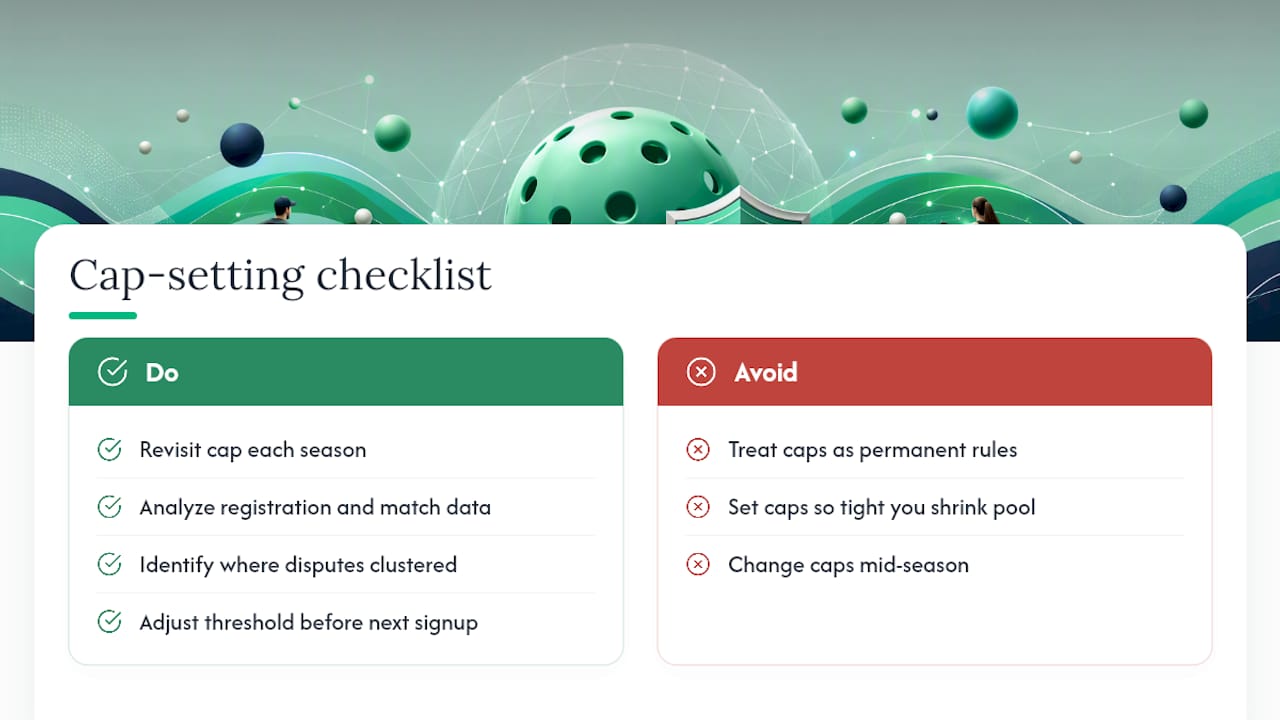
Strict caps protect your lower divisions from sandbagging, but set them too tight and you shrink your player pool until a bracket can’t fill. That trade-off doesn’t have a universal right answer. It depends on your local skill distribution and how competitive your players actually want the division to be.
My advice: treat your cap as a setting you revisit each season, not a rule carved in stone. Pull your league’s own registration and match data, see where disputes clustered, and adjust the threshold before the next signup window opens rather than mid-season.
— Robert
Run DUPR-Capped Leagues Without the Spreadsheet Headache
FlexLeague+ is the alternative to manually policing rating caps with sign-up forms and spreadsheets. Because the platform is DUPR approved, it pulls verified ratings straight into registration, flags players outside your division cap automatically, and applies your substitute margin rules without you cross-checking every swap by hand.

You still run singles, men’s doubles, women’s doubles, mixed doubles, or FLP team leagues exactly the way you want. FlexLeague+ handles scheduling, live standings, playoff brackets, and score reporting on top of the cap enforcement, and payments run through Stripe so registration fees land without chasing anyone down. There’s no monthly subscription. Organizers pay a $25 one-time platform fee per division, and you keep control of how registration revenue flows. If you’re setting up a capped division for next season, check the pickleball league software features and get your first division running before the sign-up window closes.
Where to Verify DUPR’s Official Rating Rules
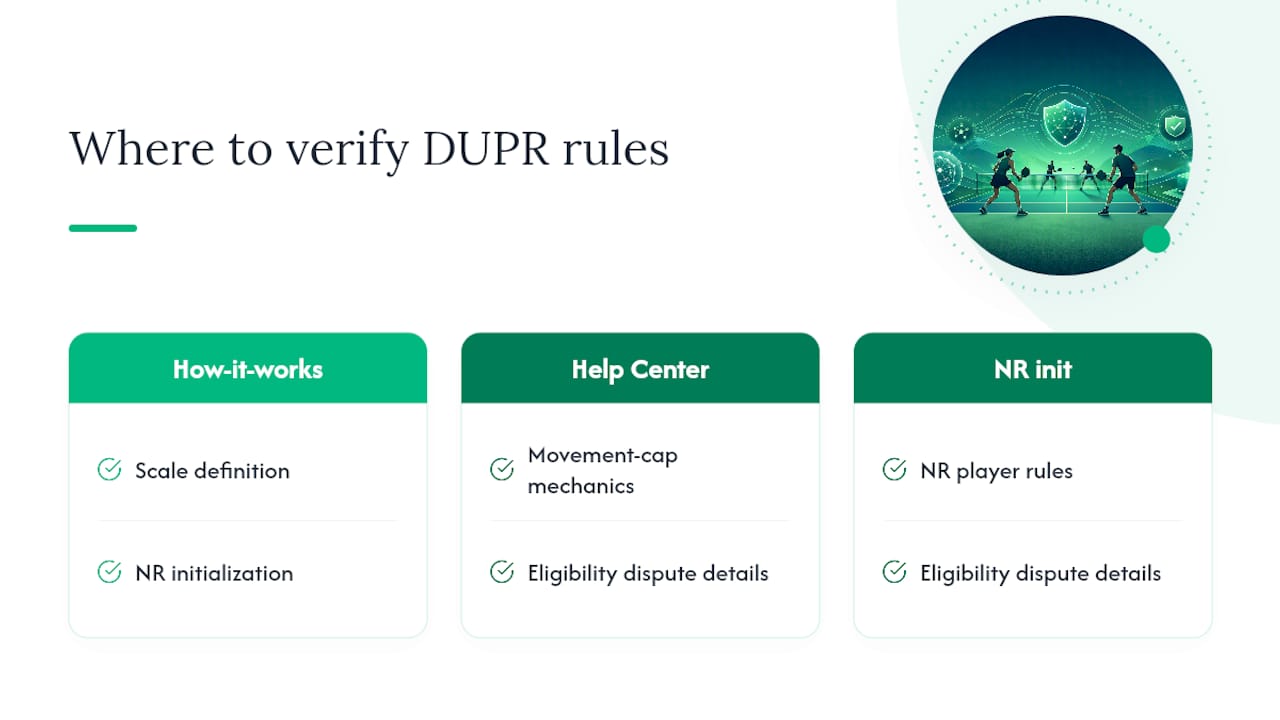
For the scale itself and NR initialization, DUPR’s how-it-works page is the primary source. For the calculation mechanics behind movement caps, the DUPR Help Center’s rating explainer and the initialization article for NR players cover the details organizers most often need for eligibility disputes.
Sources
FAQ
Is a 3.7 DUPR Rating Good?
Intermediate band players have consistent rallies, solid shot selection, and enough match history for the rating to be reliable rather than a two-game guess.
What Is Considered a 3.0 Pickleball Player?
The intermediate band starts above beginner players and includes those who can sustain rallies and understand basic strategy but are still developing consistency on harder shots like third-shot drops and dinks.
What Does a 3.5 DUPR Rating Mean in Pickleball?
A 3.5 lands solidly in the intermediate range, typically representing a player with reliable serves, returns, and enough court awareness to compete in club-level and open rec play. It’s one of the most common ratings among regular league players.
What Is the Maximum DUPR Rating?
The scale’s theoretical ceiling is 8.000, but real-world top ratings, including touring professionals, stay well below that number according to Pickleball. There’s no separate maximum organizers can override. Any cap you see in a specific division is a rule the organizer set, not a DUPR-imposed limit.