$25 Per Division: Automate Court Allocation for League Organizers
$25 Per Division: Automate Court Allocation for League Organizers

Adopt a season-aware, priority-group allocation policy that guarantees equitable access and enforces Good Standing. Open the next allocation window with the application checklist below, and run a quick roster audit before you publish it. This combination gives you a defensible, repeatable process instead of an ad hoc scramble every season.
TL;DR:
- Priority tiers should be clearly defined based on organization type, residency, and certification, with documentation requirements for verification before allocating court time.
- Application windows must be announced well in advance with strict deadlines, and incomplete applications should be held as provisional until all documents are received.
- When demand exceeds available hours, requests should be prorated proportionally by sport and request type during primary season, reserving practice-only blocks separately.
- Dispute procedures require written appeals evaluated by a review committee, with enforcement actions documented and tied to clear Good Standing criteria.
- Automated scheduling software can streamline roster verification, fee collection, and scheduling, reducing administrative work and supporting equitable, policy-driven allocations.
Table of Contents
- Core policy principles behind a fair court allocation league
- Eligibility categories and priority groups you need to define
- Application windows and the paperwork organizers must submit
- Turning applications into a real court schedule
- Handling disputes, reviews, and enforcement
- Running the schedule day to day without losing your mind
- Copy-ready policy language and a sample schedule template
- How league software supports the allocation workflow
- When equity should outweigh revenue in court allocation
- Let Flex League Plus run the operational side of your allocation
- Municipal policy templates worth downloading
- Sources
- FAQ
Core policy principles behind a fair court allocation league
A good allocation policy exists to answer one question before a dispute ever happens: who gets the court, and why. Three goals should drive every rule you write.
- Fairness: priority classes are published, applied consistently, and never negotiated case by case.
- Maximized access: courts sit empty as little as possible across both prime and off-peak hours.
- Stewardship: the facility outlasts any one league, so wear, scheduling conflicts, and maintenance windows factor into every decision.
Good Standing is the mechanism that ties conduct to access. A league or team in Good Standing has paid its fees, submitted rosters and insurance on time, and has no unresolved code-of-conduct violations. Losing Good Standing should cost a group its priority tier or its next-season slot, not just a warning email. Fairfax County’s field allocation policy ties eligibility directly to this kind of compliance record, which is why disputes there tend to resolve faster than in leagues with informal rules.
Authority to change allocations mid-season should sit with one named administrator or a small committee, not a facility scheduler fielding phone calls. Review the policy itself on a fixed cadence, once a year is typical, so priority definitions do not quietly drift out of date.
Pro Tip: Publish your Good Standing criteria on the same page as your application form. Groups that see the consequences up front file cleaner applications.
Eligibility categories and priority groups you need to define
Most municipal allocation policies rank requests into four or five priority classes, and your league should do the same rather than allocate on a first-come basis.
- City-run or facility-run programs, since public funding built the courts.
- Certified youth nonprofits with a coaching or development mission.
- Adult resident leagues in Good Standing.
- Commercial or for-profit groups, including private lesson providers.
- Nonresident or out-of-area leagues, ranked last unless capacity allows otherwise.
Residency status matters most in category three. City of Redlands’ allocation policy calculates a resident percentage for each applicant group, typically the share of rostered players who live within the service area, and uses that percentage to set priority within a tier rather than treating residency as pass or fail.
Documentation should verify these claims, not just assert them. Expect to require a current roster with home addresses, a signed code of conduct, and proof of nonprofit or CI (community interest) status for any group claiming that tier. Redlands’ policy also lists a minimum roster size before a team qualifies for a standing allocation slot at all, which keeps single-team requests from clogging a schedule meant for full leagues.
| Priority group | Typical documentation required | Relative priority |
|---|---|---|
| City or facility program | Program registration, staff sponsor | Highest |
| Certified youth nonprofit | Nonprofit certification, coaching rosters | High |
| Adult resident league | Player rosters, residency proof, insurance | Medium-high |
| Commercial or for-profit group | Business license, insurance | Medium |
| Nonresident league | Rosters, insurance | Lowest |
Under Redlands’ model, Group 1 recreational youth nonprofits can receive up to 70% of primary use hours within their category, which is worth knowing if you are drafting comparable percentage caps for your own courts.
Application windows and the paperwork organizers must submit
Set your application calendar before the season, not after requests start arriving. Most municipal policies run two windows a year, a primary season and a shorter secondary or off-season window, each with its own deadline for submissions.
- Publish “requests open” and “reservations issued” dates months ahead, the way City of Phoenix’s allocation application does, so groups can plan registration around confirmed court access.
- Require organization certification, proof of insurance, current rosters, and a residency affidavit with every application, exactly as Phoenix’s form specifies.
- Treat incomplete applications as provisional: hold the request but do not confirm a slot until every document lands.
- Enforce a hard late-application cutoff, typically two to three weeks before the season, after which requests drop to the bottom of the queue regardless of priority tier.
A published calendar with fixed deadlines is the single most effective control against last-minute disputes, because it removes the “nobody told me” argument before it starts.
Turning applications into a real court schedule
Once applications close, the math starts. A simple baseline works for most leagues: multiply your confirmed team count by the minimum roster size for the sport, then convert that figure into hours needed per week based on standard game and practice lengths. That baseline allotment is your starting ask before any prorating happens.
When total requests exceed available court hours, prorate by sport during primary season using team-count proportions, the same approach Fairfax County applies when multiple sports compete for the same fields. If pickleball and a second sport both request primary-season hours and courts fall short, each sport’s share of total teams determines its share of available hours rather than a flat split.
- Give the sport in its primary season proportional priority over hours; secondary-season sports fill remaining gaps.
- Reserve practice-only blocks separately from game blocks so a single team cannot absorb prime-time game slots for drills.
- Build a 15-minute transition buffer between bookings on the same court to cover late finishes and setup.
- Reassign unused blocks after a two-week grace period rather than letting a group sit on hours it never uses.
A standard structure might allot each team two hours of practice time and one confirmed match slot per week during primary season, dropping to practice-only access in the secondary season unless capacity allows more.
Pro Tip: Block adjacent courts together for tournament weekends instead of scattering single slots across the week. It cuts transition time and makes officiating easier to staff.
Handling disputes, reviews, and enforcement
Every allocation policy needs a formal path for challenging a decision, or the informal complaints will never stop. Fairfax County’s Allocation Review process is a workable model for structuring one.
- Require a written appeal within a fixed window, often 10 business days after allocations are published.
- Ask the appealing group to submit current rosters, registration confirmations, and any correspondence tied to the disputed slot.
- Have a review committee, not the original scheduler, evaluate the appeal against the published priority criteria.
- Issue a written decision with the reasoning, so the same dispute does not resurface next season.
- Log every decision in a shared record that future staff can reference.
Enforcement needs the same clarity. Missed insurance deadlines, unpaid fees, or code-of-conduct violations should carry defined consequences: a formal warning on first offense, suspension of the specific permit on a second, and revocation of the group’s Good Standing status for repeated or serious violations. Document each enforcement action the same way you document appeals, since a pattern of undocumented warnings collapses the first time a group challenges a suspension.
Running the schedule day to day without losing your mind
Policy on paper only matters once someone turns it into a working calendar. A stepwise workflow keeps that translation consistent from season to season.
- Collect all applications by the published deadline, then sort by priority tier and residency percentage.
- Calculate baseline allotments per team, apply prorating where demand exceeds supply, and draft a first-pass schedule.
- Circulate the draft to affected groups for a short comment window before finalizing permits.
- Publish final permits with start times, buffer windows, and contact information for the allocation administrator.
- Hold a standing reserve block, usually 5% to 10% of total court hours, for makeups and emergency reassignments.
Time-block templates make this faster to repeat. A typical structure reserves early-evening weekday slots as prime time for adult resident leagues, midday weekday slots for youth and school programs, and weekend mornings as flexible blocks for tournaments or makeup games. Non-prime slots, early mornings and late weeknights, work well for practice-only bookings that do not need officiating support.
Scheduling software earns its place here by handling the repetitive verification work: matching rosters against submitted applications, flagging incomplete insurance documents, and collecting registration fees without a staff member chasing checks. Our automated scheduling approach shows how that automation cuts admin time while the policy decisions, priority tiers, appeals, enforcement, stay firmly in human hands.
Pro Tip: Run your draft schedule past one experienced organizer from each priority tier before publishing. They catch conflicts a spreadsheet never will.

Copy-ready policy language and a sample schedule template
You do not need to write allocation language from scratch. Adapt clauses like these directly into your own policy document.
- Priority classification clause: “Court time is allocated by priority tier as published in this policy. Ties within a tier are broken by resident percentage, then by date of application.”
- Good Standing clause: “Any group with an outstanding fee, missing insurance document, or unresolved conduct violation loses its current priority tier until the issue is resolved.”
- Deadline clause: “Applications received after the published deadline are placed at the bottom of their priority tier regardless of prior standing.”
- Appeal clause: “Appeals must be filed in writing within 10 business days of schedule publication and will be reviewed by the allocation committee within 15 business days.”
Applicant checklist: organization certification, proof of nonprofit or CI status where applicable, current player rosters, proof of liability insurance, signed code of conduct, and payment of any platform or facility fee.
A simple sample schedule shows how allotments translate into actual blocks:
| Team | Priority tier | Weekly practice hours | Weekly match slot |
|---|---|---|---|
| Youth Development Club | Certified youth nonprofit | 3 | Saturday morning |
| Resident Adult League A | Adult resident league | 2 | Tuesday evening |
| Resident Adult League B | Adult resident league | 2 | Thursday evening |
| Visiting Club | Nonresident league | 1 | Sunday morning |
How league software supports the allocation workflow
Once the policy is written, the daily work is verification and scheduling, and that is exactly where software should carry the load. Flex League Plus is built for pickleball organizers running singles, doubles, and FLP team leagues, and it automates the parts of allocation that eat staff time.
- Collects player registrations and rosters in one place instead of scattered spreadsheets.
- Builds match schedules automatically once divisions and team counts are set.
- Tracks standings and playoff brackets through the season.
- Processes registration fees through Stripe, so organizers control revenue without chasing payments.
- Connects to DUPR for verified, fair competitive results.
| Policy task | Manual approach | Flex League Plus approach |
|---|---|---|
| Roster verification | Spreadsheet cross-check | Rosters stored with registration |
| Fee collection | Checks or cash | Stripe payment processing |
| Schedule drafting | Manual slot assignment | Automated scheduling by division |
| Competitive verification | Self-reported scores | DUPR integration |
Organizers still set the priority tiers, residency rules, and appeal process. The software just makes sure the roster you audit at appeal time matches the one your schedule was built on.
When equity should outweigh revenue in court allocation
Every organizer eventually faces the same choice: fill the court with the group that pays full commercial rates, or hold the slot for a youth nonprofit that pays little to nothing. I side with the youth program more often than not, because a facility that only serves paying adults loses the community support that keeps it funded long term.
A few practical calls for the next allocation cycle:
- Cap commercial group access at a fixed percentage of total hours before the season starts, rather than after complaints roll in.
- Reserve at least one standing block per week for makeup games; skipping this is the single most common cause of appeals.
- Audit rosters before publishing allocations, not after a dispute forces the issue.
The most common pitfall I see is treating residency and Good Standing as soft guidelines instead of hard gates. Once you let one exception through, every future denial looks arbitrary.
— Robert
Let Flex League Plus run the operational side of your allocation
Once your policy is set, the daily grind of matching rosters to court time, chasing registration fees, and building brackets by hand is where most organizers lose hours. Flex League Plus automates registration, scheduling, standings, and Stripe-based payment collection for pickleball leagues, with DUPR integration built in for competitive verification.
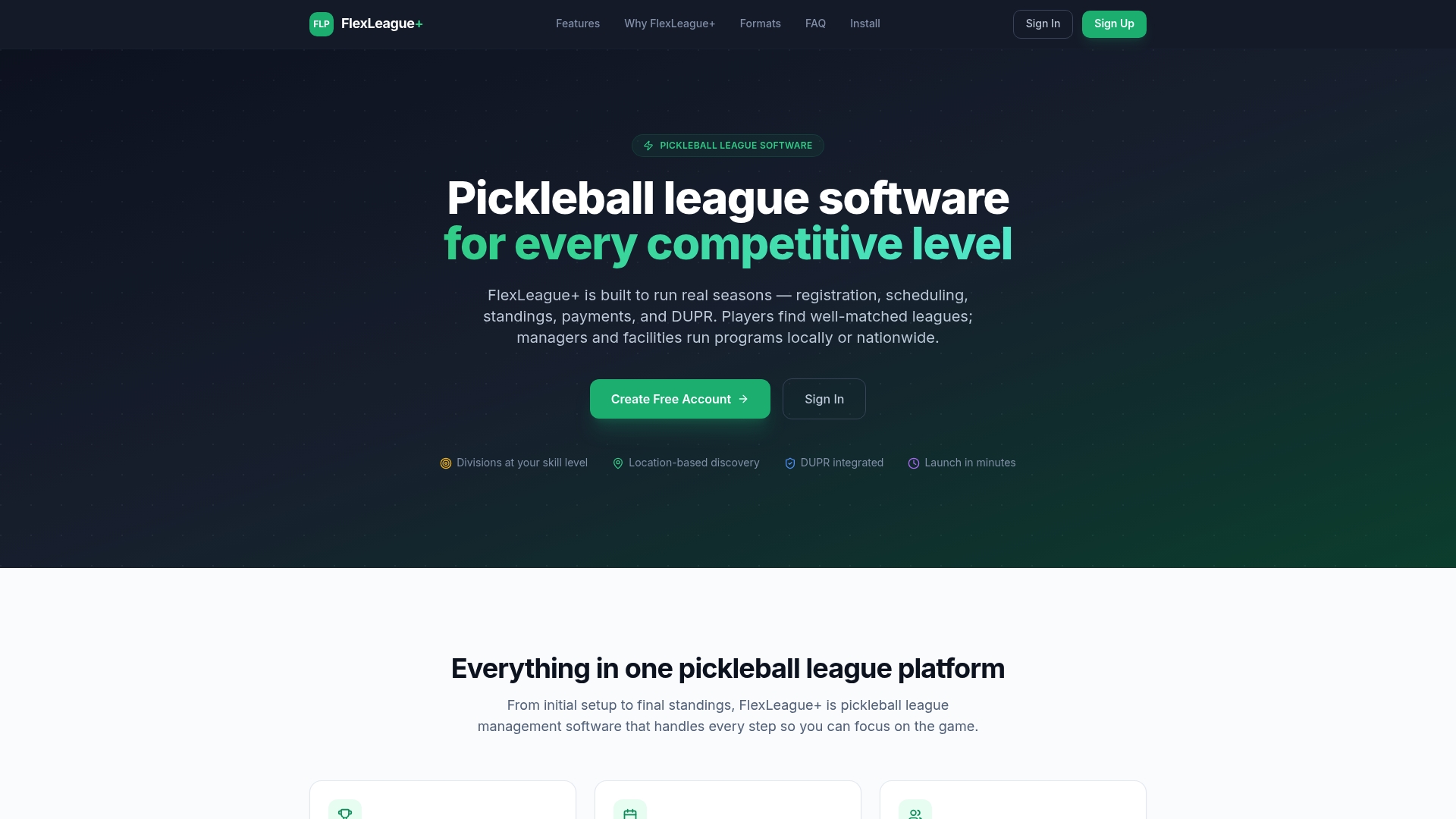
There is no monthly subscription: organizers pay a platform fee of $25 per division, collected through Stripe alongside player registration. If you are drafting practice schedules alongside your allocation calendar, a structured training plan can help fill non-prime hours productively. Check pricing and start setting up your next season at Flexleagueplus.
Municipal policy templates worth downloading
These policies are worth reading directly if you are drafting your own allocation document.
- Fairfax County’s field allocation policy for eligibility rules and its allocation review and appeal process.
- City of Redlands’ allocation policy for resident percentage calculations and priority group examples.
- City of Phoenix’s allocation application for a full application checklist and seasonal timeline.
- City of Leander’s field allocation policy for additional copyable priority-tier language.
Sources
- Community Use of Fairfax County Public Athletic Fields (field allocation policy)
- Sports field allocation policy (City of Redlands)
- Athletic Field Allocation Application (City of Phoenix)
- Field allocation policy (City of Leander)
FAQ
What happens at an allocation hearing?
An allocation hearing lets a group formally contest a scheduling decision before a review committee. The committee examines rosters, registration records, and the original application against the published priority criteria, then issues a written decision within a set number of business days.
What does court division mean in league allocation?
Court division refers to splitting available court time among competing leagues, teams, or sports based on priority tier, roster size, and seasonal demand. It typically involves prorating hours proportionally when total requests exceed the courts available, similar to how Fairfax County prorates fields by sport during primary season.
What documentation do organizers need to apply for court time?
Most municipal-style policies require organization certification, proof of liability insurance, current player rosters, and a residency affidavit where applicable. Phoenix’s allocation application lists all of these as standard attachments before an application can be processed.
How does resident priority affect who gets court time?
Resident priority ranks applicant groups by the share of their roster living within the service area, then uses that percentage to break ties within a priority tier. Redlands’ policy shows this in practice, where recreational youth groups can receive up to 70% of primary use hours in their category.
What happens if a league loses Good Standing?
A league that loses Good Standing, through unpaid fees, missing documents, or conduct violations, typically drops to a lower priority tier or loses its current allocation entirely until the issue is resolved. Enforcement steps often escalate from a warning to permit suspension to full revocation for repeated violations.