Best Amilia Alternatives for League and Rec Organizers
Best Amilia Alternatives for League and Rec Organizers

For U.S. sports leagues, parks and recreation departments, and camp organizers, the strongest Amilia alternatives are Flexleagueplus, PerfectMind, Active (ActiveWorks), SportsEngine (Stack Sports), RecDesk, and RegFox. Each one targets a different operational profile, and picking the wrong fit costs you months of re-migration.
The short verdict: if you run pickleball or recurring recreational leagues and collect registration fees, Flexleagueplus is the recommended starting point. It handles automated scheduling, DUPR integration, and Stripe payments without a subscription requirement. For municipal parks departments, PerfectMind or RecDesk are the more natural fits. Large-scale event operators should look at Active / ActiveWorks first. Occasional-event organizers who want to avoid monthly fees will find RegFox’s pay-as-you-go model worth a close look.
Here is the quick shortlist:
- Flexleagueplus — best for pickleball and recurring league organizers; automated scheduling, DUPR-approved, Stripe-connected
- PerfectMind — best for membership-heavy parks and recreation departments
- Active / ActiveWorks — best for large events and enterprise-scale municipalities
- SportsEngine (Stack Sports) — best for youth clubs and multi-team sports organizations
- RecDesk — best for community centers and municipal facility booking
- RegFox — best low-cost option for occasional events and pay-as-you-go registration
Review platforms like G2 and Capterra consistently show that pricing transparency and data portability are the two factors that most influence which platform organizations ultimately choose when switching from Amilia.
Table of Contents
- How these Amilia alternatives compare side by side
- Vendor profiles: what each platform actually does well
- What Amilia does well, and why some organizations look elsewhere
- How to choose the right Amilia alternative for your organization
- Key Takeaways
- Why league-specific software beats general-purpose platforms
- Flexleagueplus: built specifically for league organizers
- Useful sources and further reading
How these Amilia alternatives compare side by side
The table below covers the dimensions that matter most during a platform evaluation. Pricing models vary widely across this group, from per-registrant transaction fees to flat subscriptions to bundled municipal contracts, so treat any figure here as a starting point and confirm live pricing directly with each vendor.
| Platform | Best for | Pricing model | Core features | Integrations | Ease of use | U.S. support | Setup effort |
|---|---|---|---|---|---|---|---|
| Flexleagueplus | Pickleball and recurring league organizers | Transaction-based via Stripe; no subscription | Automated scheduling, division management, standings, playoffs, score reporting, DUPR integration, waivers | Stripe, DUPR | Clean admin UX; mobile-friendly player app | U.S.-based; responsive | Low; fast onboarding |
| PerfectMind | Municipal parks & rec, membership orgs | Subscription (quote-based) | Membership management, facility booking, program registration, reporting | Payment gateways, accounting tools | Moderate admin complexity; solid member-facing UX | U.S. support available | Moderate to high |
| Active / ActiveWorks | Large events, enterprise municipalities | Subscription + transaction fees | Event management, facility booking, online registration, reporting | Wide third-party ecosystem | Feature-rich but steeper learning curve | Enterprise support tiers | High |
| SportsEngine (Stack Sports) | Youth clubs, multi-team sports orgs | Subscription tiers | Team and club management, registration, communications, scheduling | Stripe, background checks | Good for club admins; mobile app for families | U.S.-based | Moderate |
| RecDesk | Parks & rec departments, community centers | Subscription (quote-based) | Facility reservations, program registration, permits, reporting | Payment processing, calendar | Simple admin UX; accessible for non-technical staff | U.S.-based | Low to moderate |
| RegFox | Occasional events, low-volume registrations | Per-registrant fee (pay-as-you-go) | Online registration, ticketing, conditional logic forms, payments | Stripe, Zapier, basic CRM | Very easy to set up; minimal admin overhead | Email/chat support | Very low |
A note on pricing: pay-as-you-go models like RegFox look cheapest upfront, but ITQlick’s comparison data shows they can become more expensive than flat-fee platforms once a league runs multiple seasons per year. Run the math against your annual registration volume before committing.
Which column matters most depends on your organization type. League operators should weight the “core features” and “integrations” columns heavily. Parks and rec managers should prioritize “ease of use” and “U.S. support.” Budget-constrained organizers running fewer than a few events per year should focus on the pricing model column first.
Vendor profiles: what each platform actually does well
Flexleagueplus
Flexleagueplus is purpose-built for league management, which is a meaningful distinction from the general-purpose registration tools on this list. It supports singles, men’s doubles, women’s doubles, mixed doubles, and FLP team formats, with automated scheduling that removes the manual bracket-building most organizers dread. DUPR integration is live, meaning player ratings update automatically as match scores are reported. Stripe handles all payment collection, so there is no separate payment processor to configure.
Pros:
- League-specific formats out of the box, including team league play
- DUPR-approved; ratings sync without manual entry
- No subscription fee for managers; revenue flows through Stripe transaction processing
- Fast to set up; organizers can launch a league in a single session
Cons:
- Focused on pickleball and recreational leagues; not designed for facility booking or camp management
- Thinner feature set for organizations that need membership management or permit workflows
Pricing model: Transaction-based through Stripe. No monthly subscription required.
Pro Tip: If you are migrating from Amilia and run recurring seasonal leagues, Flexleagueplus’s scheduling automation can cut your weekly admin time significantly compared with platforms that require manual round-robin builds.
PerfectMind
PerfectMind targets parks and recreation departments and fitness organizations that need membership management alongside program registration. Its facility booking module is one of the more complete options in this category, handling room reservations, equipment checkout, and permit workflows in a single system. CB Insights maps PerfectMind as one of the closest direct competitors to Amilia in the sports and recreation niche.
Pros:
- Strong membership and facility management in one platform
- Built for municipal workflows, including permit and reporting requirements
- Solid reporting suite for department-level accountability
Cons:
- Pricing is quote-based; no public rate card
- Implementation can take several months for larger departments
- Less suited to league-specific scheduling automation
Pricing model: Subscription, quote-based. Request a demo for current pricing.
Active / ActiveWorks
Active Network (now operating as ActiveWorks) is the enterprise option on this list. It handles large-scale event registration, facility management, and municipal recreation programs at a scale that smaller platforms cannot match. The tradeoff is complexity: the admin interface has a steeper learning curve, and implementation timelines for full deployments can run several months. SaaSHub’s aggregated shortlist consistently places ActiveNet among the top alternatives for parks and rec clients that need enterprise-grade infrastructure.
Pros:
- Handles very high registration volumes without performance issues
- Wide third-party integration ecosystem
- Strong enterprise support tiers and SLA options
Cons:
- Overkill for small leagues or single-facility operators
- Higher total cost of ownership than most alternatives here
- Longer onboarding and data migration timelines
Pricing model: Subscription plus transaction fees. Enterprise contracts; contact for pricing.
SportsEngine (Stack Sports)
SportsEngine focuses on youth sports clubs and multi-team organizations. Its club management workflows, background check integrations, and family-facing mobile app make it a natural fit for travel teams and recreational leagues with large rosters. It is less well-suited to facility-centric operations or single-sport league formats that need deep scheduling automation.
Pros:
- Background check integration built in, which youth organizations require
- Strong communications tools for coaches, parents, and administrators
- Mobile app is polished and well-reviewed by families
Cons:
- Subscription tiers can get expensive for smaller clubs
- Scheduling tools are functional but not as automated as league-specific platforms
- Less relevant for adult recreational leagues or single-sport pickleball organizers
Pricing model: Subscription tiers; pricing varies by organization size and features.
RecDesk
RecDesk is the straightforward municipal option. It covers program registration, facility reservations, and basic reporting without the complexity of enterprise platforms. Non-technical staff can learn it quickly, which matters for parks departments with high turnover or seasonal staff. The feature set is narrower than PerfectMind or Active, but that simplicity is often exactly what a community center needs.
Pros:
- Simple admin interface; minimal training required
- Facility reservation and permit workflows are well-designed
- Priced accessibly for smaller municipalities
Cons:
- Limited scheduling automation for recurring leagues
- Fewer third-party integrations than larger platforms
- Reporting is functional but not deep
Pricing model: Subscription, quote-based. Demos available on request.
RegFox
RegFox is a pay-as-you-go registration and ticketing platform. You pay a small fee per registrant rather than a monthly subscription, which makes it attractive for organizers running one or two events per year. The form builder supports conditional logic, which is genuinely useful for tiered registration (early bird, standard, VIP). For recurring leagues, though, the per-registrant cost adds up fast. Therezaali’s roundup of Amilia alternatives highlights RegFox specifically for organizers who want to avoid platform lock-in and monthly fees.
Pros:
- No monthly fee; pay only when registrations come in
- Fast to set up; no implementation timeline
- Stripe integration; Zapier connects it to other tools
Cons:
- Per-registrant fees become costly for high-volume recurring leagues
- No scheduling, standings, or league-management features
- Support is primarily email and chat; no dedicated account management
Pricing model: Per-registrant transaction fee. No subscription required.
What Amilia does well, and why some organizations look elsewhere
Amilia (marketed as SmartRec) covers online registration, facility booking, membership management, payment processing, and reporting in a single platform. It targets parks and recreation departments, community centers, and activity-based organizations. For organizations that need all of those functions under one roof, it is a credible option.
The reasons organizations start shopping for alternatives tend to cluster around a few recurring themes. G2 review trends point to support responsiveness and pricing clarity as the most common friction points. Capterra reviewers frequently mention mobile registration experience and waiver workflows as areas where expectations were not fully met.
Organizations that tend to stay with Amilia are mid-size parks and recreation departments that use its full feature set, including facility booking, membership, and reporting, and have already invested in staff training. Organizations that typically switch are league-focused operators who find the platform broader than they need, or smaller groups that find the pricing model difficult to predict.
Owler’s competitor data and CB Insights both show a competitive field of specialized alternatives, which suggests the market has moved toward purpose-built tools for specific niches rather than one-size-fits-all platforms.
How to choose the right Amilia alternative for your organization
The right platform depends on your operational profile, not on feature count. A municipal parks department and a pickleball league organizer have almost nothing in common in terms of what they actually need from software.
Questions to ask every vendor before signing:
- What are the exact transaction fees, and are they charged on top of the subscription or included?
- Can you export all registration data, rosters, and historical records in a standard format (CSV, Excel)?
- Does the platform support Stripe, and can you connect your own Stripe account?
- How does the platform handle waivers and digital signatures, and where is that data stored?
- Does the calendar sync with Google Calendar or iCal, and is that a native integration or a workaround?
- What does the mobile experience look like for players or participants registering on a phone?
- What are your U.S. support hours, and what is the typical response time for a critical issue?
- What does a data import from Amilia look like, and do you provide migration assistance?
Red flags to watch for:
- No public pricing and a sales process that delays sharing even a ballpark figure
- Data export formats that require a proprietary tool to open
- Transaction fees buried in the contract rather than disclosed upfront
- U.S. support hours that are actually routed overseas with long response windows
- Implementation timelines quoted in months with no defined milestones
Typical migration timeline:
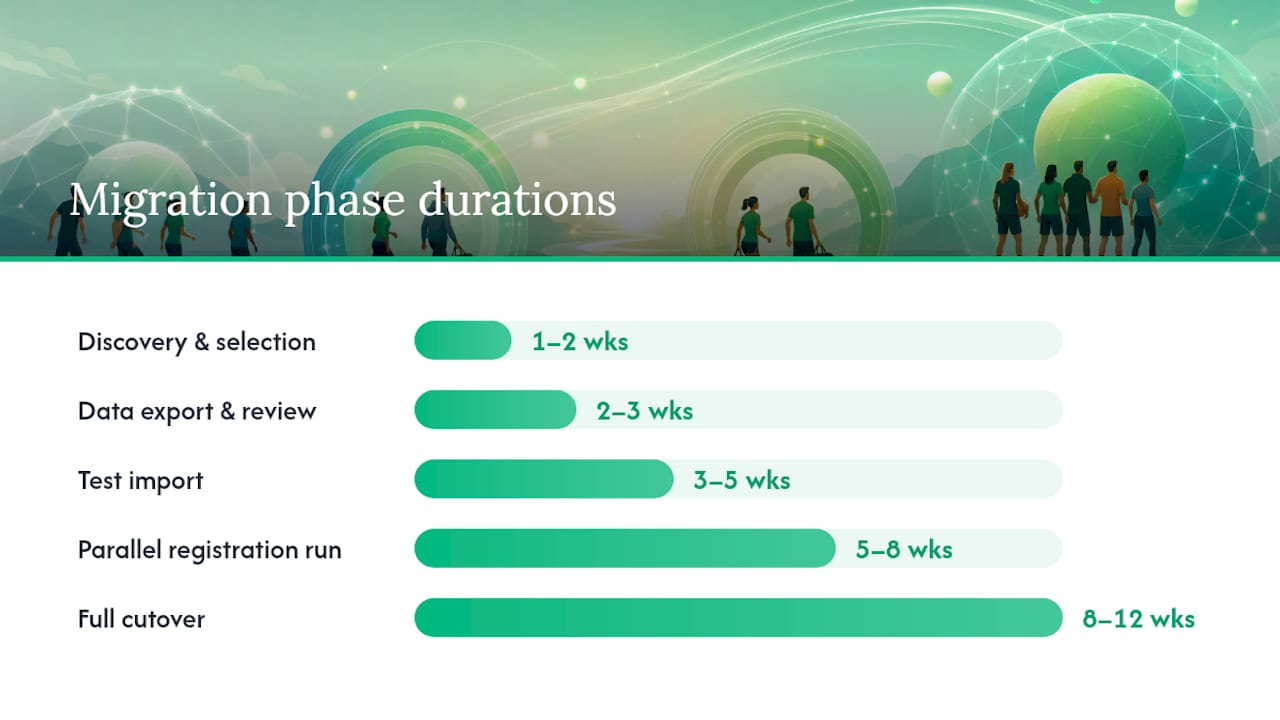
Most organizations moving from Amilia to a new platform complete the transition in 6–12 weeks when they plan it properly. A realistic milestone sequence looks like this: discovery and vendor selection (weeks 1–2), data export from Amilia and format review (weeks 2–3), test import into the new platform (weeks 3–5), parallel registration run where both platforms accept sign-ups (weeks 5–8), and full cutover with the old platform deactivated (week 8–12). Budget for staff training time on top of that, especially if the new platform has a different admin structure.
Pro Tip: Request a sample data export from your current platform before you sign with a new one. If the export is incomplete or requires manual cleanup, that is a signal of how the migration will go. Platforms that make data export easy are also the ones that tend to make data import easy.
How we picked and evaluated these alternatives
The shortlist above was built using a consistent set of criteria applied across all candidates.
Data sources used:
- G2 and Capterra for user review trends and feature feedback
- ITQlick, CB Insights, and SaaSHub for competitive landscape mapping and shortlist aggregation
- Owler for vendor-scale signals and market presence
- Vendor product documentation for feature verification
Inclusion criteria:
- Feature overlap with Amilia’s core functions (registration, scheduling, payments, reporting)
- Available to U.S.-based organizations
- Focused on activity, league, or recreation management (not generic event ticketing only)
- Sufficient review volume on G2 or Capterra to assess real-world performance
What we excluded: single-purpose bracket tools, platforms without U.S. availability, and general-purpose form builders that lack any recreation or league management context.
Pricing statements in this article reflect vendor-published information and third-party estimates. Treat them as directional. Live pricing, contract terms, and support SLAs should be confirmed directly with each vendor before signing.
Key Takeaways
For league organizers replacing Amilia, Flexleagueplus is the strongest fit, while parks and rec departments should evaluate PerfectMind, RecDesk, or Active based on their scale and budget.
| Point | Details |
|---|---|
| Match platform to org type | League operators, parks departments, and event organizers need fundamentally different tools; feature count alone is a poor guide. |
| Pricing model shapes total cost | Pay-as-you-go fees suit occasional events but cost more than flat-fee platforms for recurring seasonal leagues. |
| Data portability is non-negotiable | Request a sample export before signing; platforms that make export easy also tend to make migration easier. |
| Migration takes 6–12 weeks | Plan for discovery, test import, parallel run, and cutover; skipping the parallel run is the most common migration mistake. |
| Flexleagueplus for league organizers | Flexleagueplus is the recommended starting point for pickleball and recurring league operators replacing Amilia, with automated scheduling, DUPR integration, and Stripe payments. |
Why league-specific software beats general-purpose platforms
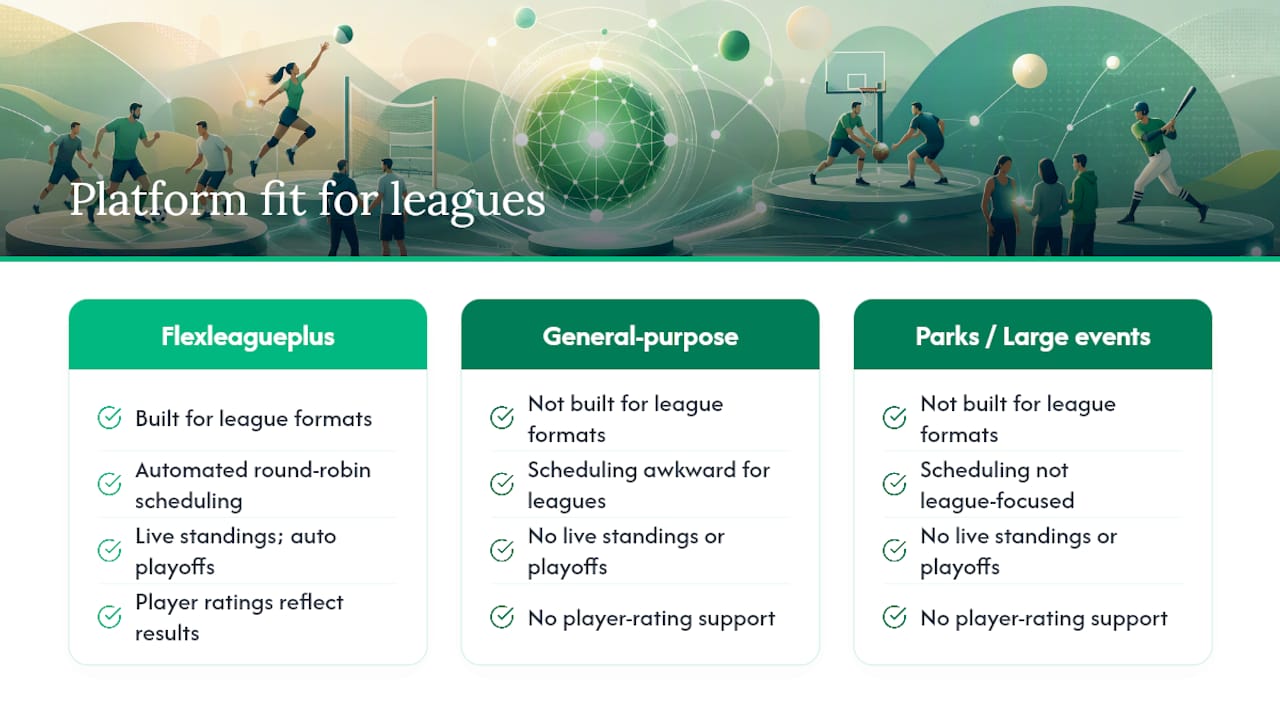
Most of the platforms on this list were built to serve parks departments, camps, and community centers. That is a legitimate use case, and they do it well. But league management has a distinct operational rhythm that general-purpose registration tools handle awkwardly: round-robin scheduling across multiple divisions, live standings that update after every match, playoff brackets that generate automatically, and player ratings that need to reflect real results.
Amilia handles registration and payments competently. What it does not do is think in league formats. Neither does RegFox, RecDesk, or Active. SportsEngine gets closer for youth sports, but its scheduling tools are not built around the kind of automated round-robin and division management that adult recreational leagues require.
The honest disclosure: Flexleagueplus is the publisher of this article, and it is also the platform this article recommends for league organizers. That recommendation is grounded in a real feature match, not just a business relationship. DUPR integration matters to pickleball organizers in a way that no general-purpose platform currently replicates. Stripe-native payment processing without a separate subscription is a genuine cost advantage for organizers running two or three seasons per year.
If you run a municipal parks department that needs facility booking, permit workflows, and membership management, Flexleagueplus is not the right tool. PerfectMind or RecDesk will serve you better. If you run large-scale events with thousands of registrants, Active / ActiveWorks has the infrastructure you need. The recommendation is specific: for recurring recreational leagues, especially pickleball, Flexleagueplus is where to start.
Flexleagueplus: built specifically for league organizers
If you have been running leagues on Amilia and spending time on manual scheduling, chasing down score reports, or managing player ratings in a spreadsheet, Flexleagueplus removes all three of those friction points. The platform supports every standard league format, including singles, men’s and women’s doubles, mixed doubles, and FLP team play. Automated scheduling generates round-robin draws across divisions. DUPR integration means player ratings update as scores come in, without any manual entry on your end. Stripe handles registration payments directly, with no separate payment processor to configure.
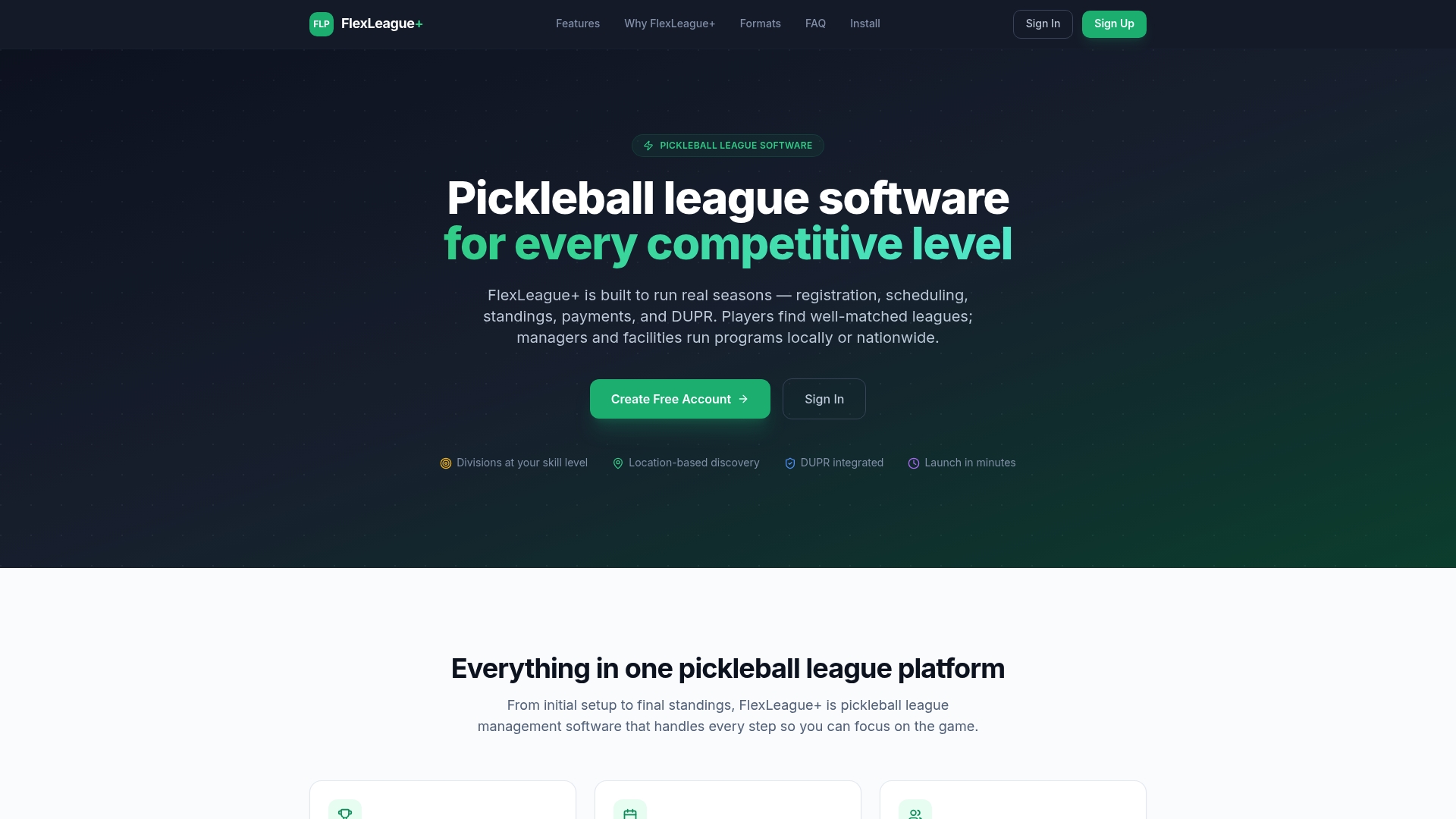
For organizers currently on Amilia who want to see how a league-first platform actually works, the Flexleagueplus pickleball league software page walks through the full feature set. You can also read about ACH payment options if your players prefer bank transfers over card payments. When you are ready to move, the platform is fast to set up, and the team can walk you through importing your existing roster data. Start at flexleagueplus.com to get your first league configured.
Useful sources and further reading
The sources below were used to build and cross-check this comparison. Before signing with any platform, re-verify live pricing, contract terms, and support SLAs directly with the vendor.
- Top Amilia Competitors in 2026 | ITQlick
- Amilia Enterprise alternatives and competitors | CB Insights
- Amilia SmartRec Alternatives & Competitors - SaaSHub
- Amilia reviews | G2
- SmartRec reviews | Capterra
- Amilia Competitors and Alternatives - Owler
- Amilia alternatives | Therezaali
- FlexLeague+ | Pickleball League Software
Before you sign anything: use the trial or demo period to run a test registration and a test data export. If the export is messy or incomplete, that is the clearest signal you will get about how the migration will actually go.