How to Accept ACH Payments for Pickleball Leagues
How to Accept ACH Payments for Pickleball Leagues

For most pickleball leagues collecting registration fees, the fastest path to lower-cost electronic payments is Stripe ACH Direct Debit via the hosted Payment Element or Checkout, paired with Stripe Connect for automated routing.
- Use Stripe’s Payment Element or Checkout to accept ACH payments with minimal code; both handle mandate presentation automatically.
- Enable Stripe Connect and activate the
us_bank_account_ach_paymentscapability on your platform account and every connected account receiving ACH debits; add Financial Connections for optional balance checks. - Expect up to 4 business days for ACH confirmation and settlement. When you need instant confirmation (limited roster spots, same-day cutoffs), use Instant Bank Payments or cards instead.
Table of Contents
- How does ACH Direct Debit work for league registration fees?
- How to implement ACH via Stripe: hosted flows and required setup
- What do fees and settlement times actually look like?
- Best practices to reduce friction and lower ACH failure rates
- Automating routing and reconciliation with Stripe Connect
- Which payment method fits your league scenario?
- How Flexleagueplus works with Stripe ACH
- Flexleagueplus makes paid league management straightforward
- Key Takeaways
- A note on building this the right way
How does ACH Direct Debit work for league registration fees?
ACH Direct Debit pulls funds directly from a player’s U.S. bank account. Before any debit happens, Stripe collects a digital mandate — the player’s explicit authorization — through your checkout flow. That step is non-negotiable under NACHA rules, and Stripe’s hosted UI handles it automatically.
The catch is timing. ACH is asynchronous and non-guaranteed: a payment that looks successful today can still fail or be returned days later. Default settlement runs up to 4 business days, so a player who registers Monday may not have their funds cleared until Friday.
Dispute windows matter for league refund policies. Personal-account ACH debits can be disputed for up to 60 calendar days under standard bank timelines. Business accounts carry shorter windows, but most recreational league players use personal checking accounts — plan your refund policy accordingly.
Financial Connections lets you verify a player’s bank account and run an optional balance check before the mandate is created. That extra step reduces the chance of a return due to insufficient funds, which is worth the minor friction for larger seasonal fees.
Instant Bank Payments is the alternative when you need a guarantee. It confirms immediately, typically settles in 2 business days, and Stripe backs it against bank-initiated returns — but at a higher cost.
How to implement ACH via Stripe: hosted flows and required setup
Stripe gives you two main paths: hosted UI (Payment Element or Checkout) and a custom API integration. For most league managers, hosted is the right call.

Hosted Payment Element or Checkout automatically surfaces ACH as a payment option when the player is eligible, presents the mandate, and collects authorization — no custom mandate UI required. It also supports Stripe Link, which lets returning players reuse saved bank details without re-entering account numbers.
Custom API integration gives you full control over the UI but requires you to build mandate presentation, handle tokenization, and wire up all webhook events yourself. Unless you have a developer on staff and a specific UX requirement, the hosted path saves weeks of work.
For platforms routing fees to facilities or managers, the setup checklist looks like this:
- Enable ACH in your Stripe Dashboard. Go to Payment Methods settings and activate ACH Direct Debit for your account.
- Enable Stripe Connect and request the
us_bank_account_ach_paymentscapability on both the platform and each connected account. Missing it on connected accounts is the most common integration error. - Choose your UI. Drop in the Payment Element or redirect to Stripe Checkout. Either option handles mandate acceptance.
- Implement webhooks. ACH events arrive asynchronously — wire up handlers for
payment_intent.succeeded,payment_intent.payment_failed, andcharge.dispute.createdto update registration status in your system. - Add Financial Connections if you want pre-authorization balance checks or faster bank verification.
Pro Tip: Test your webhook handlers in Stripe’s sandbox before going live. ACH failures that aren’t caught by a webhook will leave registrations in a permanent “pending” state with no automated resolution.
What do fees and settlement times actually look like?
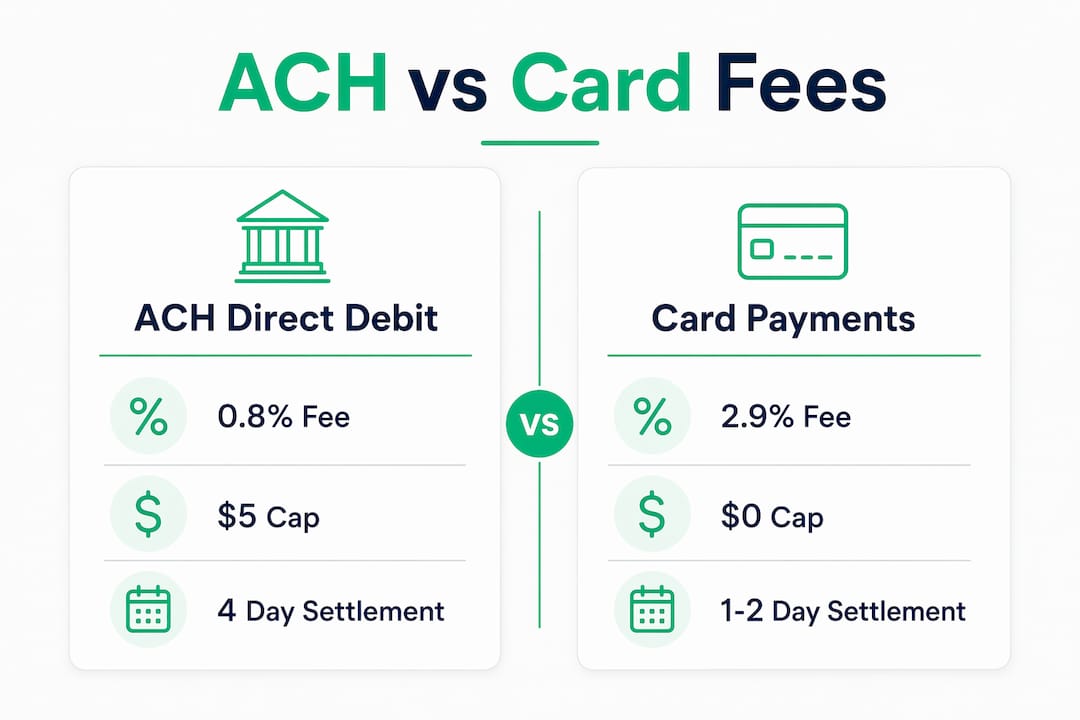
The cost difference between ACH and cards is real, especially as registration fees grow.
| Payment Method | Fee | Confirmation | Settlement | Return Risk |
|---|---|---|---|---|
| ACH Direct Debit | 0.8%, $5 cap | Up to 4 business days | Up to 4 business days | Higher; non-guaranteed |
| Instant Bank Payments | 2.6% + $0.30 | Instant | ~2 business days | Lower; Stripe-backed |
| Credit/Debit Card | ~2.9% (standard) | Instant | 2 business days | Chargeback risk |
On a typical seasonal registration, ACH Direct Debit costs significantly less compared to a card transaction at standard rates. That gap compounds fast across a 40-player league. Stripe also offers faster ACH settlement for a fee if waiting 4 business days creates cash flow problems before a season starts.
The trade-off is risk. ACH is non-guaranteed, meaning a returned payment requires manual follow-up and potentially re-collecting the fee. Instant Bank Payments costs more but removes that uncertainty.
Best practices to reduce friction and lower ACH failure rates
Getting ACH right operationally is mostly about communication and checkout design.
- Show settlement timing at checkout. Tell players upfront that their bank account will be debited within 1–2 business days and that registration is confirmed pending bank clearance. Surprises here generate support tickets.
- Use the hosted Payment Element and Stripe Link. Platforms using Stripe’s optimized checkout have seen measurable conversion improvements, partly because Link lets returning users skip re-entering bank details on mobile.
- Match the payment method to the stakes. For recurring seasonal fees or larger registrations, ACH’s cost savings are worth the async delay. For a last-spot-available tournament entry, use Instant Bank Payments or card so you can confirm the roster immediately.
- Send a confirmation email with expected timing. Something like: “Your registration is received. Your bank account will be debited within 2 business days. Registration is confirmed once payment clears — typically within 4 business days.”
- Define your return policy in ACH terms. Because personal-account disputes can arrive up to 60 calendar days after the debit, your refund window should account for that exposure — especially for leagues with early-bird pricing.
On failure handling: when an ACH payment returns, don’t just mark the registration failed and move on. Send a direct message to the player with a link to retry using a different payment method. A clean retry flow recovers most failed registrations without manual intervention.
Automating routing and reconciliation with Stripe Connect
Stripe Connect is what turns a basic payment setup into an actual financial workflow. Instead of collecting all fees into one account and manually transferring to facilities or co-managers, Connect routes funds automatically at the time of payment.
Key configuration points:
- Enable
us_bank_account_ach_paymentson both the platform and connected accounts. Enabling it only on the platform account does not allow connected accounts to receive ACH debits — a common mistake that causes silent failures. - Set platform fees at the charge level. Stripe Connect lets you take an application fee from each transaction automatically, so your cut never requires a manual transfer.
- Wire reconciliation webhooks. Record
charge.succeeded,charge.failed, andcharge.dispute.createdevents and map them to league invoices or registration records. Platforms using Connect report significantly less manual reconciliation work because payouts and fees are handled by the payment stack itself.
Pro Tip: Build your webhook handler to update registration status in three states: “pending” (mandate collected, awaiting settlement), “confirmed” (charge succeeded), and “reversed” (charge returned). That three-state model covers every ACH outcome without custom edge-case logic.
Which payment method fits your league scenario?
| Scenario | Recommended Method | Why |
|---|---|---|
| Seasonal league registration (fees above $50) | ACH Direct Debit | Lowest cost; async delay acceptable for planned signups |
| Last-spot tournament entry | Instant Bank Payments or Card | Instant confirmation; roster can close immediately |
| Weekly drop-in fee (less than $50) | Card | Low absolute fee; friction of ACH mandate not worth it |
| Recurring season pass (multi-month) | ACH Direct Debit | Cost savings compound; mandate reuse reduces friction over time |
For most pickleball league registration flows, ACH Direct Debit is the default choice for fees above $50. Below that threshold, the cost savings shrink and the async delay becomes harder to justify operationally.
How Flexleagueplus works with Stripe ACH
Flexleagueplus connects directly to Stripe for payment processing, so the ACH setup happens inside your Stripe account and flows through the platform automatically.
- Connect your Stripe account in the Flexleagueplus dashboard. The platform uses Stripe Connect, so your account is linked as a connected account.
- Enable ACH-related capabilities in Stripe. Request
us_bank_account_ach_paymentson your connected account if you plan to route ACH debits through the platform. - Configure your league’s fee structure in Flexleagueplus. Set registration fees per division (singles, men’s doubles, mixed doubles, FLP teams) and the platform passes those amounts to Stripe at checkout.
- Confirm mandate acceptance is active. Flexleagueplus’s registration flow presents Stripe’s hosted checkout, which handles mandate collection automatically.
- Enable webhook endpoints in your Stripe dashboard pointing to Flexleagueplus’s reconciliation hooks so registration status updates when ACH events arrive.
The platform’s DUPR integration and automated scheduling run alongside payment collection, so a player who registers and pays moves directly into the division draw without manual intervention.
Flexleagueplus makes paid league management straightforward
Running a paid pickleball league means juggling registration, scheduling, scoring, and payments simultaneously. Flexleagueplus handles the league side — division management, automated scheduling, live standings, playoff brackets, and DUPR score reporting — while Stripe handles the money.
The Stripe connection means you can accept ACH payments, cards, or Instant Bank Payments from day one, with reconciliation built into the registration workflow. No manual payout spreadsheets, no chasing down bank transfers. Connect your Stripe account at flexleagueplus.com and configure your first paid league in the same session.
Key Takeaways
ACH Direct Debit via Stripe is the lowest-cost way to collect league registration fees, but the 4-business-day settlement window requires clear player communication and webhook-based reconciliation.
| Point | Details |
|---|---|
| ACH cost advantage | At 0.8% with a $5 cap, ACH undercuts card rates significantly on fees above $50. |
| Settlement timing | Default ACH settlement runs up to 4 business days; faster options exist for a fee. |
| Connect capability | Enable us_bank_account_ach_payments on both platform and connected accounts — not just the platform. |
| Failure handling | Map webhook events to three registration states: pending, confirmed, and reversed. |
| Flexleagueplus integration | Connect your Stripe account in Flexleagueplus to accept ACH with built-in reconciliation and no manual payout work. |
A note on building this the right way
Integrating Stripe for sports leagues sounds straightforward until you hit the first ACH return on a $120 registration and realize your system has no state for it. The mandate, the async settlement, the Connect capability gap on connected accounts — these are the details that separate a payment setup that works from one that creates support tickets every season.
Flexleagueplus was built with this in mind. The Stripe connection is not a bolt-on; it’s wired into the registration workflow, which is why the platform carries DUPR approval and handles the full league lifecycle. The payment layer and the league layer talk to each other, so a returned ACH payment doesn’t leave a ghost registration in your draw.
The conventional wisdom is to “just use cards” because they’re instant. That’s fine for small fees. But for a $150 seasonal registration across 60 players, the difference between 0.8% and 2.9% is real money that stays in your league’s budget. Get the webhook handling right, communicate timing clearly, and ACH is the better default for most league scenarios.